

Key Takeaways
- Fast charging slows above 80% to prevent permanent chemical damage to battery cells.
- The slowdown is controlled by the vehicle's battery management system, not the charger's hardware.
- Lithium plating - a harmful side effect of charging too fast at high states of charge - is the main risk being avoided.
- Planning road trips to stop at 80% and recharge from a low state is faster in total than charging from 80% to 100%.
- The taper is more pronounced in colder temperatures, which slow ion movement inside the battery.
Charge Taper
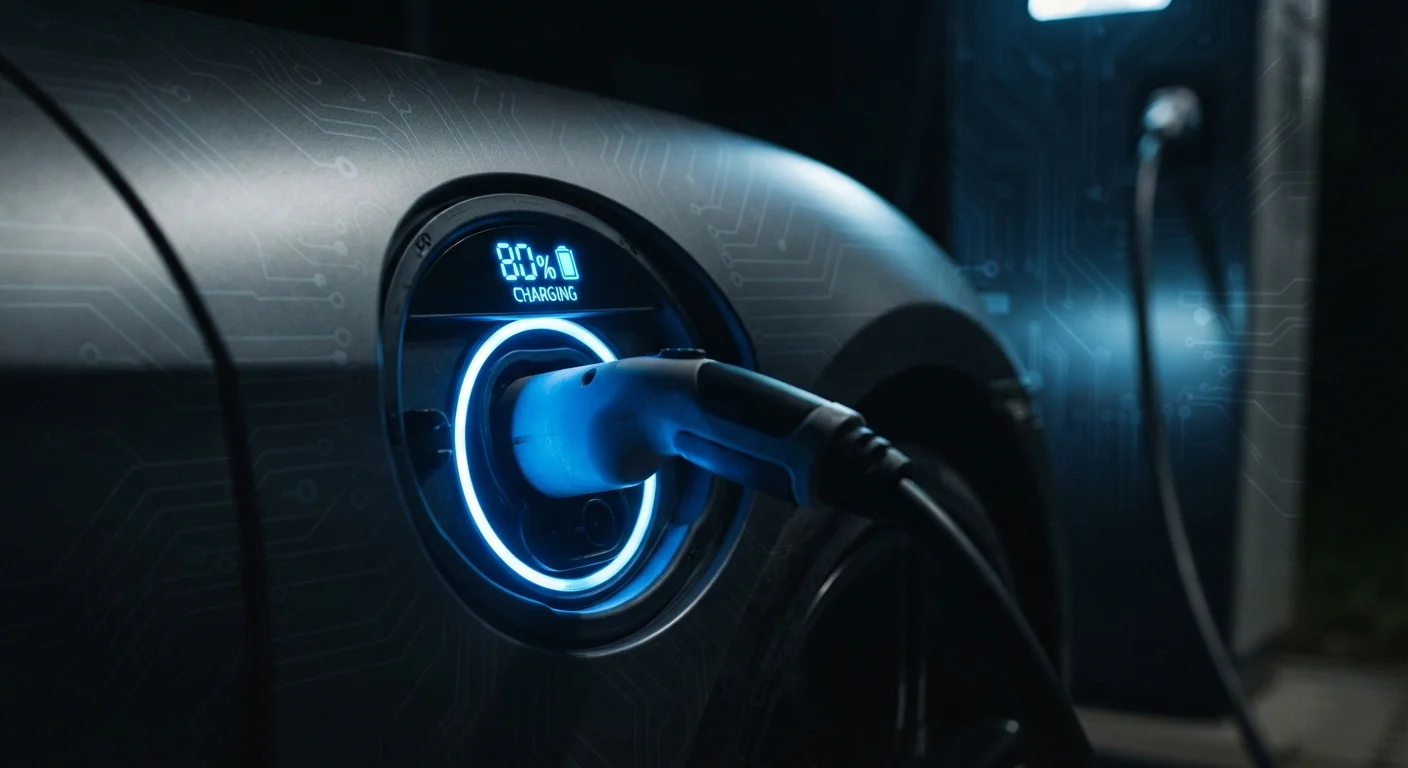
A charge taper is the deliberate reduction in charging speed that occurs as a lithium-ion battery approaches full capacity. DC fast chargers deliver power at their peak rate only during the lower portion of the charge cycle, then progressively slow down - especially above 80% state of charge. This isn't a malfunction; it's the battery management system protecting the cells from damage.
The taper follows a Constant Current / Constant Voltage (CC/CV) charging profile. Below ~80%, the charger holds a high, steady current. Above that threshold, it switches to holding a constant voltage while current drops to prevent lithium plating and cell stress.
What Happens Inside the Battery During Fast Charging
Every lithium-ion battery stores energy by moving lithium ions between two electrodes - a graphite anode and a metal-oxide cathode - through a liquid electrolyte. When you plug into a DC fast charger, the battery management system (BMS) allows a high electrical current to push those ions rapidly from cathode to anode. The faster the current, the faster the ions move, and the faster the battery fills.
The problem is that the graphite anode can only absorb those ions so quickly. Think of it like filling a sponge: water soaks in fast when the sponge is dry, but slows as it saturates. Below roughly 80% state of charge, there are abundant vacant sites in the graphite structure for ions to occupy. Above that threshold, available sites become scarce and ion traffic jams form at the electrode surface.
~80%
State of charge where the taper typically begins
Most lithium-ion EV battery packs transition from the high-current CC phase to the tapering CV phase at approximately 80% state of charge under normal temperature conditions.
Up to 40%
Potential reduction in peak charge rate in cold weather
Industry testing and automaker data indicate that sub-freezing temperatures can reduce DC fast-charge peak rates substantially before pre-conditioning is applied.
2x-4x
Longer time to add last 20% vs. first 80%
Due to current tapering in the CV phase, adding the final 20% of charge during a DC fast-charging session commonly takes as long as or longer than reaching 80% from near-empty.
When ions can't intercalate - embed themselves into the graphite layers - fast enough, they begin depositing as metallic lithium on the anode surface instead. This is called lithium plating, and it is one of the most damaging things that can happen to a battery cell. Plated lithium can form needle-like structures called dendrites that, in severe cases, puncture the separator between electrodes and cause short circuits or thermal events. Even minor plating that falls short of that extreme accelerates capacity loss permanently. For a deeper look at how this and other mechanisms age a battery over time, see our plain-language guide to lithium-ion battery aging.
The CC/CV Profile: How Chargers Manage the Transition
DC fast chargers don't simply push a fixed wattage into the battery from empty to full. They follow a two-phase protocol called Constant Current / Constant Voltage (CC/CV) charging, governed by the vehicle's BMS rather than the charging station's hardware.
During the Constant Current (CC) phase - typically from 0% to around 80% - the charger delivers a high, stable current. This is when you see the peak kilowatt figures advertised for a charger or vehicle. The voltage across the battery rises gradually as it fills.
Once the battery reaches a threshold voltage (corresponding to roughly 80% state of charge), the BMS switches to the Constant Voltage (CV) phase. It now holds voltage steady at its safe ceiling and allows current to taper off as the battery's internal resistance to accepting more charge rises. The charger doesn't fail or throttle arbitrarily - the battery is actively resisting higher current, and the BMS complies to protect cell chemistry.
Plan Your Road Trip Stops Around 80%
On long drives, targeting a charge from around 15% to 80% at each stop maximizes the time you spend in the fast CC phase. Once you pass 80%, charging time per mile of added range increases sharply. Multiple shorter stops can be faster in total than waiting for a single charge to reach 100%.
This is why the final 20% of a charge at a DC fast charger can take as long - or longer - than the first 80%. The math is straightforward: charging speed has dropped to a fraction of its peak. For practical trip planning around different charging levels, comparing Level 1, Level 2, and DC fast charging side-by-side gives a useful framework.
Temperature, Battery Age, and the Variable Taper
The taper threshold and severity are not fixed constants - they shift based on conditions.
Temperature has the largest real-world impact. Ion diffusion through the electrolyte slows in cold conditions, which means the anode becomes overwhelmed more easily at lower states of charge. A battery at 14°F (−10°C) may begin tapering well before 80%, and its peak charge rate may be a fraction of its warm-weather capability. Many modern EVs mitigate this by pre-conditioning the battery pack - actively heating it - before a charging session when the driver has entered a destination.
Battery age also changes the picture. As cells cycle through hundreds of charge-discharge cycles, graphite layers degrade and available intercalation sites decrease. An aged battery has less capacity overall and a less forgiving taper curve. The BMS compensates by becoming more conservative earlier in the state-of-charge window.
The BMS, Not the Charger, Controls the Taper
A common misconception is that the charging station decides when to slow down. In reality, the vehicle's battery management system sends real-time signals to the charger specifying exactly how much current to deliver. The same EV will taper at the same state of charge regardless of whether it is connected to a 50 kW or a 350 kW charger - the ceiling is set by battery chemistry, not charger capacity.
Understanding these variables helps explain why two drivers with the same EV model can report noticeably different fast-charging experiences on the same hardware. It isn't the charger behaving inconsistently - it's the BMS adapting to the specific thermal and electrochemical state of that particular battery at that moment. Charging habits that quietly shorten battery life can also shift that curve earlier over the long run.
Practical Implications for EV Drivers
Knowing why the taper exists changes how rationally to plan charging stops. A few practical points follow directly from the chemistry:
- For road trips, stopping to charge from roughly 10-20% up to 80% is typically the fastest strategy per session. Adding the final 20% takes disproportionate time relative to the energy gained.
- For daily driving, Level 2 home charging overnight to 80% avoids the high-voltage stress of the CV phase altogether and produces no taper - Level 2 operates well within the CC zone for most vehicles.
- In cold weather, allow extra time at the charger or use your vehicle's trip-planning feature to trigger battery pre-conditioning automatically.
- As the battery ages, don't interpret a more aggressive early taper as charger failure. It is the BMS being appropriately protective of older cells.
The charge taper isn't a limitation to work around - it's a safety mechanism working as intended. Understanding the electrochemistry behind it turns a frustrating observation into a predictable variable that drivers can plan around with confidence.