

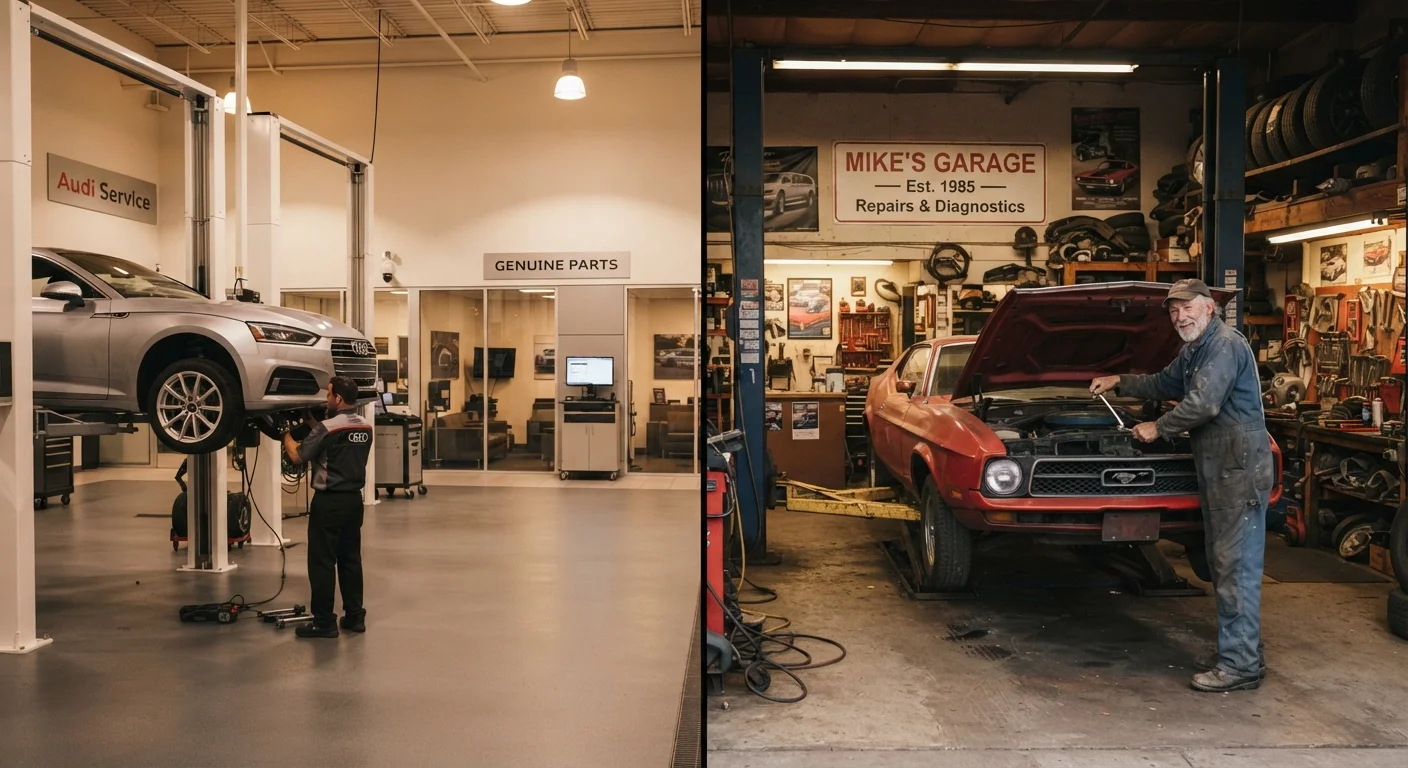
Key Takeaways
- Dealerships are typically better equipped for warranty work, recalls, and complex repairs on newer vehicles.
- Independent mechanics often charge lower labor rates and can offer more personalized service.
- Your vehicle's warranty status is one of the most important factors in this decision.
- Asking the right questions matters more than the shop type - vet any mechanic carefully.
- Neither option is universally superior; the best choice depends on your specific situation.
Our Verdict
Dealerships hold a clear edge for in-warranty vehicles, recalls, and brand-specific diagnostics. Independent mechanics often deliver comparable - or better - value for out-of-warranty vehicles, routine maintenance, and everyday repairs. The key is evaluating each shop on its own merits rather than defaulting to one category.
| Best for | Recommended |
|---|---|
| Vehicles still under the manufacturer's warranty | Dealership |
| Routine maintenance on older, out-of-warranty vehicles | Independent Mechanic |
| Open safety recalls or brand-specific software updates | Dealership |
| Cost-conscious owners seeking competitive labor rates | Independent Mechanic |
Why This Decision Matters More Than Most Owners Realize
Most American drivers pick a repair shop based on proximity or habit - and then stick with it indefinitely. But dealership service centers and independent mechanics operate under fundamentally different business models, and those differences have real consequences for your wallet and your vehicle's long-term health.
The right choice isn't fixed. It shifts depending on your car's age, warranty status, the complexity of the repair, and how well you can verify a shop's credentials. Understanding those variables puts you in a much stronger position before you hand over your keys.
For context on how repair quotes themselves can vary - and what to watch for - see how to evaluate repair quotes.
Where Dealerships Have a Genuine Edge
Dealerships employ factory-trained technicians who work exclusively on one or a few brands. That specialization matters most in three scenarios:
- Active warranty coverage: Manufacturer warranties generally require repairs to be performed by an authorized dealer to remain valid, though federal law (the Magnuson-Moss Warranty Act) does provide some consumer protections here. If your vehicle is under a bumper-to-bumper or powertrain warranty, a dealership is typically the safer default.
- Safety recalls: Recall repairs are always performed free of charge at authorized dealerships. Independent shops cannot complete recall work.
- Complex, brand-specific diagnostics: Modern vehicles - especially those with advanced driver-assistance systems (ADAS) or proprietary software - sometimes require manufacturer-specific diagnostic tools that most independent shops don't carry.
If you hold an extended service contract, review the fine print carefully. Extended warranties and vehicle service contracts have meaningful differences that can affect where repairs must be performed.
| Dealership | Independent Mechanic | |
|---|---|---|
| Labor rates | Generally higher | Generally lower |
| Warranty work | Required for most manufacturer warranties | Typically not authorized |
| Recall repairs | Yes - performed free of charge | Not available |
| Brand-specific diagnostics | Proprietary tools available | Varies by shop and vehicle brand |
| Parts used | OEM parts standard | OEM or quality aftermarket |
| Personal relationship / continuity | Variable; often high turnover | Often stronger with repeat customers |
| Best for vehicle age | Newer, in-warranty vehicles | Older, out-of-warranty vehicles |
Where Independent Mechanics Often Win
For the majority of American car owners driving out-of-warranty vehicles, independent mechanics present a compelling case. Labor rates at independent shops are generally lower than dealership rates - often meaningfully so, depending on the region. Overhead costs at smaller operations tend to be lower, and those savings can pass to customers.
Beyond price, many independent mechanics build long-term relationships with repeat customers. A trusted shop owner who knows your vehicle's history can catch patterns that a high-volume dealership service writer might miss.
Ask About Certifications Before You Commit
Look for shops displaying ASE (Automotive Service Excellence) certification for their technicians. ASE credentials indicate that a mechanic has passed standardized competency tests in specific repair categories. Many reputable independent shops are also AAA-approved, which requires meeting defined quality and customer service standards. These markers don't guarantee a perfect experience, but they raise the baseline significantly.
Independent shops are also more likely to use quality aftermarket parts, which are often equivalent in performance to OEM (original equipment manufacturer) parts at a lower cost. That said, for certain repairs - particularly on newer or high-end vehicles - OEM parts may genuinely be preferable. It's reasonable to ask any shop which parts they plan to use and why.
For a broader look at hands-on ownership decisions, the pros and cons of DIY car maintenance offers useful context on where professional service always makes sense.
How to Vet Any Shop Before You Commit
Shop type matters less than shop quality. Whether you're considering a dealership or an independent garage, a few questions can reveal a lot:
- Are the technicians ASE-certified (Automotive Service Excellence)? This credential indicates a baseline of tested competence.
- Does the shop provide written estimates before beginning work?
- What warranty do they offer on parts and labor?
- Can they show a repair history or explain their diagnostic process clearly?
These aren't confrontational questions - any reputable shop should welcome them. Similar vetting logic applies when hiring professionals for other skilled trades; questions that reveal whether a contractor is qualified outlines a comparable framework worth reviewing.
Finally, if your vehicle is older and facing a major repair, it's worth stepping back to weigh the bigger picture. How to think about an aging vehicle provides a clear framework for the repair-versus-replace decision.
~70%
Owners who switch shops post-warranty
Industry surveys consistently indicate the majority of car owners shift away from dealership service once their factory warranty expires, citing cost as the primary reason.
$100-$200+
Typical hourly labor rate range
Dealership labor rates in many U.S. metro areas commonly exceed $150/hour, while independent shops often range from $80-$130/hour, though regional variation is significant.