

Key Takeaways
- VFX encompasses far more than green screens - it's a multi-stage pipeline spanning pre-production through final delivery.
- Compositing is the core process that blends live-action footage with digital elements into a single, convincing image.
- Motion capture translates physical performances into data that animators use to drive digital characters.
- Even subtle, "invisible" VFX - like removing a safety wire or extending a skyline - appear in nearly every modern film.
- A major blockbuster can involve hundreds of VFX artists working simultaneously across multiple studios worldwide.
Visual Effects (VFX)
Visual effects, commonly abbreviated as VFX, are digitally created or enhanced images integrated into live-action footage to produce environments, characters, or events that couldn't be captured on camera alone. Unlike practical effects - physical props, pyrotechnics, or makeup - VFX are built primarily in post-production using specialized software. The result is what you see on screen: seamless worlds that feel entirely real.
VFX is distinct from CGI (computer-generated imagery), which refers specifically to fully computer-rendered elements. VFX is the broader discipline that includes compositing, motion capture, matte painting, and CGI as individual components.
It Starts Long Before Anyone Yells 'Action'
Most people assume VFX is a post-production problem - something artists handle after filming wraps. In reality, the process begins during pre-production, sometimes months before cameras roll. VFX supervisors collaborate with directors and cinematographers to plan exactly which shots will require digital work and how on-set elements should be photographed to integrate cleanly with computer-generated imagery later.
This planning phase - called pre-visualization, or "previs" - uses rough 3D animation to map out complex sequences. Action scenes, creature interactions, and sprawling digital environments are all blocked out digitally before a single actor steps on set. Previs helps studios budget accurately, avoid costly reshoots, and give directors a concrete visual language to communicate with their crews.
59
VFX shots in an average blockbuster (in hundreds)
Industry analyses have noted that major studio tentpoles regularly feature 1,500-2,000+ individual VFX shots, each requiring its own pipeline of artist work before delivery.
~$300M
Estimated VFX budget on large-scale productions
According to publicly reported production cost breakdowns, VFX can represent 40-60% of a major blockbuster's total budget on effects-heavy productions.
3-4 years
Total development-to-screen timeline for VFX-heavy films
Including pre-visualization, on-set VFX supervision, and post-production rendering, major franchise films often require three to four years of overlapping VFX work.
On Set: Green Screens, Tracking Markers, and Reference Balls
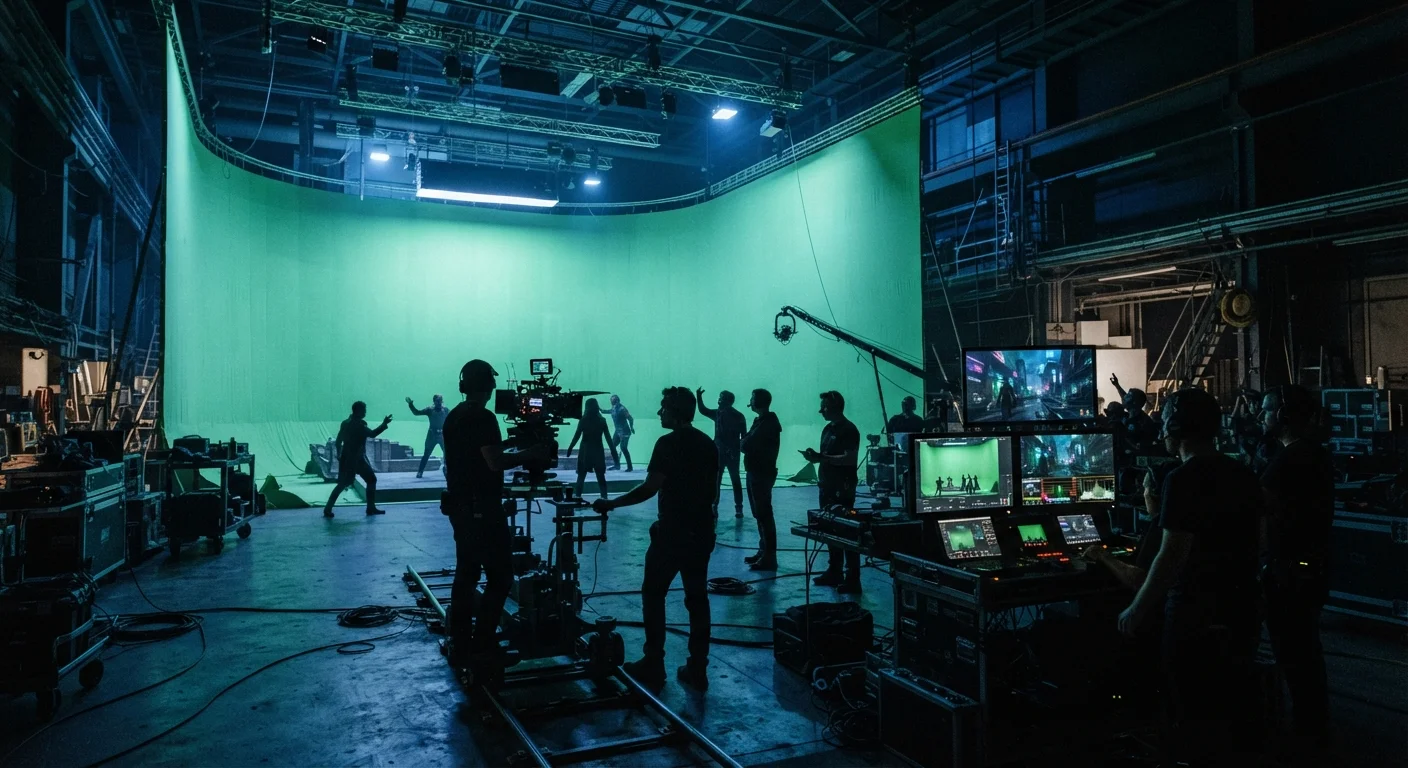
When production begins, the VFX team's fingerprints are everywhere - even if they're invisible. Green screens (or blue screens) are stretched behind actors to be replaced with digital environments in post. But simply slapping a performer in front of a green backdrop isn't enough. Lighting on set must precisely match the light conditions of the digital world that will eventually surround them, or the result looks fake regardless of how polished the CGI is.
Small tracking markers - often simple dots of tape - are placed around the set so software can calculate exact camera movement during a shot. This data allows artists to anchor digital elements to the live-action footage with pixel-perfect accuracy. Chrome reference balls and gray cards are photographed on set to capture how light behaves in that specific environment, giving digital artists a measurable guide when rendering synthetic objects.
Motion capture - where performers in sensor-covered suits have their physical movements recorded as 3D data - is used to bring digital characters to life with genuine human expressiveness. This technique powered characters across major fantasy and sci-fi franchises and remains a cornerstone of performance-driven VFX.
Post-Production: Where the Magic Actually Happens
Once filming wraps, footage is handed to VFX houses - sometimes dozens of them simultaneously on a large production. The central process is compositing: layering multiple visual elements (live-action plates, CGI renders, digital environments, atmospheric effects) into a single, unified image. Software like Nuke allows compositors to blend these layers with fine control over color, shadow, depth, and motion blur so everything reads as one cohesive shot.
Before compositing can happen, artists perform rotoscoping - manually tracing the outlines of subjects frame by frame to separate them from backgrounds. It's painstaking work, but essential for shots where chroma keying alone can't produce a clean separation. Hair, translucent fabric, and complex edges all require rotoscoping by hand.
“The goal of visual effects isn't to show the audience something impossible - it's to make them forget they're watching a movie at all. The best work is the work nobody talks about because it never broke the spell.”
— A leading VFX supervisor, Industry practitioner, multi-film VFX pipeline lead
Digital environments - from alien planets to historical cityscapes - are built using a combination of 3D modeling, matte painting (digitally illustrated backgrounds), and photogrammetry (turning real-world photographs into 3D geometry). These assets are lit and rendered to match on-set footage, then composited into the final image. Just as sound design shapes how a scene feels aurally, digital environments shape how it reads visually - often without the audience ever realizing the set wasn't real.
Invisible Effects Are Everywhere
VFX isn't only explosions and dragons. A significant portion of modern VFX work is intentionally undetectable. Removing safety wires from stunt performers, digitally erasing boom microphones that crept into frame, extending a building's height, or replicating a crowd of 200 extras into thousands - these "invisible" fixes and enhancements appear in nearly every film released today, including dramas with no obvious fantastical elements.
Train Your Eye to Spot Invisible VFX
Next time you watch a film set in a real city, look closely at crowd density, sky gradients, and building tops - these are common areas where digital extensions are added. Rewatching scenes from a craft perspective, rather than a narrative one, reveals just how much invisible digital work surrounds even the most grounded dramas.
This invisible layer of VFX is one reason the discipline has expanded so dramatically. Understanding how editing shapes a film's rhythm becomes even richer when you realize VFX is quietly reshaping individual frames that editors then cut together. The crafts are deeply intertwined - and both are largely invisible when done well.
The scale and economics of VFX production are also deeply shaped by how studios operate. The Hollywood studio system plays a direct role in how much VFX budget a film receives, which vendors are hired, and how tight post-production timelines are - factors that ripple into the final quality of every shot audiences see.