

Key Takeaways
- Nearly every sound in a finished film was crafted or replaced in post-production.
- Sound design is a separate craft from film scoring, dialogue recording, and music.
- Foley artists recreate everyday sounds - like footsteps - in a studio to match the picture.
- Sound can signal emotion and narrative meaning just as powerfully as visuals.
- Great sound design is often unnoticed precisely because it works so well.
Sound Design in Film
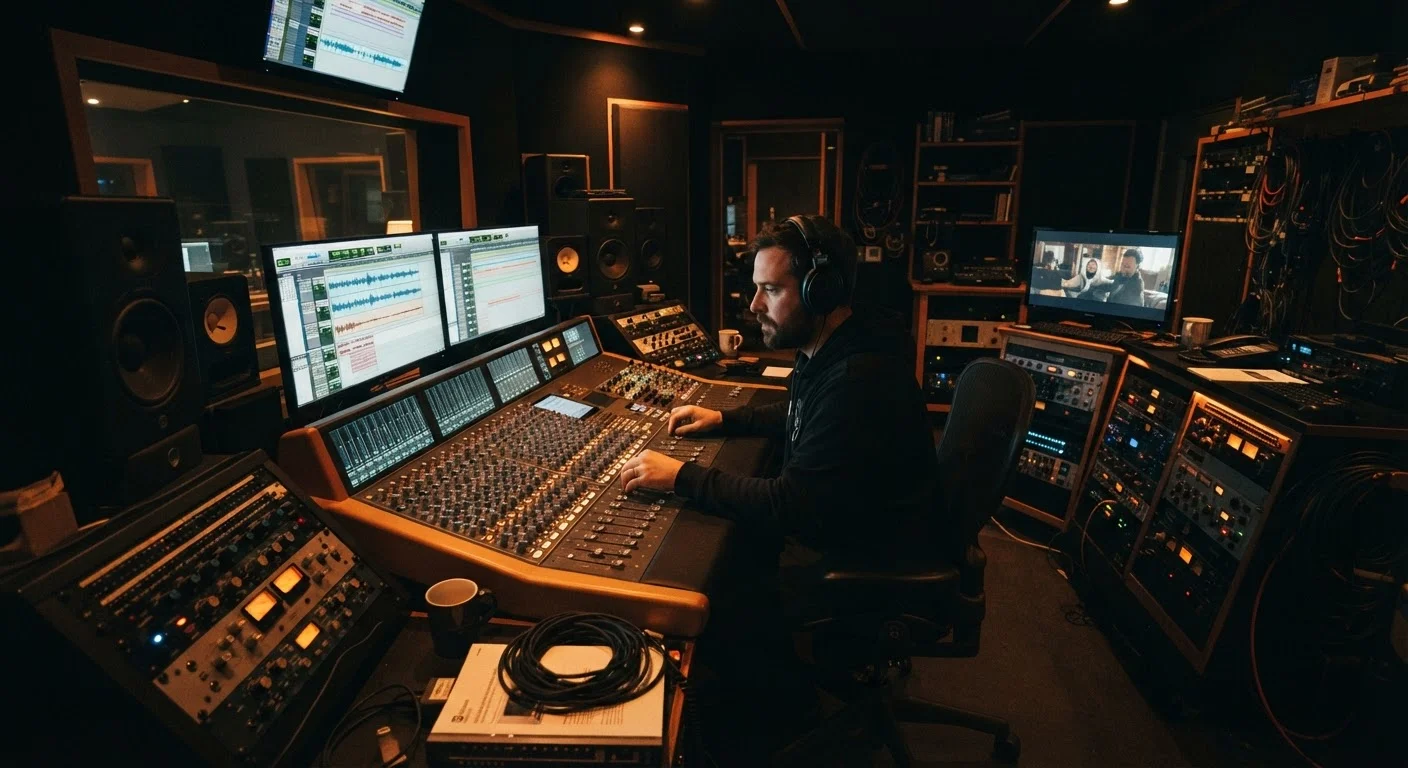
Sound design is the craft of creating, recording, editing, and layering all the audio elements in a film - beyond just dialogue and music. It includes everything from footsteps and ambient noise to creature sounds and futuristic machinery. A sound designer's job is to make a film's world feel real, immersive, and emotionally resonant through audio. Most of what you hear on screen was constructed deliberately in a studio, not simply captured during filming.
Sound design is a distinct discipline from music scoring and production sound mixing. It typically involves field recording, Foley artistry, and digital audio workstations (DAWs) to build layered soundscapes that sync with picture.
Why Sound Is Half the Movie
Filmmaker George Lucas famously observed that sound is half the experience of cinema - and while that's a well-worn industry maxim, it holds up. Close your eyes during an action sequence and you'll still feel the chaos. Mute the same scene and it loses much of its power. What most audiences don't realize is that the sounds they're responding to were almost entirely built from scratch.
On a professional film set, the audio captured by production sound mixers is rarely the audio audiences hear in theaters. Dialogue is often re-recorded in a process called ADR (Automated Dialogue Replacement). Background sounds, footsteps, and environmental detail are replaced entirely. The resulting audio landscape - every creak, rustle, and distant siren - is the work of a sound design team operating largely in post-production.
Just as good editing is nearly invisible, great sound design goes unnoticed precisely because it works. When it fails, you notice immediately - a sound that doesn't match what's on screen pulls you out of the story.
~70%
Of cinema audio replaced in post-production
Industry professionals widely estimate that the majority of sound heard in a finished film is replaced or supplemented after principal photography, though exact figures vary by production.
1929
Year of the first Academy Award for Sound
The Academy of Motion Picture Arts and Sciences has recognized sound as a distinct craft category since the early sound era, reflecting its foundational role in cinematic storytelling.
3-6 months
Typical post-production sound timeline
Major studio films commonly allocate three to six months for sound post-production, including editing, design, Foley, ADR, and final mixing - a significant portion of the overall production schedule.
The Building Blocks: Foley, Effects, and Ambience
Sound designers work with several distinct audio layers, each serving a different function in the final mix.
- Foley: Named after pioneer Jack Foley, this is the art of performing everyday sounds - footsteps, fabric movement, the clink of glasses - in a studio while watching the picture. Foley stages are stocked with different floor surfaces and physical props to create an array of textures. What sounds like a fist hitting a face in a fight scene? Often a raw chicken slapped against a cutting board.
- Hard sound effects: Discrete, specific sounds tied to on-screen events - a gunshot, a car starting, an explosion. These are pulled from large sound libraries or recorded in the field and edited to picture.
- Ambience and room tone: The background audio that makes a space feel inhabited. A forest scene has layers of wind, insects, and distant wildlife. An office has hum, ventilation, and faint conversation. Strip these out and a scene feels eerily empty.
- Designed sounds: Invented sounds for things that don't exist - alien creatures, futuristic technology, interdimensional portals. These are built by layering and manipulating real-world recordings in unexpected ways.
Together, these elements are mixed and balanced by a re-recording mixer, who determines what the audience hears and at what volume relative to dialogue and music. Music shapes what you feel, but sound design shapes what you believe.
Try a Sound-Focused Rewatch
Pick a film you've already seen and watch a single scene with your eyes closed. Pay attention to how many distinct audio layers you can identify - ambience, Foley, effects, music. Then watch it again with your eyes open and notice which sounds you can now locate on screen. This exercise makes the craft of sound design immediately tangible.
Designed Sounds and the Art of Invention
Some of the most celebrated sounds in cinema history were created from objects that have nothing to do with what's on screen. The roar of a T. rex in Jurassic Park combined recordings of tigers, alligators, elephants, and a baby elephant's cry - layered and pitch-shifted until something genuinely new emerged. The breathing of Darth Vader was a modified scuba regulator. These aren't party trivia facts; they're examples of how sound designers approach non-existent or larger-than-life subjects.
The discipline requires both technical fluency and genuine artistic imagination. A sound designer working on a science fiction film can't simply look up what a faster-than-light engine sounds like - they have to invent it from first principles, drawing on physics, emotion, and storytelling instinct simultaneously. This is why sound design is increasingly recognized in its own right, distinct from the craft of scoring. Visual effects teams face a similar challenge when building creatures or environments that have never existed.
“The best sound design goes unnoticed. When people walk out of a movie talking about the sound, something has probably gone wrong - unless the film itself was about sound.”
— Randy Thom, Oscar-winning sound designer and director of sound design at Skywalker Sound
For audiences interested in going deeper, thoughtful questions after watching a film can help you start noticing sound as a deliberate creative layer rather than background noise.
Why You Rarely Notice - and That's the Point
The highest compliment you can pay a sound designer is to say you didn't notice their work. The goal isn't to impress the audience with clever audio; it's to serve the story so completely that the sound world feels inevitable. When a film's sound design is praised - as with the Oscar-winning work on films like Apocalypse Now, Mad Max: Fury Road, or Dune - it's usually because it was so fully realized that it expanded what cinema felt capable of expressing.
Sound also communicates information that visuals can't. The tone of an off-screen footstep tells you the size and weight of who's approaching. A shift in ambience signals that a character has crossed from safety into danger. Low-frequency sound - below the threshold of conscious hearing - can create a physical sense of unease that audiences can't quite explain. These are tools that sound designers deploy with the same intentionality that a cinematographer uses light and lens.
The next time you're absorbed in a film and feel your pulse quicken, your eyes water, or your skin prickle - listen. Half of what you're feeling might be something you never consciously heard at all.
Sound and Screen Technology Matter
The experience of a film's sound design varies significantly depending on your playback setup. A theater with Dolby Atmos or DTS:X can spatially place sounds in three dimensions around the audience; a laptop speaker collapses that entire landscape into a single point. Some films' sound work is genuinely difficult to appreciate outside a theater context, which is worth keeping in mind when comparing viewing experiences.