

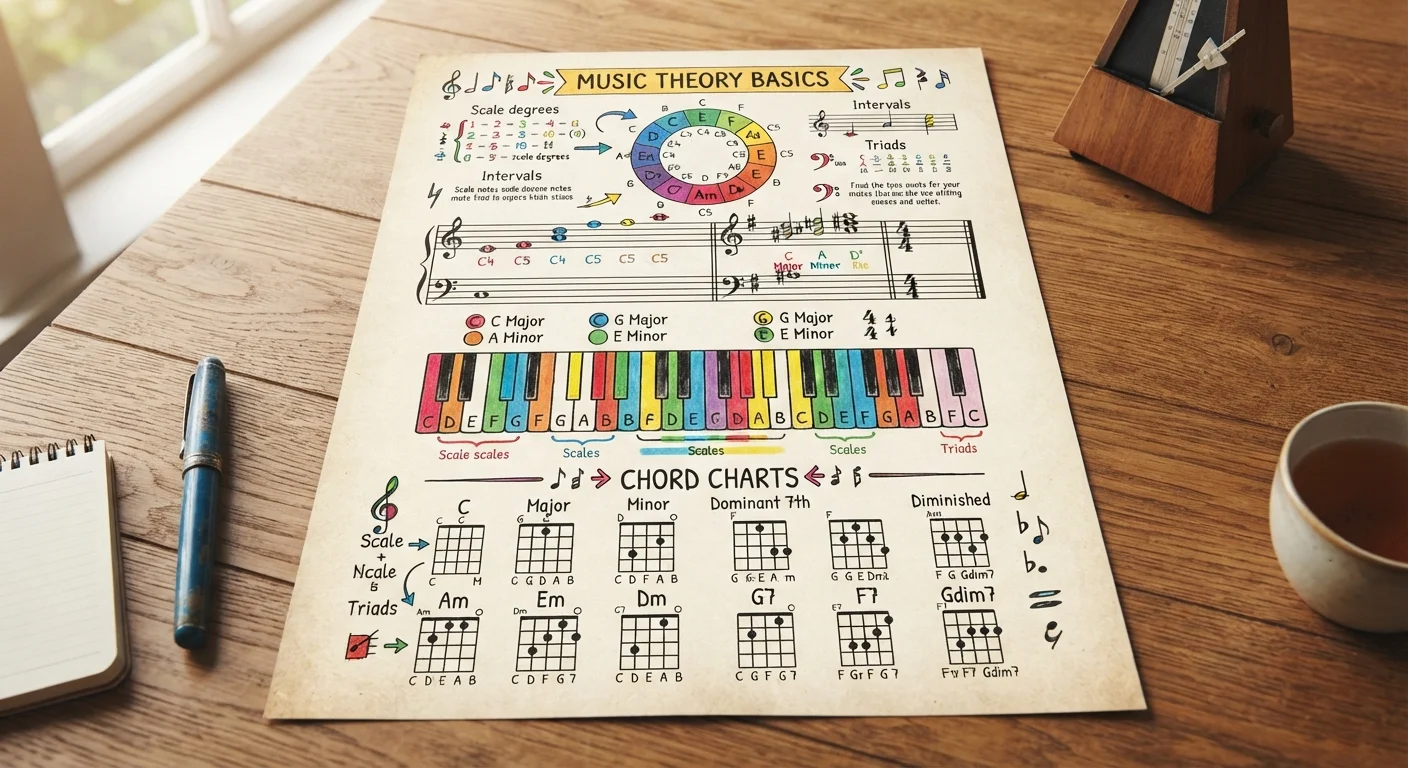
Key Takeaways
- Music theory describes patterns that already exist in songs you enjoy - it's observation, not memorization.
- Scales are ordered sequences of notes that give music its characteristic mood or flavor.
- Chords are built by stacking notes from a scale, and their combinations drive emotional impact.
- Rhythm and tempo determine how music feels in your body, independent of melody.
- Understanding basic theory deepens how you listen, even if you never play an instrument.
Start here
Why Music Theory Isn't as Scary as It Sounds
Next
Scales: The Building Blocks of Every Song
Then
Chords: How Notes Team Up to Create Feeling
Keep going
Rhythm and Tempo: The Pulse That Moves You
Put it together
How Theory Shows Up in Music You Already Know
Why Music Theory Isn't as Scary as It Sounds
Here's a secret that music schools don't always advertise: you already know music theory. Every time you recognize that a song feels sad, or notice that a chorus hits harder than the verse, or catch yourself anticipating a melody's next move - that's theory working inside your head. Music theory is simply the language humans developed to describe patterns that exist in music naturally.
You don't need to read a single note of sheet music to benefit from understanding it. Think of it the way you might think about grammar: you were speaking sentences long before anyone explained what a noun was. Theory just gives names to the moves music was already making.
Note
A single musical sound with a specific pitch, identified by letters A through G. Notes are the basic atoms of all music.
Scale
An ordered sequence of notes following a specific pattern of intervals. Scales define the pool of notes a song draws from and establish its general mood.
Chord
Three or more notes played at the same time. Chords are the harmonic backbone of most songs and are built by combining notes from a scale.
Interval
The distance in pitch between two notes. Intervals determine whether two notes sound consonant (smooth) or dissonant (tense) together.
Tempo
The speed of a piece of music, usually measured in beats per minute (BPM). Higher BPM means faster music; lower BPM means slower.
Time Signature
A notation that tells you how many beats appear in each measure and what kind of note gets one beat. The most common is 4/4, meaning four beats per measure.
Chord Progression
A sequence of chords played in order. Progressions create the emotional arc of a song - building tension, releasing it, and returning to a sense of home.
Tonic
The 'home base' note of a scale or key - the note that feels like resolution or arrival when the music lands on it.
Once you know a few foundational concepts, listening becomes richer - and for curious fans exploring genres from jazz to film scores, that payoff is immediate. Our guide to how film scores are composed is a great companion read once you've got the basics down.
Scales: The Building Blocks of Every Song
A scale is simply a specific set of notes arranged in order from low to high. Different scales have different patterns of spacing between notes - called intervals - and those patterns are what give music its mood. The major scale has a bright, open sound (think the opening of a classic pop song). The minor scale feels more inward or melancholy.
Here's the non-intimidating version: picture a piano keyboard. The white keys, played from C to C in sequence, form the C major scale. That's it. Every other scale is just that same concept shifted to a different starting point or with a slightly different interval pattern.
Try This Active Listening Exercise
Pick any song you love and hum just the melody. Notice whether it feels bright and resolved or darker and unfinished - that feeling is coming directly from the scale it uses. Listening with this question in mind is one of the fastest ways to start hearing theory in practice.
Scales also explain why certain notes sound like they "belong" in a song while others clash. Songwriters stay within a scale most of the time - and when they step outside it, that's often when music gets interesting. The blues scale, widely used in American rock and soul, deliberately bends and blurs those boundaries to create tension and release.
Chords: How Notes Team Up to Create Feeling
A chord is what happens when three or more notes from a scale play simultaneously. The most common type - a triad - stacks every other note of a scale together. Major triads sound stable and bright. Minor triads sound softer or more emotional. That's essentially the entire secret behind why so many pop songs feel the way they do.
What makes chords powerful is progression - the order in which they appear. The I-V-vi-IV progression (four specific chords based on a scale's first, fifth, sixth, and fourth notes) underlies an enormous range of hit songs across multiple decades and genres. Once you know it, you'll hear it everywhere.
Don't Overthink Chord Labels
Roman numeral notation (I, IV, V) looks intimidating at first glance, but it's just a shorthand for describing chords relative to a scale - it has nothing to do with math. Focus on recognizing how chord combinations feel rather than memorizing symbols, and the labels will start making sense naturally over time.
For a deeper look at how these structures become full songs, the songwriter's craft explores the verse-chorus forms and hooks that make music stick.
Rhythm and Tempo: The Pulse That Moves You
Rhythm is the pattern of long and short sounds over time. Tempo is how fast or slow that pattern moves, typically measured in beats per minute (BPM). These two elements determine how music feels in your body before your brain even processes the melody.
Most Western pop music organizes rhythm into groups of four beats - called 4/4 time or common time. That steady, predictable pulse is why you tap your foot without thinking. Jazz and classical music frequently use different time signatures, like 3/4 (waltz-like) or 5/4, which can feel unexpectedly off-balance in a compelling way. If you're curious how jazz uses rhythm as a creative tool, our guide to getting into jazz is a natural next step.
How Theory Shows Up in Music You Already Know
The beauty of learning these basics is how fast they start connecting to familiar music. That Taylor Swift bridge that gives you chills? It likely shifts to a new chord that wasn't used in the verse, creating harmonic surprise. The Kendrick Lamar track that feels unresolved and tense? The rhythm might be syncopated - emphasizing unexpected beats - and the chord choices may deliberately avoid landing on the "home" chord.
Music theory isn't a rulebook artists follow obediently; it's a toolkit they use, ignore, and subvert on purpose. Knowing the toolkit means you understand what's happening when someone breaks the mold - and that's when listening becomes genuinely exciting.
Even understanding just scales, basic chords, and rhythm puts you miles ahead as a listener. From there, exploring music industry terminology adds another layer of context to how the music world works beyond the notes themselves.
Theory Describes Music - It Doesn't Constrain It
Music theory was developed by observing what musicians were already doing, not by inventing rules for them to follow. Many celebrated artists learned theory formally and then deliberately broke its conventions to find their own sound. Understanding the framework is a starting point, not a ceiling.