

Key Takeaways
- Hip-hop originated in the South Bronx during the early 1970s as a community-driven creative response to urban hardship.
- The culture is built on four foundational elements: DJing, MCing, breakdancing, and graffiti art.
- Distinct regional sounds - East Coast, West Coast, Southern - each pushed the genre's evolution forward.
- Hip-hop became the most-streamed music genre in the United States by the mid-2010s.
- Today, hip-hop continues to reshape pop, country, and R&B, blurring genre boundaries across American music.
Birth of a Movement: The South Bronx in the 1970s
Few cultural revolutions have a clearer origin story than hip-hop. In the early 1970s, the South Bronx was one of the most economically distressed urban neighborhoods in America - gutted by urban renewal policies, housing fires, and disinvestment. What emerged from that pressure was extraordinary: a youth-driven creative movement that would eventually reshape global culture.
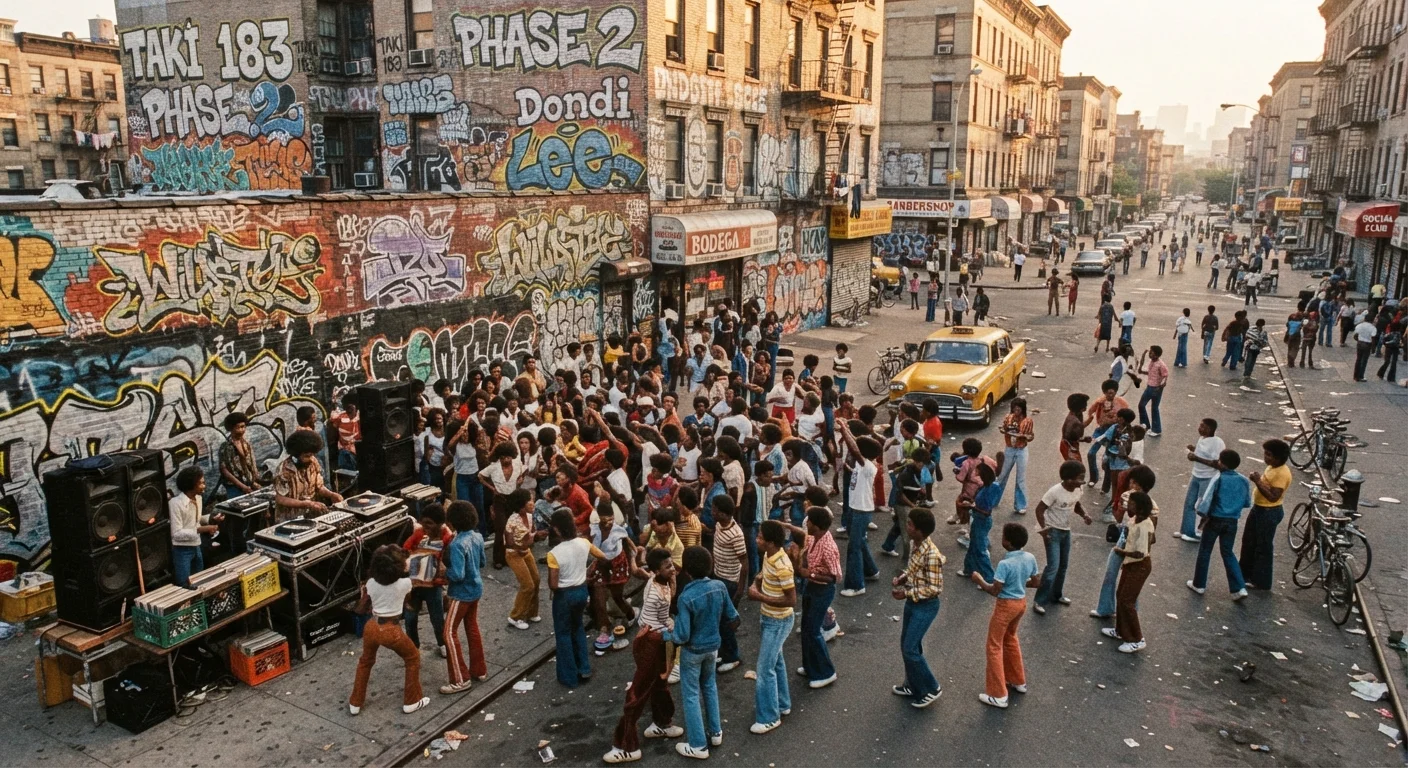
On August 11, 1973, a teenager named Clive Campbell - better known as DJ Kool Herc - hosted a back-to-school party in the recreation room of 1520 Sedgwick Avenue in the Bronx. Using two turntables, he isolated and looped the percussive breakbeats of funk and soul records, creating an extended dance groove that the crowd went wild for. That technique, known as the "Merry-Go-Round," is widely recognized as a foundational moment for the genre.
Hip-hop didn't emerge from one person, though. Grandmaster Flash refined turntable technique. Afrika Bambaataa, through his Universal Zulu Nation, framed hip-hop explicitly as a peaceful alternative to gang violence. These early architects understood they were building something bigger than a party. As part of the broader story of American popular music's decade-by-decade evolution, hip-hop's 1970s roots represent one of the genre's most dramatic origin points.
#1
Most-streamed genre in the US
Hip-hop/R&B surpassed rock as the top-consumed genre in the United States by 2017, according to Nielsen Music's annual year-end report.
50+ years
Duration of hip-hop's cultural run
Measured from DJ Kool Herc's 1973 Bronx party, hip-hop has sustained cultural and commercial relevance for over five decades.
4
Foundational cultural elements
DJing, MCing, breakdancing, and graffiti art are the four pillars recognized as hip-hop's core cultural framework since its South Bronx origins.
The Four Elements: Hip-Hop's Cultural Foundation
Hip-hop has never been just music - it's a full cultural system with four recognized pillars: DJing (turntablism), MCing (rapping), breakdancing (b-boying/b-girling), and graffiti art. Each element gave a different group of young people a creative outlet and a way to compete, express, and connect.
DJing provided the sonic backbone. MCing evolved from hype-man call-and-response into intricate lyrical storytelling. Breakdancing turned parking lots and cardboard-covered floors into performance stages. Graffiti transformed subway cars and building walls into public galleries. Together, these four elements created a self-contained culture with its own aesthetics, hierarchies, and values.
To truly understand a rap artist's work, explore the producers behind the records - the beat is often where the genre's most innovative thinking lives.
Production trends (boom-bap, G-funk, trap, drill) frequently drive hip-hop's evolution before lyrical trends catch up, making producers key figures in genre history.
When exploring hip-hop's history, use regional playlists as your guide - start with East Coast, then West Coast, then Southern subgenres to hear how geography shaped distinct sounds.
Hip-hop's regional identities are so pronounced that listening geographically provides a faster orientation to the genre's range than a purely chronological approach.
Understanding these elements matters because they explain why hip-hop has proven so durable. It isn't a single musical formula - it's a flexible framework that accommodates vastly different expressions, from jazz-influenced boom-bap to trap beats to spoken-word poetry.
Golden Era and Mainstream Breakthrough
The late 1970s brought hip-hop's first commercial moment: the Sugarhill Gang's "Rapper's Delight" (1979), which proved the genre could sell records nationally. Through the 1980s, Run-DMC cracked rock radio with their Aerosmith collaboration, LL Cool J went platinum, and Public Enemy and N.W.A introduced politically charged, confrontational lyricism that forced mainstream America to pay attention.
The 1990s are widely called the Golden Era - an explosion of artistic ambition from artists like Nas, Jay-Z, The Notorious B.I.G., Tupac Shakur, A Tribe Called Quest, and Lauryn Hill. Lyricism, production depth, and cultural commentary reached new heights. These were records that didn't just entertain - they documented lived experience and demanded cultural recognition. For a deeper look at landmark recordings from this period, formative albums that defined American genres offers essential context.
“Hip-hop is a reflection of the community that created it, but also a mirror held up to the whole of American society.”
— Tricia Rose, Cultural critic and author of 'Black Noise: Rap Music and Black Culture in Contemporary America'
Regional Voices: How Geography Shaped the Sound
One of hip-hop's greatest strengths is its regional diversity. The East Coast established dense, jazz- and soul-sampled production with razor-sharp lyricism. The West Coast - led by artists in Los Angeles and Compton - introduced G-funk's synthesizer-heavy grooves and an unflinching narrative style rooted in California street life.
By the late 1990s and 2000s, the South became the genre's creative engine. Atlanta's trap sound, Houston's chopped-and-screwed movement, New Orleans bounce, and Miami bass all introduced rhythmic frameworks and regional slang that eventually dominated national charts. Artists like OutKast, Lil Wayne, and T.I. proved Southern rap wasn't a regional curiosity - it was the future.
This geographic variety also explains hip-hop's intersections with other American genres. The cross-pollination between Southern rap and country music, for example, is part of a broader genre-blurring story explored in where country, pop, and hip-hop collide.
Explore Hip-Hop Beyond the Charts
Some of the genre's most important creative moments never received mainstream radio play. Digging into independent and underground releases from each region and era reveals a richer, more complete picture of how hip-hop actually evolved. Local record stores and dedicated streaming playlists curated by music historians are great starting points.
Hip-Hop's Commercial and Cultural Dominance
By the mid-2010s, hip-hop and R&B had surpassed rock as the most-consumed music genre in the United States, driven largely by streaming platform data. This wasn't a fluke - it reflected decades of audience-building, cultural relevance, and the genre's uncanny ability to absorb and reflect the national mood.
Hip-hop's influence radiates far beyond music charts. It reshaped fashion (streetwear's global rise is inseparable from hip-hop), language (countless slang terms have entered mainstream American English via rap), and visual culture (music videos, album artwork, and sneaker culture all carry its fingerprints). Its relationship to Motown's lasting influence on American popular music is worth noting - both movements transformed how Black American artistry was packaged, sold, and heard by mainstream audiences.
Hip-Hop's Roots Are Inseparable from Race and Inequality
Understanding hip-hop fully requires acknowledging that it emerged as a direct creative response to systemic disinvestment in Black and Latino communities. The genre has always carried political and social weight alongside its entertainment value. Separating the music from that context gives an incomplete - and misleading - picture of why it exists and why it matters.
Hip-Hop Today: Genre Fusion and the Next Chapter
Contemporary hip-hop is less a single genre than a gravitational field pulling other sounds into its orbit. Artists like Tyler, the Creator and Kendrick Lamar push the album format as high art. Trap beats underpin pop hits by artists who would never call themselves rappers. Country-rap hybrids and Latin trap are charting simultaneously - a sign of how thoroughly hip-hop has rewired the architecture of popular music.
Streaming has also democratized production, allowing bedroom producers and independent artists to build global audiences without major-label infrastructure. The genre's next generation is already here, absorbing everything from drill to hyperpop to Afrobeats and building something new from those influences.
What began at a Bronx block party half a century ago has become the dominant language of American popular culture. Hip-hop's ongoing story isn't a conclusion - it's a live document, still being written with every beat drop and bar.
Genres That Blurred: Where Country, Pop, and Hip-Hop Collide
An exploration of how hip-hop has crossed into country and pop territory, redefining what each genre even means in modern American music.
Sounds Worth Knowing: Formative Albums That Defined American Genres
A curated look at landmark albums - including pivotal hip-hop records - and the movements they crystallized across American music history.
The Eras of American Pop Music: A Decade-by-Decade Overview
Places hip-hop within the full arc of American popular music, showing how the genre fits into and transformed the broader musical landscape.