

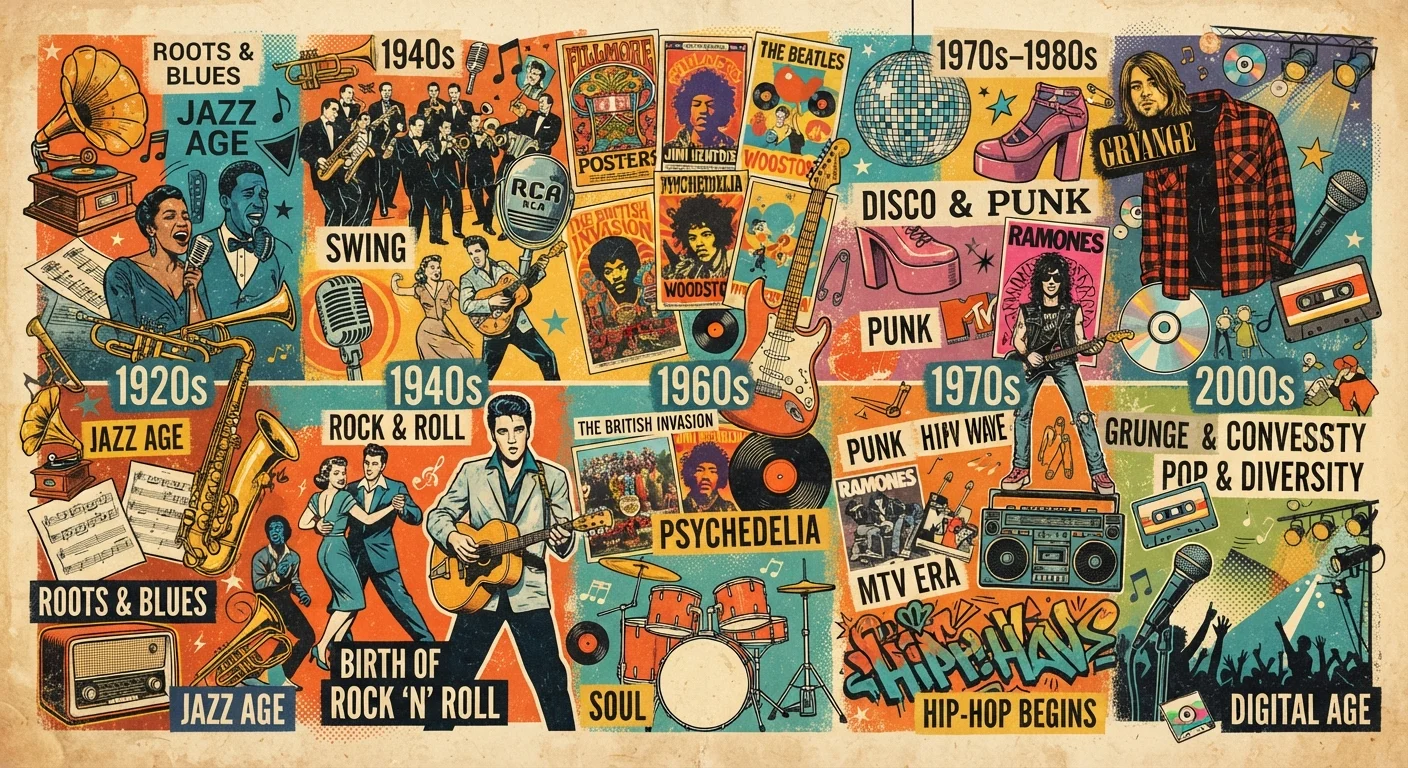
The Building Blocks: 1920s-1950s
American pop music didn't arrive fully formed - it was assembled, decade by decade, from a remarkable collision of cultures, technologies, and social upheavals. Understanding what makes a music era distinct helps explain why each decade below feels so unmistakably different from the last.
The 1920s gave America jazz and the blues as commercial forces. Radio broadcasting transformed regional sounds into national phenomena almost overnight. The 1930s and 40s belonged to the swing era - big bands led by figures like Duke Ellington and Benny Goodman filled ballrooms and jukeboxes alike. Crucially, Black American musical traditions were the engine driving nearly all of it, even as segregation kept many artists from receiving full credit or compensation.
The 1950s detonated everything. Rhythm and blues collided with country to produce rock and roll - a sound that terrified some parents and electrified an entire generation of teenagers. This decade also saw the rise of the teen market as a commercial force, a dynamic that still shapes the industry today. Music was already responding to the tensions of postwar America, and the soundtrack got louder.
Revolution and Reinvention: 1960s-1990s
The 1960s are impossible to overstate. Soul, Motown, folk revival, psychedelic rock, and the British Invasion all competed for American ears simultaneously. Motown's Detroit hit factory perfected a crossover pop formula that brought Black artistry into mainstream white radio in unprecedented ways. Meanwhile, iconic venues were cementing regional scenes from Nashville to New York.
Swing Era
A period roughly spanning the 1930s-40s when big band jazz, featuring large ensembles and danceable rhythms, dominated American popular music. It was one of the first musical movements to achieve true mass-market commercial success.
Crossover
A song or artist that achieves success across multiple genre charts - for example, a country song that also performs well on pop radio. Crossover success has been a commercial holy grail for decades.
AutoTune
A pitch-correction software tool introduced in the late 1990s. Originally used discreetly in studios, it became a recognizable stylistic effect in pop and hip-hop from the 2000s onward.
Hyperpop
An experimental microgenre emerging in the late 2010s, characterized by maximalist production, distorted vocals, and internet-native aesthetics. It blurs the lines between pop, electronic music, and avant-garde experimentation.
Streaming Era
The period from roughly 2010 onward in which on-demand audio platforms replaced physical media and digital downloads as the primary way Americans consume music.
The 1970s splintered pop into tribes: disco, punk, soft rock, funk, and country crossover all thrived at once. Synthesizers and multitrack recording reshaped what a pop record could sound like. The 1980s doubled down on technology - drum machines, synthesizers, and MTV video aesthetics turned image into a commercial instrument alongside sound. Hip-hop, born in 1970s New York, became a dominant commercial genre by the decade's end.
The 1990s delivered yet another reinvention. Grunge, R&B, boy bands, gangsta rap, and country's commercial boom all coexisted on the charts. The CD format peaked, and the music industry hit record revenues - just before the internet began dismantling the model entirely. Landmark albums from this era still rank among the most culturally defining records ever made.
The Streaming Age and Beyond: 2000s-Present
The 2000s were defined by disruption. Napster, iTunes, and broadband internet collapsed album sales and forced the industry to rethink distribution. Pop production grew glossier; AutoTune shifted from studio secret to stylistic signature. Indie music found genuine mass audiences online for the first time.
The 2010s completed the streaming transition. Spotify, Apple Music, and YouTube changed how listeners discovered artists and how artists measured success - streams replaced sales as the primary currency. Genre barriers blurred aggressively: pop absorbed hip-hop, country flirted with rap, and EDM crossed into Top 40 radio.
Today, the landscape is more fragmented and more connected than ever. Hyperpop, bedroom pop, Latin pop crossovers, and algorithm-driven viral moments coexist on the same charts. What hasn't changed is the underlying dynamic: American pop music keeps absorbing influences from its margins - particularly from Black and Latino communities - and repackaging them for broader audiences. Recognizing that lineage is essential to understanding where the music has been, and where it's heading next.
This article is intended as a general cultural overview and does not represent comprehensive musicological scholarship. Perspectives on pop music history vary widely among historians and critics.