

Key Takeaways
- Motown was founded in Detroit in 1959 by Berry Gordy Jr. as a Black-owned independent label.
- Its crossover appeal broke down racial barriers in American radio and mainstream pop culture.
- The Funk Brothers session band played on more number-one hits than any other group in pop history.
- Motown's influence can be heard across modern pop, R&B, hip-hop, and even country music.
- The label's artist development model - grooming performers for mainstream audiences - shaped the modern music industry.
The Motown Sound
Motown refers to both a record label founded in Detroit in 1959 and the distinctive musical style it popularized - a blend of soul, R&B, gospel, and pop characterized by catchy melodies, lush string arrangements, and a driving backbeat. Founded by Berry Gordy Jr., Motown became the first Black-owned record label to achieve mainstream crossover success on a massive scale. Its name derives from Detroit's nickname, "Motor City," a nod to the city's automotive industry.
The label's signature drum and bass sound was partly engineered by the in-house session musicians known as The Funk Brothers, whose rhythmic foundations underpinned virtually every Motown hit of the 1960s.
A Detroit Dream That Rewrote the Rules
In 1959, Berry Gordy Jr. borrowed $800 from his family savings club, rented a two-story house on West Grand Boulevard in Detroit, and set out to build a hit factory. What followed was one of the most improbable success stories in American cultural history. Within just a few years, Motown Records was producing chart-topping music that transcended genre, generation, and - crucially - race.
Gordy modeled his operation deliberately after Detroit's auto plants: a structured assembly line where songwriters, producers, musicians, and artists each played a specialized role. Songs were workshopped in weekly quality-control meetings where only the strongest material made the cut. That relentless focus on craft and commercial appeal produced a catalog so durable that its songs remain instantly recognizable more than six decades later.
Music has always reflected America's emotional landscape, and Motown arrived at exactly the right moment - the civil rights era - offering a sound so joyful and polished that it slipped past the gatekeepers of segregated radio and onto national airwaves.
110+
Top Ten Pop Hits in the 1960s
Motown Records placed more than 110 singles in the top ten of the Billboard pop charts during the 1960s alone, according to music historians.
#1
Most Number-One Records by Any Band
The Funk Brothers are widely credited by music historians with performing on more number-one hit records than any other group in pop history.
1959
Year Motown Was Founded
Berry Gordy Jr. launched Motown Records in Detroit, Michigan, starting the label with an $800 loan from a family savings pool.
The Architecture of the Motown Sound
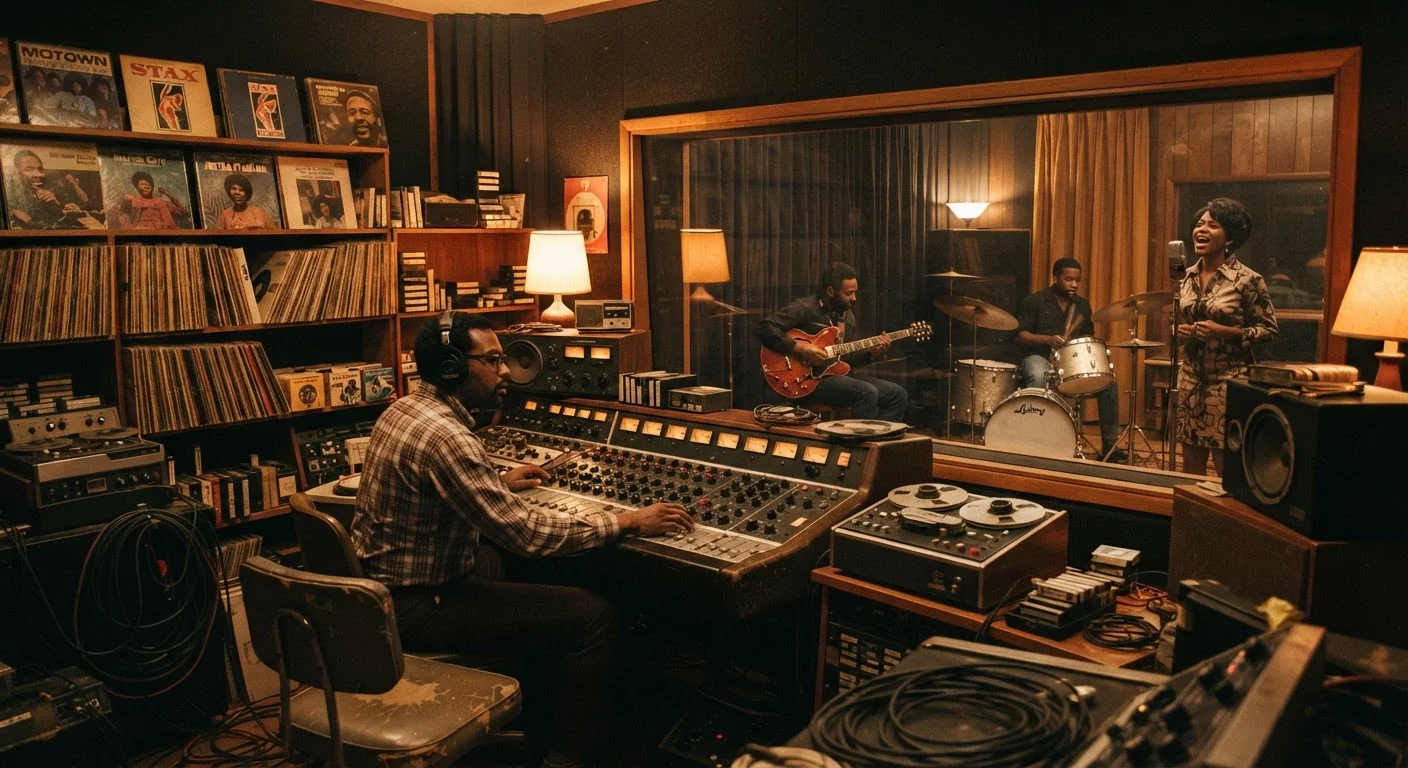
What made a Motown record sound like a Motown record? The answer lives in layers. The Funk Brothers laid down bass-heavy rhythmic grooves in the basement studio. Above that, Holland-Dozier-Holland and other in-house songwriting teams crafted melodies built around emotional hooks that almost anyone could sing along to. Then came orchestral strings, gospel-influenced call-and-response vocals, and tambourines striking on every beat - a technique that gave the music a propulsive, almost physical energy.
This wasn't accidental. Gordy famously tested mixes by playing them in the Hitsville corridor - if the bass and melody hit hard even through a hallway, the song was ready. The label also invested heavily in artist development: performers took etiquette classes, choreography rehearsals, and media training before they ever appeared on television.
Listen Like a Producer
To really hear what made Motown special, try listening to a classic track with headphones and isolating each layer - bass, drums, strings, and vocals. The interplay between the Funk Brothers' rhythmic foundation and the melodic arrangements above it reveals a level of musical craftsmanship that still holds up under scrutiny. Many streaming platforms offer isolated stems or remastered versions that make this exercise even more rewarding.
The result was a roster of artists who felt simultaneously aspirational and approachable - an aesthetic that would later become a blueprint for how major labels groom pop stars. Certain albums from this era didn't just chart - they crystallized what soul and pop could achieve together.
Breaking Barriers, Building Bridges
Motown's crossover achievement cannot be overstated in its historical context. American radio in the early 1960s operated with distinct "race music" and pop formats that rarely overlapped. Motown dismantled that divide not through protest, but through sheer musical magnetism. Songs by The Supremes and The Temptations topped both R&B and pop charts simultaneously, reaching audiences across geographic and cultural lines.
This integration of mainstream pop had profound social implications. When Ed Sullivan booked Motown acts on his nationally televised variety show, millions of white American households were introduced to Black performers in a glamorous, non-threatening context. Scholars of American music history have argued that Motown did as much to normalize racial integration in entertainment as any explicit civil rights campaign of the era.
“Motown music was not just entertainment - it was integration in action. It was the sound of America trying to become what it said it wanted to be.”
— Nelson George, Music journalist and author of 'Where Did Our Love Go: The Rise and Fall of the Motown Sound'
The label's reach also extended globally - The Beatles were early admirers, and British acts absorbed Motown's melodic sensibility into what would become the British Invasion sound. The venues that hosted these artists across America became cultural landmarks in their own right.
How Motown's Echo Shapes Music Today
Motown's DNA is woven into the fabric of virtually every American pop genre that followed it. Neo-soul artists of the 1990s and 2000s drew explicitly from Marvin Gaye's introspective later work. Contemporary R&B's emphasis on vocal runs, emotional authenticity, and high-gloss production owes a clear structural debt to Motown's approach. Even hip-hop - a genre born in very different circumstances - has sampled Motown's catalog extensively, recognizing the grooves laid down by the Funk Brothers as foundational rhythmic material.
Hip-hop's own story traces a different but parallel path through American music culture, and the two traditions have long cross-pollinated. Beyoncé, Bruno Mars, and John Legend have all cited Motown's influence in interviews, and their music reflects it - in the attention to vocal harmony, the emphasis on live instrumentation, and the ambition to reach the widest possible audience without sacrificing emotional depth.
Motown proved that commercial success and artistic integrity don't have to be mutually exclusive. That lesson, perhaps more than any single song, is the label's most enduring contribution to American music.