

Key Takeaways
- American music has consistently responded to war, protest, and social upheaval with genre-defining songs.
- From the Civil Rights era to post-9/11 country anthems, music captures collective emotion that words alone often cannot.
- Multiple genres - folk, blues, hip-hop, punk - have each shaped how Americans process historical turning points.
- Songs born from crisis frequently outlast the moment itself, becoming cultural touchstones for future generations.
America's Soundtrack, Chapter by Chapter
Music doesn't just accompany history - it argues with it, mourns it, and sometimes helps change it. From battlefield ballads to protest anthems streamed by millions, American musicians have always reached for their instruments when the country reached a crossroads. This connection between sound and society is explored in depth in our decade-by-decade overview of American pop music, which maps just how consistently each era's defining events left fingerprints on its charts.
The list below traces seven pivotal moments when music didn't just reflect the national mood - it helped shape it.
The Civil War Era and the Power of Communal Song
Long before recording technology existed, music during the Civil War served a practical purpose: it unified soldiers, mourned the dead, and carried messages of hope across divided communities. Songs like "Battle Hymn of the Republic" and "When Johnny Comes Marching Home" became emotional anchors for a country tearing itself apart. Spirituals - particularly those rooted in the Black American tradition - carried double meanings, functioning simultaneously as worship and coded communication. These songs established a template American music would return to again and again: collective grief transformed into collective voice.
Spirituals carried double meanings, functioning as both worship and coded communication during America's bloodiest conflict.
The Great Depression and the Rise of the Blues
When economic collapse gutted American life in the 1930s, the blues - already established in Southern Black communities - became a national language for hardship. Artists like Robert Johnson and Bessie Smith gave voice to dispossession, displacement, and grief in ways that formal media rarely acknowledged. Woody Guthrie, traveling the same Dust Bowl roads as displaced families, channeled the Depression into folk songs that would influence American music for generations. His work is a foundational example of how economic crisis can push artists toward radical honesty, stripping music down to its most essential human elements.
The blues gave voice to dispossession in ways that formal media of the era rarely dared to acknowledge.
World War II and the Swing That Kept the Home Front Moving
Big band swing didn't just entertain - it energized a wartime nation. Dance halls packed with workers and families offered a few hours of normalcy against a backdrop of rationing, loss, and uncertainty. Songs celebrated soldiers, mourned their absence, and sometimes grappled with the strangeness of waiting. The Andrews Sisters and Glenn Miller's orchestra became synonymous with American resilience during the war years. Importantly, this era also saw Black musicians like Duke Ellington continuing to push American music forward even as segregation kept them locked out of many of the venues where their music was celebrated.
Dance halls offered wartime families a few hours of normalcy - and swing music made that escape feel like solidarity.
The Civil Rights Movement and the Protest Anthem
No era illustrates music's political power more vividly than the Civil Rights Movement of the 1950s and 1960s. "We Shall Overcome" became a hymn of nonviolent resistance. Nina Simone's work captured fury and dignity in equal measure. Sam Cooke's "A Change Is Gonna Come" distilled the longing of an entire generation into three and a half minutes. Motown, meanwhile, was quietly rewriting the rules of what Black American artists could achieve commercially - a legacy explored in detail in our piece on Motown's enduring influence. These songs weren't background music to the movement - they were organizing tools, shared rituals, and emotional sustenance.
Civil Rights anthems weren't background music - they were organizing tools and emotional sustenance for an entire movement.
Vietnam and the Fracturing of American Musical Identity
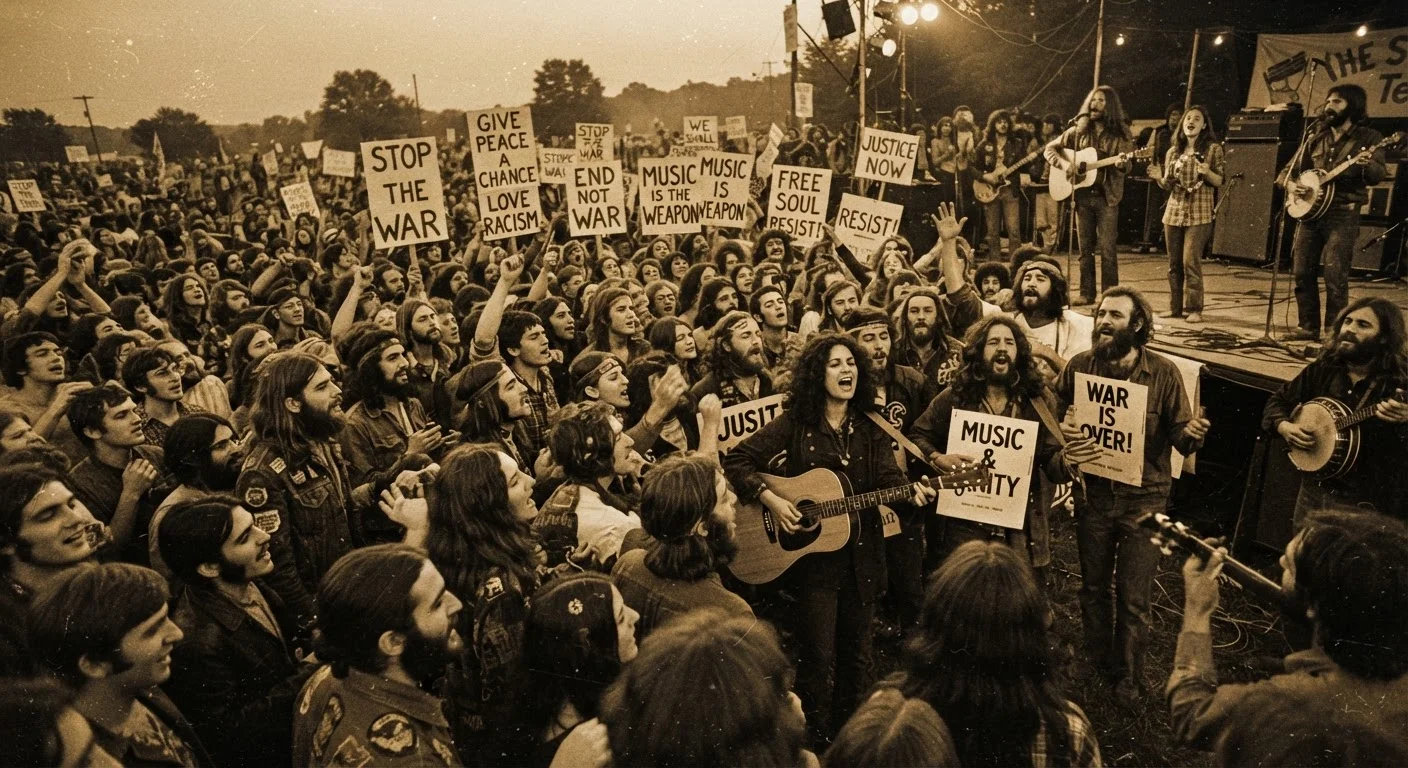
The Vietnam War produced one of the most musically complex periods in American history. Folk and rock artists challenged the war directly - Creedence Clearwater Revival, Joan Baez, Country Joe and the Fish. But country music often pushed back, with songs expressing pride, patriotism, and support for troops. The result was a rare moment when the American musical landscape literally split along political lines, each camp producing its own anthems. This fracture was itself historically significant, previewing the culture-war dynamics that would define later decades of American life.
Vietnam split American music into rival camps - a cultural fracture that previewed decades of political division to come.
Hip-Hop and the Reagan Era's Urban Crisis
As federal policy shifted away from urban communities in the 1980s, hip-hop emerged from New York, Los Angeles, and other cities as an unflinching documentary of what that abandonment looked like on the ground. Artists like Grandmaster Flash, Public Enemy, and N.W.A gave voice to experiences that mainstream media systematically ignored. Hip-hop was journalistic, angry, and alive - and it forced American popular culture to reckon with realities it preferred to overlook. The genre's rise during this period is one of the clearest examples of music functioning as counter-narrative, challenging the official story of an era with street-level testimony.
Hip-hop functioned as counter-narrative, challenging official accounts of the Reagan era with street-level testimony.
September 11 and Country Music's Patriotic Surge
The aftermath of the September 11 attacks produced an outpouring of music across genres, but country music's response was particularly swift and commercially dominant. Toby Keith's "Courtesy of the Red, White and Blue" sparked debate about the line between patriotism and aggression. Alan Jackson's "Where Were You (When the World Stopped Turning)" struck a quieter, more reflective note that resonated with listeners across political lines. The contrast between these two approaches captured the full range of American emotional response - grief, anger, pride, confusion - and demonstrated once again how a single historical event can generate an entire spectrum of musical reactions simultaneously.
Two country hits after 9/11 captured the full range of American feeling - from quiet grief to fierce, defiant pride.
Why These Songs Still Matter
Every entry on this list shares a common thread: the music outlived the moment that created it. A protest song written for a specific march still sounds urgent decades later. A post-war love ballad still catches in the throat. That staying power is part of what makes American musical history so worth revisiting.
Music as Historical Record
Historians and musicologists increasingly treat popular songs as primary sources - artifacts that capture emotional and social realities that formal documents miss. Songs can reveal how ordinary people experienced major events in ways that newspaper accounts and official records often do not. Listening to an era's music is, in a very real sense, one way of reading its history.
If you're curious about how certain sounds and scenes gave rise to these movements outside the obvious cultural capitals, our look at underrated American music cities shows how much history happened far from the spotlight. And for the records that crystallized entire genres in a single album, our guide to formative American albums is a natural next stop.