

Key Takeaways
- Several American cities have shaped entire genres without receiving mainstream credit for it.
- Local venue culture, geography, and community identity all influence how unique sounds develop.
- These underrated scenes continue producing artists and movements that ripple into mainstream music.
- Exploring lesser-known music cities reveals how diverse and decentralized American music culture truly is.
The Map of American Music Is Bigger Than You Think
Ask most people where American music is made, and Nashville and New York come up almost immediately - followed closely by Los Angeles. These cities deserve their reputations. But reducing the country's musical geography to a handful of coastal and southern capitals misses a wilder, richer story happening in clubs, studios, and practice spaces across the rest of the map.
From the swampy blues crossroads of the Mississippi Delta to the post-industrial grit of Detroit's electronic underground, regional music scenes have long incubated sounds that eventually reshaped what the whole country was listening to. The stories of subcultures going mainstream often trace back to exactly these kinds of overlooked cities. Below are seven American cities whose musical contributions punch well above their cultural profile.
Detroit, Michigan
Detroit's musical legacy is staggering for a city that rarely tops "music capital" lists. Motown's assembly-line of soul classics defined American pop in the 1960s, but the city's contributions didn't stop there. In the late 1980s and early 1990s, Detroit techno - developed largely by a trio of Black producers known as the Belleville Three - created the blueprint for electronic dance music that still drives global club culture today. That double legacy, soulful melody and machine-driven rhythm, reflects Detroit's industrial identity in ways few cities can claim.
Detroit invented techno and Motown - two genres that still shape global music.
New Orleans, Louisiana
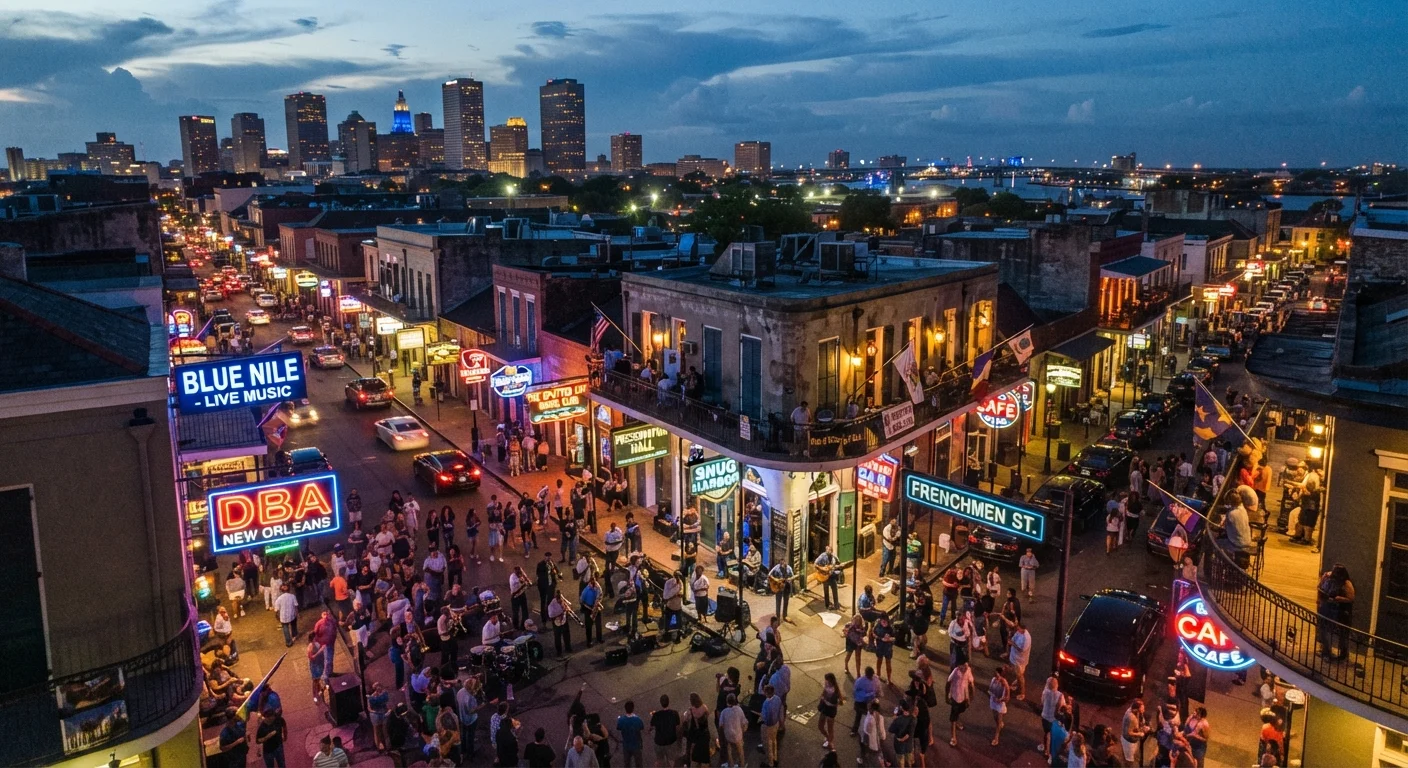
New Orleans is well-known, but its depth is still underestimated. It is arguably the single city most responsible for the variety of American music, having incubated jazz, blues, R&B, and brass band traditions simultaneously. What makes the city exceptional is how those traditions remain living, street-level practices - second-line parades, Mardi Gras Indian performances, and neighborhood brass bands aren't museum pieces; they're ongoing cultural events. This continuity gives New Orleans a musical ecosystem unlike any other in the country.
New Orleans keeps its musical traditions alive as active street-level practices, not museum exhibits.
Muscle Shoals, Alabama
A small town of under 15,000 people, Muscle Shoals produced some of the most emotionally direct recorded music in American history. FAME Studios and the Muscle Shoals Sound Studio attracted artists ranging from Aretha Franklin to the Rolling Stones, all seeking the warm, unhurried groove that local session musicians - the Swampers - seemed to channel effortlessly. The sound they created influenced soul, rock, and country production for decades, a reminder that geography and personnel can matter more than city size. That story connects directly to albums that defined American genres.
Muscle Shoals proved that a small Alabama town could outrecord almost any big-city studio.
Austin, Texas
Austin holds a unique position: it's well enough known to seem obvious, but its scene is genuinely deeper than the "Live Music Capital of the World" branding suggests. Beyond the Sixth Street tourist corridor, Austin has sustained an ecosystem of country, blues, psych rock, and Latin music that resists easy categorization. The city's music infrastructure - hundreds of active venues, a supportive local press, and South by Southwest as a global showcase - makes it one of the few mid-sized cities where full-time careers in music remain structurally possible.
Austin's musical depth goes far beyond its branding, sustaining careers across multiple genres.
Minneapolis, Minnesota
Minneapolis punched so far above its weight in the 1980s that it temporarily became the center of American pop music. The Minneapolis Sound - a funk-influenced, synth-heavy style developed in the city's independent recording scene - produced artists and records that reshaped what pop could sound like. The city's cold-climate isolation reportedly pushed musicians to develop their craft intensively indoors, building a tight-knit creative community that prized originality. That independent spirit has continued to shape the city's hip-hop, punk, and indie scenes in subsequent decades.
Minneapolis's isolation bred an intensely original music scene that briefly led American pop.
Chicago, Illinois
Chicago's role in American music is enormous and still underappreciated in casual conversation. The city's South Side blues scene - electric, amplified, urban - was a direct ancestor of rock and roll. Chicago house music, born in the early 1980s at clubs like the Warehouse, created the foundation for virtually all modern electronic dance genres. And the city's hip-hop scene, particularly the drill movement that emerged in the 2010s, has had a measurable global influence on rap production styles. Chicago keeps reinventing itself musically in ways that reflect the social pressures of its time.
Chicago gave the world electric blues, house music, and drill rap - each revolutionary in its era.
Seattle, Washington
Seattle's grunge explosion in the early 1990s is well-documented, but the city's musical culture runs deeper than one decade. A strong independent label infrastructure, built around Sub Pop Records, helped create a model for artist-friendly music distribution that influenced the industry long after the grunge era faded. Seattle's geographic distance from Los Angeles and New York encouraged a DIY ethos that has sustained waves of indie rock, hip-hop, and electronic music without requiring industry validation to thrive.
Seattle's DIY infrastructure outlasted grunge, quietly sustaining decades of independent music culture.
Why These Scenes Matter
What unites every city on this list is a combination of necessity, community, and creative friction. When artists aren't competing for the same industry spotlight, they tend to experiment more freely. Local venues shape those experiments - a specific room's acoustics, booking philosophy, and regular crowd can push a genre in directions no label executive would have predicted.
Dig Into Local Music Press
If you want to genuinely understand a city's scene, seek out its local music journalism - alt-weeklies, independent blogs, and community radio playlists often surface artists and venues that national outlets ignore for years. City-specific music coverage tends to capture the current pulse far better than broader publications chasing trends.
Genre fluidity plays a role too. Many of these cities became hotbeds precisely because they sat at the intersection of multiple traditions - country leaking into soul, blues bending into rock, electronic rhythms folding into hip-hop. The blurring of genre lines is often most visible in cities where no single sound dominates. Whether you experience these scenes through festivals or intimate clubs, the cultural depth is unmistakable.