

Key Takeaways
- Fixed expenses stay the same each month, making them easy to plan around in a budget.
- Variable expenses change based on usage or behavior, offering real flexibility to cut spending.
- Knowing the split between fixed and variable costs helps you identify where you actually have financial control.
- Most budgets benefit from listing fixed costs first, then allocating what remains to variable categories.
- Some expenses appear fixed but can be renegotiated - such as insurance premiums or subscription plans.
Option A
Fixed Expenses
The predictable, unchanging costs that anchor your budget.
Best for: Building a reliable spending baseline each month, since the amount never changes.
Option B
Variable Expenses
The flexible costs that shift with your habits and circumstances.
Best for: Finding room to trim spending, since these amounts respond to conscious choices.
If you are building your first budget from scratch
Fixed Expenses
Start by listing all fixed expenses first. They form a non-negotiable floor that tells you the minimum monthly income you need to cover obligations.
If you want to find ways to spend less each month
Variable Expenses
Variable costs are where day-to-day choices live. Adjusting dining out, subscriptions, or shopping habits in this category is the fastest path to freeing up cash.
If you experience an unexpected income drop
Variable Expenses
Fixed costs are difficult to reduce quickly, but variable costs can often be trimmed in days. Targeting this category first gives you near-term breathing room.
If you want to evaluate whether your financial obligations are sustainable
Fixed Expenses
Mapping fixed expenses as a share of your take-home income reveals whether your committed costs leave sufficient margin for savings, emergencies, and daily living.
What Makes an Expense 'Fixed' or 'Variable'?
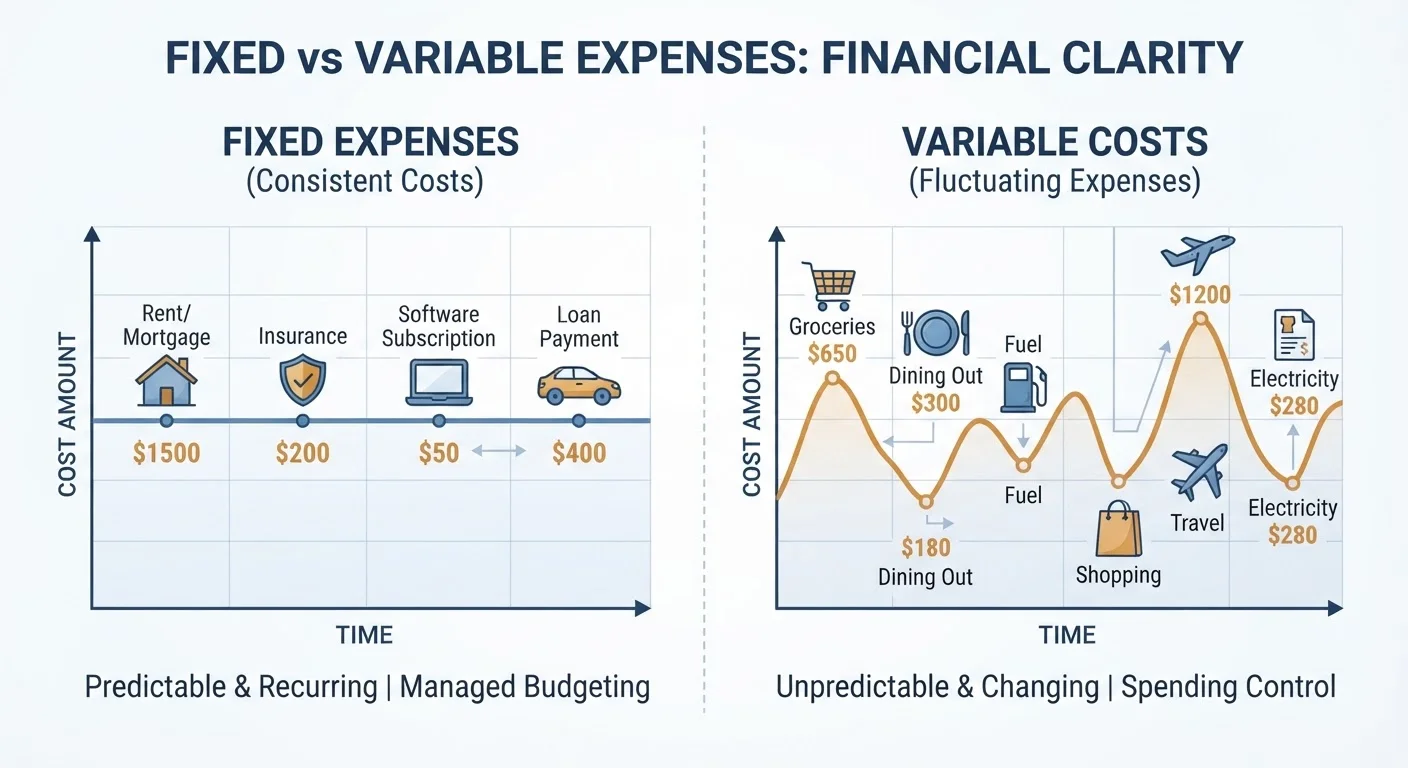
A fixed expense is a cost that stays the same from month to month regardless of how much you use a service or product. Rent or mortgage payments, car loan installments, and fixed-rate insurance premiums are classic examples. You owe the same dollar amount each billing cycle, which makes forecasting straightforward.
A variable expense, by contrast, changes based on your behavior or circumstances. Groceries, gasoline, utilities billed by usage, dining out, and entertainment spending all fall into this camp. The category still exists every month - you will always buy food - but the amount shifts.
Recognizing the difference matters because the two types require completely different budgeting strategies. Fixed costs need to be covered first; variable costs need to be estimated and monitored. For a deeper look at how categorization shapes your view of spending, see how to categorize expenses in a budget.
Side-by-Side Comparison
The table below shows how fixed and variable expenses differ across several practical dimensions. Use it as a reference when organizing your own spending categories.
| Criterion | Fixed Expenses | Variable Expenses |
|---|---|---|
| Amount each month | Stays the same | Changes with behavior or usage |
| Examples | Rent, car loan, insurance premium | Groceries, gas, dining out, utilities |
| Ease of forecasting | Very easy - exact figure known | Requires estimation based on past spending |
| Room to reduce quickly | Low - tied to contracts or terms | High - respond to daily choices |
| Budgeting priority | Cover first, before allocating elsewhere | Allocate from remaining income |
| Renegotiable over time | Sometimes - at renewal or refinance | Yes - adjustable at any time |
One nuance worth noting: some costs feel fixed but are actually negotiable on a longer time horizon. An annual car insurance premium can often be reduced by shopping coverage terms at renewal. A streaming subscription can be paused or canceled. The distinction between truly fixed and quasi-fixed is worth making when you audit your budget.
When 'Fixed' Doesn't Mean Permanent
Fixed expenses are stable month to month, but most can be changed over a longer horizon. A mortgage refinance, an insurance policy review, or canceling an auto-renewing subscription can all reduce costs that once seemed locked in. Schedule a quarterly audit of your fixed expenses to catch opportunities you may be overlooking. Even modest reductions compound meaningfully over a year.
How to Use This Distinction When Building a Budget
The most practical budgeting approach treats fixed and variable costs as two separate layers. Start by listing every fixed expense and totaling them. This is your committed cost floor - the minimum your income must cover before anything else is considered.
Next, subtract that floor from your monthly take-home pay. What remains is available for variable expenses and, critically, for savings. This sequencing prevents a common budgeting error: allocating money to discretionary spending before confirming that fixed obligations are covered.
Within the variable bucket, set a realistic ceiling for each category based on your past spending - tracking your spending first gives you accurate averages to work from. Then monitor those categories weekly so small overruns do not compound into large ones.
~67%
Share of spending that is non-discretionary for average U.S. households
Bureau of Labor Statistics Consumer Expenditure data consistently shows housing, transportation, and food - largely fixed or semi-fixed costs - account for roughly two-thirds of household budgets.
1 in 3
Americans with no monthly budget in place
Surveys by the National Foundation for Credit Counseling have found approximately one-third of U.S. adults do not follow a formal budget, leaving variable spending largely unmonitored.
If you prefer a savings-first approach, the same logic applies: treat your savings contribution as a fixed-like item that comes off the top, then manage variable expenses with what is left. That method is explored in detail in pay-yourself-first vs. traditional budgeting.
A Note on Semi-Variable and Irregular Expenses
Not every expense fits cleanly into either category. Semi-variable expenses - like a utility bill that has a fixed base charge plus a usage component - straddle the line. Budget for them using a conservative estimate drawn from your highest past bills.
Then there are irregular but predictable costs: annual subscriptions, vehicle registration fees, holiday travel, and the like. These are not truly variable in the behavioral sense - they happen on a schedule - but they are easy to forget when building a monthly budget. The solution is to divide the annual total by twelve and set that amount aside each month. Our guide on budgeting for irregular annual expenses walks through this method in full detail.
Mapping your expenses across all three categories - fixed, variable, and irregular - gives you the most complete picture of where your money actually goes each year. That clarity is the starting point for any budget that works under real-life conditions.
This article is for general informational and educational purposes only and does not constitute personalized financial advice. Consider consulting a qualified financial professional regarding decisions specific to your situation.