

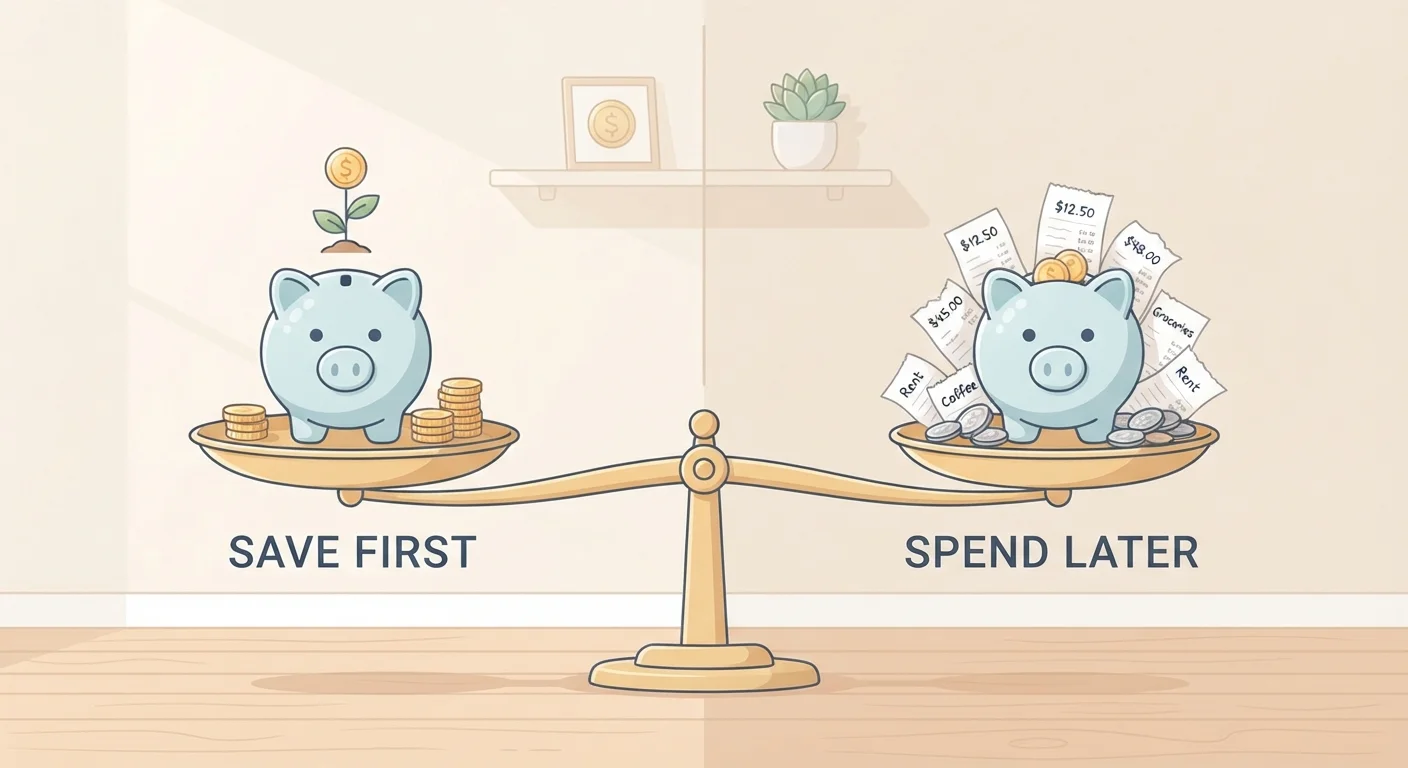
Key Takeaways
- Pay-yourself-first moves savings automatically before any spending decisions are made.
- Traditional budgeting tracks and allocates every expense category in advance, requiring more active management.
- Neither method is universally superior - the right fit depends on your income stability and personal habits.
- Both approaches benefit from using your net (take-home) pay as the starting figure.
- Hybrid strategies combining elements of both methods are a practical middle ground for many households.
Option A
Pay-Yourself-First Budgeting
The savings-priority approach that automates discipline.
Best for: People who struggle to save consistently and want a low-maintenance system that secures savings before discretionary spending begins.
Option B
Traditional Budgeting
The expense-tracking framework built on detailed planning.
Best for: Detail-oriented individuals who want full visibility into every spending category and the flexibility to adjust allocations each month.
If you consistently spend what you have before saving anything
Pay-Yourself-First Budgeting
Automating savings at the start of each pay cycle removes the temptation to spend first. It makes saving the default rather than the afterthought.
If you have irregular income or highly variable expenses
Traditional Budgeting
Category-level planning lets you adjust allocations each month based on what you actually earn and owe, providing the flexibility that a rigid savings-first approach may lack.
If you're new to budgeting and want a simple starting framework
Pay-Yourself-First Budgeting
With fewer decisions to make each month, it's easier to stay consistent. The first-budget walkthrough pairs well with this approach.
If you want detailed insight into where every dollar goes
Traditional Budgeting
Traditional budgeting's category-by-category structure gives you granular control and a clear record of spending patterns over time.
If you're planning for retirement or major life transitions
Traditional Budgeting
Detailed expense planning becomes especially important when income sources shift. Understanding fixed versus variable costs supports more accurate long-range planning.
How Each Method Works
Despite sharing the same end goal - financial stability - pay-yourself-first and traditional budgeting take opposite starting points.
Pay-yourself-first treats savings as a non-negotiable expense paid at the top of every income cycle. Before rent, groceries, or any discretionary spending, a predetermined amount moves into a savings or retirement account - often via automatic transfer. Whatever remains becomes the spending budget. This approach leans on behavioral automation: by making saving involuntary, it sidesteps the willpower problem that trips up many savers.
Traditional budgeting works from the opposite direction. You start with your total take-home income, then assign specific dollar amounts to each spending category - housing, food, transportation, utilities, entertainment - and savings appears as one category among many. This method is detailed by design, giving you a clear map of where every dollar is expected to go. Methods like zero-based budgeting and the envelope system fall within this broader traditional framework. See how they compare in our overview of budgeting frameworks.
A key principle both methods share: always budget from your net income - the amount that actually lands in your account after taxes and deductions. Budgeting from gross income is a common planning error that leads to consistent shortfalls.
| Criterion | Pay-Yourself-First | Traditional Budgeting |
|---|---|---|
| Starting point | Savings moved first | Income allocated by category |
| Level of detail | Low - broad strokes | High - category-by-category |
| Maintenance effort | Low - largely automated | Moderate to high - requires regular review |
| Best income type | Stable, predictable income | Any income type, especially variable |
| Savings protection | Strong - saved before spending | Moderate - savings is one category among many |
| Spending visibility | Limited without supplemental tracking | High - every category mapped |
| Learning curve | Low - simple to start | Moderate - requires setup and ongoing adjustments |
The Case for Pay-Yourself-First
The central strength of pay-yourself-first is its psychological efficiency. By automating savings before you ever see the money in your checking account, you remove the daily decision of whether to save. Research in behavioral economics consistently finds that defaults matter: people are more likely to save when it happens automatically than when it requires active choice each month.
This method works particularly well for people with stable, predictable incomes - salaried employees who receive the same amount each pay period. It's also well-suited to those who find detailed category tracking tedious or stressful. After the savings transfer, the remaining balance functions as a self-limiting spending budget. Overspending on one category might squeeze another, but savings remain protected.
The trade-off is reduced visibility. Because pay-yourself-first doesn't prescribe how remaining funds are spent, it can allow problematic spending habits to persist undetected. If you consistently run out of money before your next paycheck, the method won't tell you which category is the culprit. Pairing it with even basic expense tracking can fill that gap.
~57%
Americans who say they save whatever is left over
Federal Reserve surveys on household economics consistently find that a majority of US adults save opportunistically rather than systematically, underscoring why automation helps.
3-6 months
Recommended emergency fund coverage
Financial planning guidance widely suggests holding three to six months of essential expenses in liquid savings - a target pay-yourself-first is specifically designed to build toward.
The Case for Traditional Budgeting
Traditional budgeting's greatest asset is transparency. When every category has a defined allocation, you can see at a glance whether your spending plan is realistic and where adjustments are needed. This level of detail is especially valuable when managing fixed and variable expenses that shift from month to month - utility bills, medical costs, irregular subscriptions.
For households with variable income - freelancers, hourly workers, or anyone with fluctuating pay - traditional budgeting offers essential flexibility. You can recalibrate allocations each month based on actual earnings rather than working from a fixed savings-first formula that may not hold during lean periods.
The challenge is the maintenance it demands. Category-level budgeting requires regular reviews, honest record-keeping, and the discipline to reallocate rather than simply overspend. Many people start with enthusiasm but abandon the process within a few months. Evidence-informed habits - like weekly 10-minute check-ins and consistent labeling - significantly improve long-term consistency.
A Note on Savings Rate Targets
Neither method prescribes a specific savings percentage, and no universal target fits every household. Common guidelines - such as saving 10-20% of net income - are useful starting benchmarks, but your optimal rate depends on your income, debt load, expenses, and goals. Start with a rate you can sustain and adjust upward over time. A licensed financial adviser can help you establish a target suited to your situation.
Choosing the Right Approach for You
The most effective budgeting method is the one you'll actually maintain. Both approaches have a strong track record when applied consistently, and many people find that a hybrid works best: automate a savings transfer first (pay-yourself-first logic), then track remaining spending by category (traditional logic).
Consider your income pattern, your appetite for detail, and where your money tends to slip away. If you're building your first structured spending plan, the five-step first-budget guide provides a practical foundation regardless of which philosophy you lean toward. Once your savings habit is established, the next step is understanding how to grow what you've set aside - our investing fundamentals hub is a good place to start exploring those options.
This article is for general informational and educational purposes only. It does not constitute personalized financial, tax, or investment advice. Consult a qualified financial professional before making decisions based on your individual circumstances.