

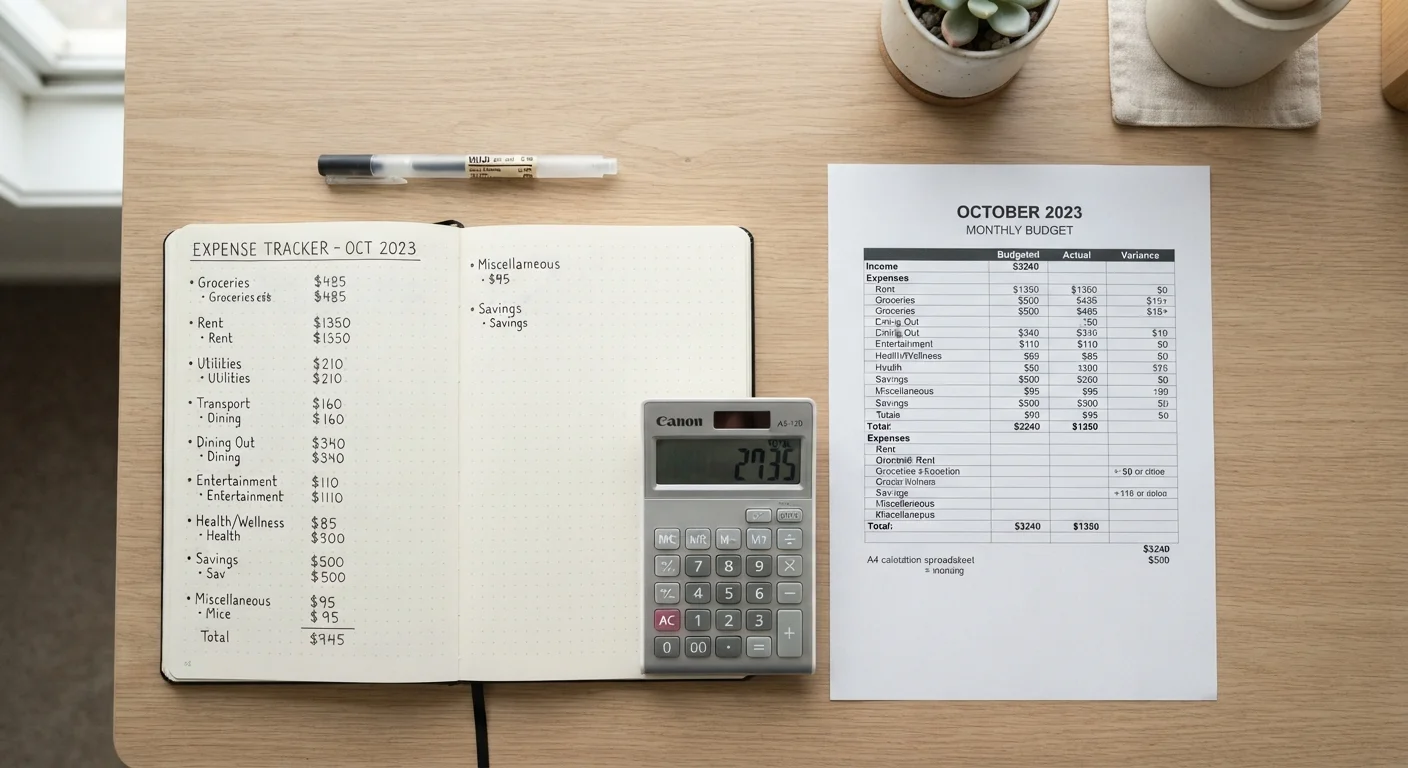
Key Takeaways
- Expense tracking is descriptive - it records what already happened with your money.
- Budgeting is prescriptive - it sets rules for how money will be spent before it leaves your account.
- Most people benefit from tracking first, then using that data to build a realistic budget.
- Both tools address the same goal: giving you control over your financial life.
- Neither tool alone is sufficient; they reinforce each other over time.
Option A
Expense Tracking
The diagnostic tool - revealing where your money actually goes.
Best for: Anyone who wants to understand current spending patterns before making any financial plans.
Option B
Budgeting
The blueprint - directing where your money should go going forward.
Best for: People ready to set intentional spending limits and work toward specific financial goals.
If you have no idea where your paycheck disappears each month
Expense Tracking
You need real data before you can set realistic spending limits. Tracking for 30-60 days reveals patterns that guesswork cannot.
If you already know your spending habits and want to change them
Budgeting
A budget gives your money a job before you spend it, making intentional trade-offs possible rather than reactive ones.
If you're working toward a specific financial goal like paying off debt or building an emergency fund
Budgeting
Goal-directed budgeting lets you carve out deliberate allocations each month, keeping progress visible and consistent.
If your budget keeps failing or feeling unrealistic
Expense Tracking
Returning to tracking often reveals that budget categories were set based on aspiration, not actual behavior - fixing that starts with data.
What Each Tool Actually Does
Expense tracking and budgeting are frequently used interchangeably, but they do fundamentally different things. Confusing them is one reason many people struggle to get traction with either.
Expense tracking is backward-looking. You record transactions after they happen - every coffee, grocery run, and subscription charge - and then review what that data shows. The output is a clear picture of actual behavior. It answers the question: Where did my money go?
Budgeting is forward-looking. You decide in advance how much to allocate to each spending category for an upcoming period, typically a month. The output is a spending plan you compare reality against. It answers the question: Where should my money go?
Because one looks backward and the other looks forward, they work best as a sequence, not substitutes. Tracking generates the evidence; budgeting applies a framework to it. If you want to understand how a budget fits into a broader financial strategy, see how a budget differs from a financial plan.
| Criterion | Expense Tracking | Budgeting |
|---|---|---|
| Time orientation | Backward-looking (past) | Forward-looking (future) |
| Primary question answered | Where did money go? | Where should money go? |
| Setup effort | Low - just record transactions | Moderate - requires income and category planning |
| Best starting point | Complete beginners | Those with some spending awareness |
| Ongoing maintenance | Daily or weekly logging | Monthly review and adjustment |
| Behavioral impact | Raises awareness of habits | Actively redirects habits |
| Goal-setting capability | Indirect - reveals room for saving | Direct - allocates money toward goals |
How Expense Tracking Works in Practice
At its most basic, tracking means capturing every dollar spent and grouping those transactions into categories - groceries, transportation, dining out, utilities, and so on. You can do this in a notebook, a spreadsheet, or a dedicated app.
The value isn't in the act of recording; it's in the review. After two to four weeks, patterns emerge that most people find surprising. Subscriptions that were forgotten. Dining expenses that dwarf the grocery bill. Irregular costs - car repairs, annual fees, gifts - that blow up an otherwise stable month.
This data becomes the raw material for realistic budgeting. Without it, people tend to underestimate variable spending by wide margins. For a deeper look at how apps can automate this process - and the trade-offs involved - explore the pros and cons of budgeting apps.
~33%
Americans who track spending regularly
Surveys by the National Foundation for Credit Counseling have consistently found that a minority of adults actively monitor their day-to-day spending.
20%+
Typical underestimate of discretionary spending
Research in behavioral economics suggests people routinely underestimate variable spending categories like dining and entertainment by significant margins.
How Budgeting Translates Data Into a Plan
Once you have a realistic picture of your spending, a budget lets you make deliberate choices about it. Rather than watching money disappear reactively, you assign every dollar a purpose before the month begins.
A budget typically starts with your take-home income and then allocates amounts to fixed expenses (rent, loan payments), variable necessities (groceries, gas), discretionary spending (entertainment, dining), and savings or debt repayment. The categories you use matter - broad buckets are easier to maintain but hide detail; granular tracking surfaces more insight but demands more upkeep. Learn practical ways to categorize expenses to find the balance that works for you.
Understanding which of your costs are fixed and which fluctuate is especially important at this stage. Fixed vs. variable expenses each require different budgeting strategies, and conflating them leads to plans that crumble under normal monthly variation.
If you've never built a budget before, a structured walkthrough can help. Your first budget in five steps offers a straightforward process for turning income and expense data into a workable monthly plan.
Budgeting Methods Vary - And That's Okay
There is no single correct budgeting structure. Common frameworks include percentage-based allocation (such as dividing income into broad spending, saving, and giving buckets) and zero-based budgeting (where every dollar is assigned a category until income minus allocations equals zero). Some people prefer saving first and spending what remains - a philosophy sometimes called paying yourself first. Compare pay-yourself-first and traditional budgeting to see which approach fits your habits. The best method is whichever one you can maintain consistently.
Which Tool to Start With - and When to Use Both
The most common recommendation from financial educators is to track first, then budget. Spending data removes the guesswork from category limits, making a budget more likely to hold up under real-life conditions.
That said, some people benefit from starting with a loose budget immediately - particularly if spending is clearly out of control in one area and waiting for a full month of data would mean more harm than good. In that case, set conservative estimates and adjust as actual figures come in.
Over time, the two tools create a feedback loop: your budget sets the targets; your tracking tells you whether you hit them. If the gap between plan and reality is consistently large, that's a signal to revisit either the category limits or the underlying habits driving the variance.
For households managing shared costs, the same dynamic applies - tracking shared expenses before negotiating a household budget prevents assumptions from derailing the plan. Shared expense tracking for roommates and households covers approaches that work in multi-person living situations.
This article is for general informational and educational purposes only. It does not constitute personalized financial advice. For guidance specific to your financial situation, consult a qualified financial professional.