

Key Takeaways
- Spreadsheets give you complete control over structure but require manual data entry and maintenance.
- Budgeting apps automate transaction tracking but may introduce privacy trade-offs and categorization errors.
- Your best tool depends on your comfort with technology, desire for customization, and consistency habits.
- Neither method guarantees financial success - consistent use matters more than which tool you pick.
Our Verdict
Spreadsheets suit detail-oriented users who want full customization and are willing to invest time in manual upkeep. Budgeting apps work better for people who need automation to stay consistent and don't mind linking financial accounts. The right choice isn't universal - it's the one you'll actually use regularly.
| Best for | Recommended |
|---|---|
| Those who want granular control and custom formulas | Spreadsheet budgeting |
| Those who prefer automation and mobile convenience | App-based budgeting |
| Privacy-conscious users uncomfortable linking bank accounts | Spreadsheet budgeting |
| Beginners who need structure and guided category setup | App-based budgeting |
What Each Approach Actually Involves
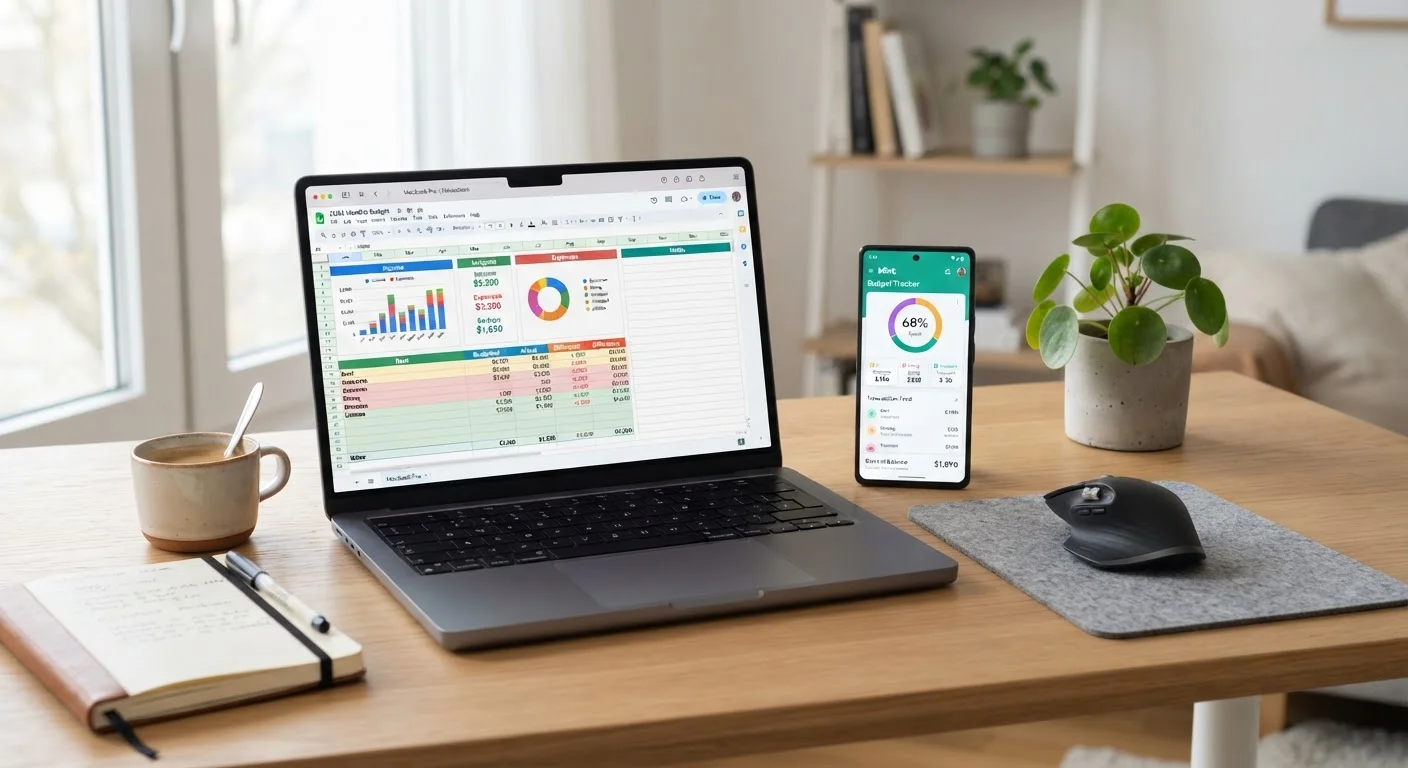
Spreadsheet budgeting means building and maintaining your own budget inside a program like Google Sheets or Microsoft Excel. You set up income and expense categories, enter transactions manually or in batches, and use formulas to calculate totals and variances. The result is a fully customized financial document you control entirely.
App-based budgeting relies on dedicated software - typically connected to your bank and credit card accounts - to pull in transactions automatically. The app categorizes spending, tracks progress toward limits, and often sends alerts when you're approaching a cap. The experience is designed for low-friction, ongoing monitoring rather than deep customization.
For a broader view of how these fit into different budgeting philosophies, see budgeting frameworks compared.
| Criterion | Spreadsheet Budgeting | App-Based Budgeting | |
|---|---|---|---|
| Setup effort | High - build from scratch | Low - guided onboarding | |
| Ongoing maintenance | Manual entry required | Mostly automated | |
| Customization | Unlimited flexibility | Limited to app features | |
| Data privacy | Stays on your device | Shared with third-party servers | |
| Real-time tracking | Only if updated manually | Near real-time via bank sync | |
| Cost | Free or low-cost tools | Often subscription-based | |
| Best for beginners | Steeper learning curve | More beginner-friendly |
Where Spreadsheets Have the Edge
The strongest argument for spreadsheets is flexibility. You can model any scenario - irregular income, variable expenses, multi-account tracking - without being constrained by a developer's design choices. Want to track spending by paycheck rather than calendar month? You can build exactly that.
Spreadsheets also keep your financial data entirely under your control. No third-party server stores your account numbers or transaction history. For people who are uncomfortable linking bank credentials to an external service, this matters significantly. Budgeting apps come with real privacy trade-offs worth weighing before connecting accounts.
Finally, the act of manually entering transactions can itself be a useful habit. Many personal finance researchers suggest that intentional, deliberate review of spending - rather than passive monitoring - encourages more mindful financial decisions.
Try a Hybrid Approach
Some people find the most success by using an app for daily transaction awareness and a spreadsheet for monthly planning and scenario modeling. The app keeps you honest day-to-day; the spreadsheet lets you think strategically about upcoming expenses or savings goals. You don't have to choose exclusively one method if both serve distinct purposes in your routine.
Where Apps Have the Edge
The primary advantage of budgeting apps is automation. Transactions import in near real-time, which means you always have an up-to-date picture of where you stand without carving out time to enter data. For people with busy schedules or inconsistent habits, this reduces the friction that causes most budgets to fail.
Apps also excel at alerts and visualizations. Knowing you've spent 80% of your dining budget by the 15th of the month - with a push notification rather than a manual check - creates a more immediate feedback loop. This kind of timely nudge is difficult to replicate with a spreadsheet you open weekly.
Beginners often find apps easier to start with because they offer pre-built category structures and onboarding flows. Rather than staring at a blank spreadsheet, a new budgeter gets guided setup. That said, it's worth understanding the difference between tracking spending and building a budget - apps are stronger at the former.
Key Trade-Offs to Weigh
Neither method is without drawbacks. Spreadsheets demand time and discipline. If you skip data entry for two weeks, your budget becomes unreliable - and rebuilding accurate records from bank statements is tedious. The tool is only as good as the attention you give it.
Apps, meanwhile, frequently miscategorize transactions - a hardware store purchase might show up under "Entertainment" depending on the merchant code. If you don't audit these regularly, your category totals can mislead you. There are also subscription costs with many apps, and the ongoing risk that a service changes terms, raises prices, or shuts down.
Both approaches also sit within a broader behavioral context. Building consistent budgeting habits matters more than which tool you choose. A beautifully designed app you check twice a month will underperform a simple spreadsheet you review every Sunday evening.
If you prefer a tactile, category-based method rather than either digital approach, the envelope budgeting system offers a third path worth exploring.
~33%
Americans who follow a formal budget
Gallup survey data has consistently found that fewer than half of US adults maintain a detailed household budget, highlighting the challenge of sustaining any budgeting method.
60%+
Budget app users who lapse within 3 months
Research on habit formation in personal finance suggests that a majority of new app adopters disengage within the first quarter, underscoring the importance of behavioral consistency over tool selection.
This article is for general informational purposes only and does not constitute personalized financial advice. For guidance specific to your situation, consider consulting a qualified financial professional.