

Key Takeaways
- A budget controls monthly cash flow; a financial plan sets direction for years or decades ahead.
- Budgets are tactical and recurring; financial plans are strategic and periodically reviewed.
- Both tools are complementary - a budget funds the goals outlined in a financial plan.
- You can start budgeting immediately; a financial plan often benefits from professional guidance.
- Neither tool guarantees outcomes, but using both together improves your financial decision-making.
Option A
A Budget
The short-term cash flow controller.
Best for: Anyone who wants to manage monthly income and expenses, avoid overspending, and stay on top of day-to-day financial decisions.
Option B
A Financial Plan
The long-term roadmap for your money.
Best for: Anyone building toward major life goals - retirement, homeownership, education funding - and who needs a structured strategy to get there.
If you want to stop overspending this month
A Budget
A budget gives you immediate, concrete limits for each spending category, helping you redirect cash flow in real time.
If you're planning for retirement or a major life milestone
A Financial Plan
A financial plan maps out the savings rates, investment strategies, and timelines needed to reach long-horizon goals - territory a monthly budget alone can't cover.
If you're just starting out and feel overwhelmed
A Budget
Budgeting builds foundational money habits and creates the cash surplus that eventually funds a broader financial plan.
If you have a budget but feel financially directionless
A Financial Plan
A financial plan connects your daily spending decisions to meaningful long-term goals, giving your budget a clear purpose.
What Each Tool Actually Does
The terms budget and financial plan are often used interchangeably, but they operate at very different levels. Confusing them can leave you managing the present well while drifting financially into the future - or dreaming about the future while struggling month to month.
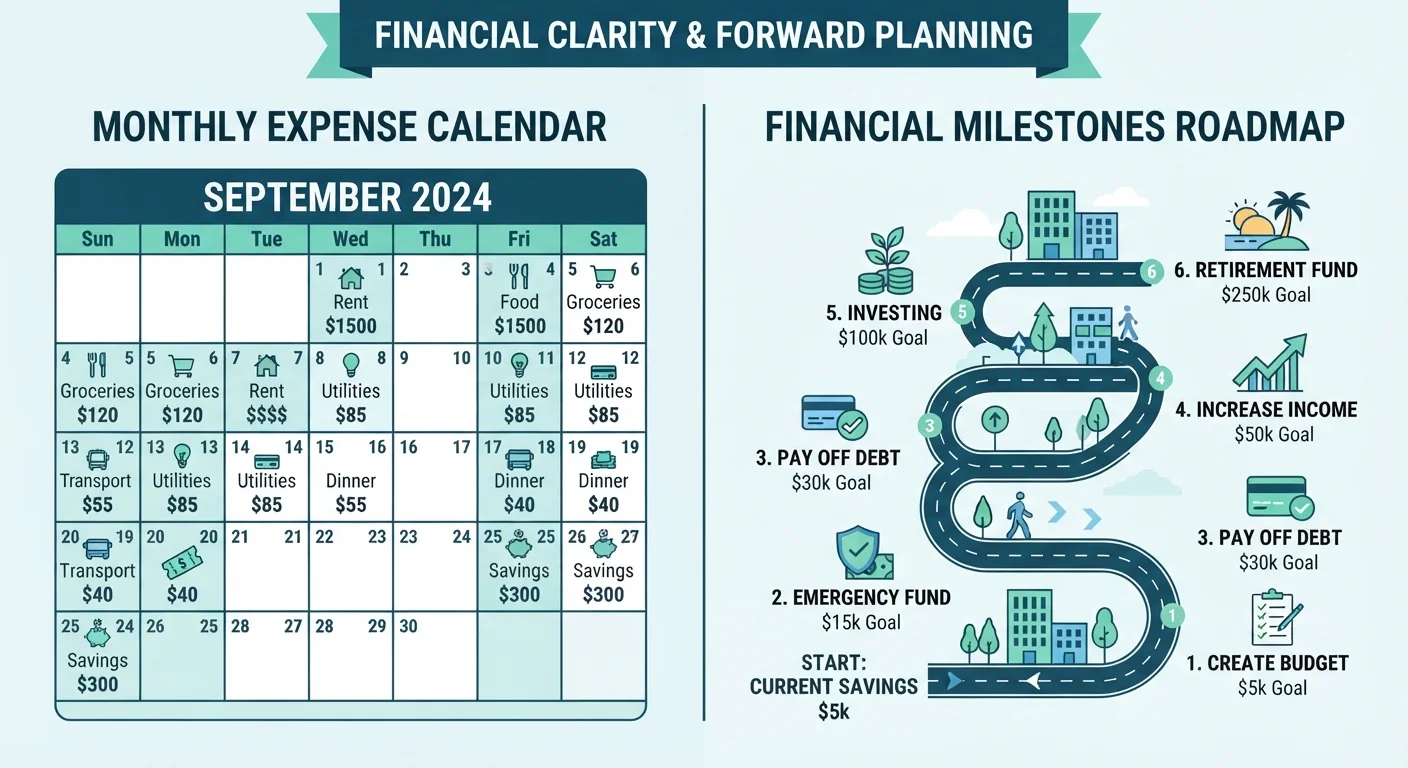
A budget is a short-term spending framework, typically covering one month at a time. It allocates your expected income across categories - housing, food, transportation, savings contributions - so that outflows don't exceed inflows. Think of it as a recurring operational tool. Understanding which costs are fixed versus flexible is a useful first step; see why fixed and variable expenses matter for your budget for a closer look.
A financial plan is a long-term strategic document. It typically covers three to twenty or more years and addresses goals like retirement savings, paying off debt, building an emergency fund, purchasing a home, or funding education. Where a budget asks "Where does my money go this month?", a financial plan asks "Where does my money need to take me over the next decade?"
| Criterion | A Budget | A Financial Plan |
|---|---|---|
| Time horizon | Monthly (short-term) | Years to decades (long-term) |
| Primary question | Where does money go this month? | Where does money need to take me? |
| Review frequency | Weekly or monthly | Annually or after major life events |
| Scope | Income, expenses, savings contributions | Goals, investments, insurance, taxes, debt |
| Who creates it | Anyone, independently | Often with a licensed financial adviser |
| Starting point | Immediate - begin this month | After baseline financial habits are in place |
How They Differ in Practice
The most useful way to understand the difference is by looking at how each tool is built and maintained.
A budget is recurring and tactical. You create or revise it each month based on that period's income and expected expenses. It requires regular attention - weekly check-ins are common - and responds quickly to life changes like a pay raise or an unexpected bill. Various budgeting frameworks (zero-based, 50/30/20, envelope method) each offer a different structure for organizing these monthly decisions. Compare popular budgeting frameworks to find one that fits your habits.
A financial plan is strategic and periodically reviewed. It's typically created once - often with the help of a licensed financial adviser - and revisited every one to three years or after major life events such as marriage, a job change, or the birth of a child. It incorporates projections, risk tolerance, insurance needs, and tax considerations that are simply outside a monthly budget's scope.
Financial Plans Are Not One-Size-Fits-All
A financial plan's components vary significantly depending on age, income, family situation, and goals. A 25-year-old with student debt has very different planning priorities than a 50-year-old approaching retirement. This is one reason professional guidance adds particular value when building a plan - a licensed financial planner can tailor the strategy to your specific circumstances and help you account for factors like inflation, tax efficiency, and risk tolerance.
It's also worth distinguishing budgeting from basic expense tracking. Tracking spending tells you where money went; budgeting tells you where it should go - both are useful, but they serve different moments in your financial practice.
Why You Need Both - and How They Connect
A budget and a financial plan are most powerful when used together. Think of the financial plan as the destination and the budget as the vehicle that moves you there each month.
Your financial plan might identify that you need to save a specific percentage of income annually toward retirement. Your monthly budget is where you carve out that savings line item and protect it from being crowded out by discretionary spending. Without a budget, even a well-crafted financial plan goes unfunded. Without a financial plan, even a disciplined budget has no larger purpose.
~33%
US adults with a written financial plan
According to research from Schwab's Modern Wealth Survey, only about one in three Americans has a documented long-term financial plan.
74%
Planners who feel financially stable
The same Schwab survey found that people with written financial plans were significantly more likely to report feeling financially stable compared to those without one.
If you're earlier in your financial journey - perhaps navigating college finances or an entry-level income - budgeting is often the right starting point. Budgeting as a college student involves unique challenges, but the underlying logic is the same: manage cash flow now so you can build toward something larger later. As income grows and goals become clearer, layering in a formal financial plan - and eventually exploring foundational investing concepts - becomes increasingly valuable.
For personal financial planning, consider consulting a licensed financial adviser or certified financial planner (CFP) who can account for your specific circumstances. This article provides general financial education and is not a substitute for personalized professional advice.
This article is for informational purposes only and does not constitute personalized financial, investment, tax, or legal advice. Consult a qualified financial professional before making decisions based on your individual situation.