

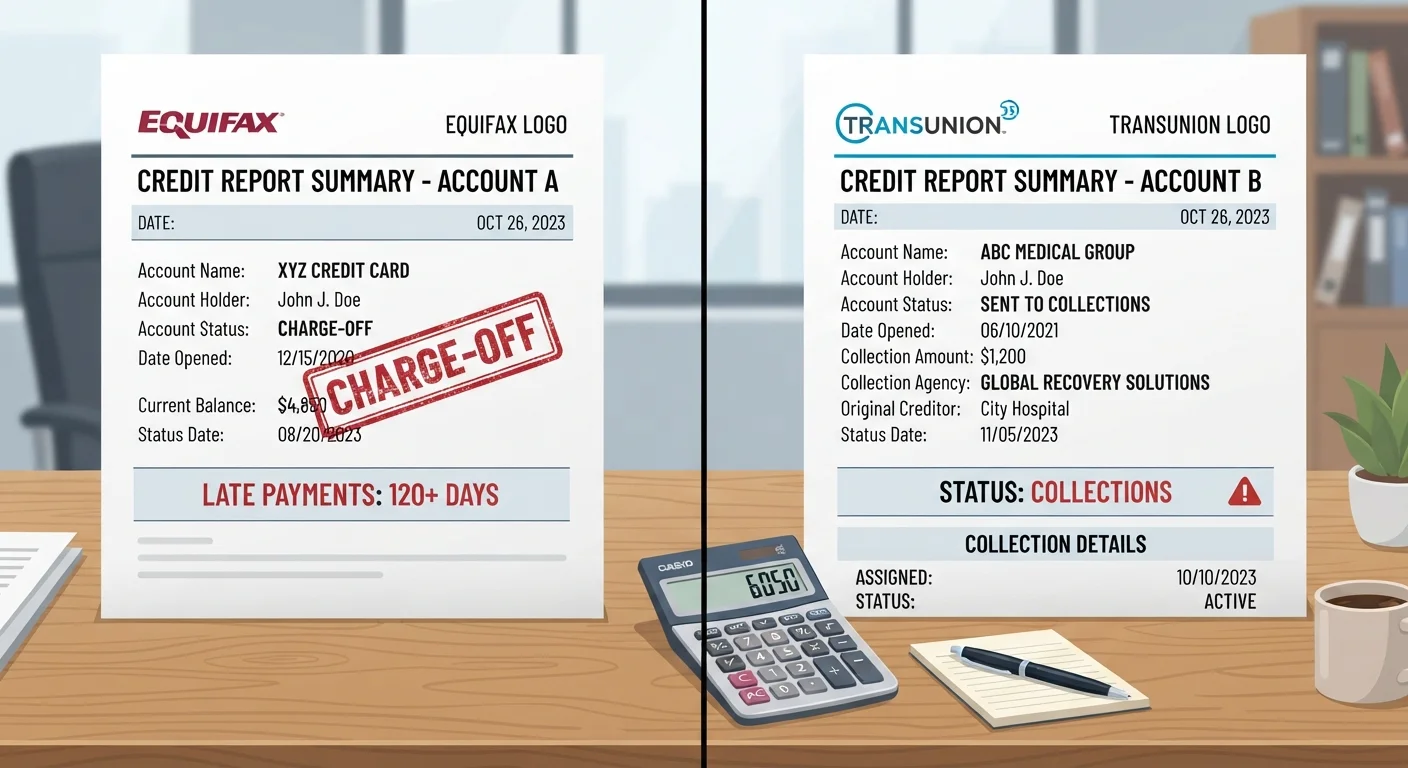
Key Takeaways
- A charge-off is a creditor's internal accounting decision; the debt itself does not disappear.
- A collections account appears when a debt is sold or assigned to a third-party collector.
- Both entries can appear on the same credit report for the same debt, compounding the damage.
- Each negative entry generally remains on a credit report for up to seven years from the original delinquency date.
- Paying or settling either type of debt does not automatically remove the entry from your credit report.
- Consulting a nonprofit credit counselor or financial professional can help you navigate both situations.
Option A
Charge-Off
The lender's internal declaration of a debt as a loss.
Best for: Understanding what happens when a creditor writes off a severely delinquent account on their own books.
Option B
Collections Account
The active pursuit of an unpaid debt by a third party.
Best for: Understanding what happens when an unpaid debt is transferred or sold to a debt collector for recovery.
If you just received a charge-off notice from your original creditor
Charge-Off
Focus first on understanding that the debt is still legally owed and contact your original creditor about resolution options before the account is sold.
If a debt collector has started contacting you about an old account
Collections Account
You are likely dealing with a collections account; verify the debt in writing and understand your rights under the Fair Debt Collection Practices Act before taking action.
If you are rebuilding credit after multiple derogatory marks
Charge-Off
Resolving the original charge-off with the creditor - before it moves to collections - may limit the number of negative entries appearing on your report.
What Is a Charge-Off?
A charge-off occurs when a creditor - typically a credit card issuer, lender, or bank - concludes that a delinquent account is unlikely to be repaid and writes the balance off as a loss on their financial records. This generally happens after an account has gone unpaid for 120 to 180 days, depending on the type of credit and the creditor's internal policies.
It is critical to understand what a charge-off does not mean: it does not erase the debt. The creditor simply reclassifies the account for accounting purposes. The borrower still legally owes the balance, and the creditor retains the right to pursue collection - or to sell the debt to another party.
On your credit report, a charge-off appears as a derogatory mark under the original account. It signals to future lenders that you failed to repay the debt as agreed, which can meaningfully lower your credit scores. For more on how these terms appear on your report, see the difference between a credit score and a credit report.
| Criterion | Charge-Off | Collections Account |
|---|---|---|
| Who creates the entry | Original creditor | Third-party debt collector |
| When it typically occurs | 120-180 days past due | After charge-off or creditor referral |
| Does the debt disappear? | No - still legally owed | No - ownership transferred |
| Credit report impact | Derogatory mark on original account | Separate derogatory entry added |
| Reporting duration | Up to 7 years from delinquency | Up to 7 years from delinquency |
| Effect of payment | Status updated; entry may remain | Collection activity stops; entry may remain |
What Is a Collections Account?
A collections account is created when a creditor transfers or sells an unpaid debt to a third-party debt collection agency - or when an in-house collections department takes over the account. This step often follows a charge-off, but it can also occur independently, for example with unpaid medical bills or utility accounts.
Once an account enters collections, the collector's primary goal is recovering the outstanding balance. They may contact you by phone, mail, or other permitted means. Under the FDCPA, you have legal rights in how collectors may communicate with you, and you may request debt verification in writing.
Crucially, a collections entry often appears as a separate line item on your credit report, distinct from the original charged-off account. This means a single unpaid debt can generate two derogatory marks - the charge-off from the original creditor and the collections entry from the collector. How a collections account affects your credit explores this impact in greater detail.
One Debt Can Produce Two Entries
When a charged-off account is sold to a collections agency, both the original creditor's charge-off entry and the collector's new collections entry can appear on your credit report simultaneously. This is legal under credit reporting rules, but it can make a single unpaid debt look like two separate problems to future lenders. Always request a free copy of your credit report from AnnualCreditReport.com to see exactly what is listed and from whom.
How They Compare - and Why It Matters
While charge-offs and collections often travel together, they are distinct credit events with separate timelines and consequences. Both generally remain on a credit report for seven years from the original delinquency date - not from the date the account was charged off or sent to collections. This is an important distinction: the clock does not reset when a debt changes hands.
Paying or settling a charged-off account or a collections account is generally beneficial - it stops additional collection activity and demonstrates resolution - but it does not guarantee removal of the entry from your report. Some collectors may agree to a "pay for delete" arrangement, but this is not required by law and is not universally offered.
7 years
How long derogatory marks typically remain on credit reports
Under the Fair Credit Reporting Act (FCRA), most negative items including charge-offs and collections may be reported for up to seven years from the date of first delinquency.
120-180 days
Typical delinquency period before a charge-off
Most creditors follow regulatory guidance suggesting accounts are charged off after 120 to 180 days of non-payment, though exact timelines vary by creditor type.
If you are managing multiple derogatory marks alongside other credit challenges, reviewing your full credit picture - including the key credit terms every consumer should recognize - can help you prioritise next steps. In severe cases, understanding more serious options like bankruptcy and its credit implications may also be relevant.
This article is for general informational and educational purposes only and does not constitute personalised financial, legal, or credit advice. Consult a qualified financial professional or nonprofit credit counselor for guidance specific to your situation.