

| Score Range | 300 - 850 (FICO scoring model) |
| Payment History Weight | 35% (myFICO.com) |
| Amounts Owed Weight | 30% (myFICO.com) |
| Length of Credit History Weight | 15% (myFICO.com) |
| Credit Mix Weight | 10% (myFICO.com) |
| New Credit / Inquiries Weight | 10% (myFICO.com) |
| Hard Inquiry Impact Duration | Up to 2 years on report; score effect typically fades in months (Consumer Financial Protection Bureau) |
| Negative Mark Reporting Period | Up to 7 years (bankruptcies up to 10 years) (Fair Credit Reporting Act (FCRA)) |
What Is a FICO Score and Why Do the Five Factors Matter?
A FICO score is a three-digit number, typically ranging from 300 to 850, that lenders use to gauge how likely you are to repay debt. It is calculated using a specific formula built on five weighted factors drawn from your credit reports. Understanding those factors gives you a concrete roadmap for improvement - rather than treating your score as a mysterious number that changes without explanation.
For a broader foundation, see what your credit score actually measures before diving into the factor breakdown below.
| Score Range | 300 - 850 (FICO scoring model) |
| Payment History Weight | 35% (myFICO.com) |
| Amounts Owed Weight | 30% (myFICO.com) |
| Length of Credit History Weight | 15% (myFICO.com) |
| Credit Mix Weight | 10% (myFICO.com) |
| New Credit / Inquiries Weight | 10% (myFICO.com) |
| Hard Inquiry Impact Duration | Up to 2 years on report; score effect typically fades in months (Consumer Financial Protection Bureau) |
| Negative Mark Reporting Period | Up to 7 years (bankruptcies up to 10 years) (Fair Credit Reporting Act (FCRA)) |
The Five Factors, Ranked by Weight
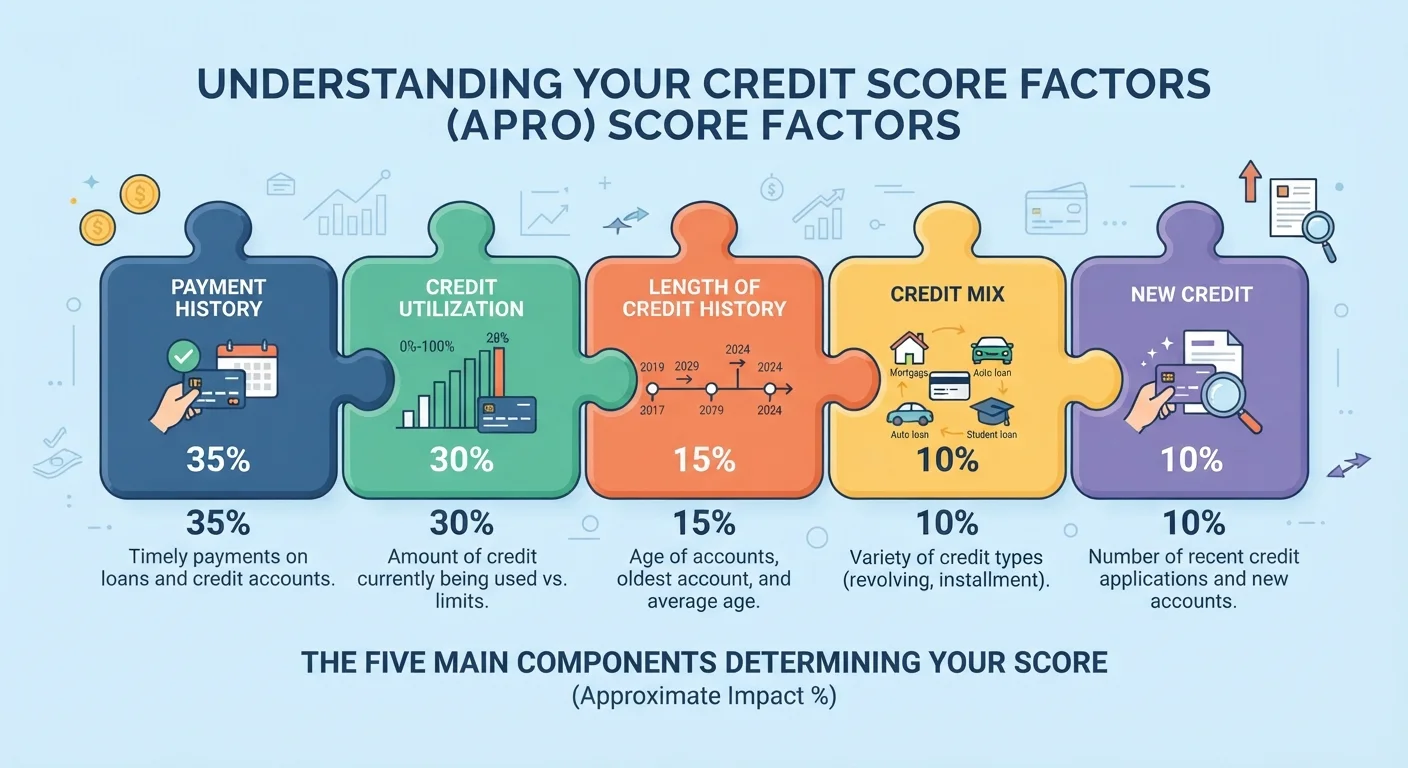
FICO publicly discloses the approximate weight each factor carries. Here they are, from most to least influential:
- Payment History (35%) - The single largest factor. Every on-time payment reinforces a positive pattern; missed or late payments - especially those 30+ days past due - can cause significant score drops. Negative marks from collections, bankruptcies, or foreclosures fall here too.
- Amounts Owed / Credit Utilization (30%) - How much of your available revolving credit you are currently using. A lower ratio generally signals lower risk. Carrying high balances relative to your credit limits can drag down your score even if you pay on time. Credit utilization deserves its own deep read because small changes in this ratio can move your score quickly.
- Length of Credit History (15%) - Longer, older accounts generally help your score. FICO considers the age of your oldest account, your newest account, and the average age of all accounts. Closing an old card or opening several new ones can lower this average. See how account age is calculated for a fuller explanation.
- Credit Mix (10%) - Lenders like to see that you can manage different types of credit responsibly - revolving accounts like credit cards alongside installment loans such as auto loans or mortgages. You do not need every type, but having some variety can help.
- New Credit / Hard Inquiries (10%) - Applying for new credit triggers a hard inquiry, which can temporarily lower your score by a few points. Multiple applications in a short window can compound the effect, though rate-shopping for mortgages or auto loans within a focused period is typically treated as a single inquiry by scoring models.
Credit Utilization Ratio
The percentage of your total available revolving credit that you are currently using. For example, a $2,000 balance on a $10,000 limit equals 20% utilization. Lower ratios generally benefit your score.
Hard Inquiry
A review of your credit report triggered by a formal application for new credit, such as a credit card or loan. Hard inquiries can cause a small, temporary dip in your score, unlike soft inquiries, which do not affect it.
Revolving Credit
A type of credit account with a variable balance and a set limit that you can borrow against repeatedly, such as a credit card or home equity line of credit.
Installment Loan
A loan repaid in fixed, scheduled payments over a set term - such as a mortgage, auto loan, or personal loan. Installment loans are distinct from revolving credit accounts.
Credit Mix
The variety of credit account types appearing on your credit report, including both revolving and installment accounts. Having a diverse mix can positively influence your FICO score.
How the Factors Interact - and What to Prioritize
The five factors do not operate in isolation. Your utilization ratio (Factor 2) is calculated from data reported by your lenders, which flows through the three major credit bureaus. Because each bureau maintains its own records, your FICO score can vary slightly depending on which bureau's data a lender pulls. Learn why your reports may differ across bureaus to understand this dynamic.
For most people, the clearest path to score improvement follows this priority order:
- Eliminate any pattern of late or missed payments - even one 30-day late mark can remain on your report for up to seven years.
- Reduce revolving balances to bring utilization below 30%, and ideally below 10%, before major credit applications.
- Avoid closing your oldest accounts unnecessarily, as doing so shortens your average credit age.
- Space out new credit applications rather than opening several accounts at once.
For a complete, start-to-finish guide on building and protecting your credit, the full credit score picture from first card to mortgage covers every stage in detail.
Your Score Can Vary by Bureau
FICO scores are calculated from data held by each of the three major credit bureaus - Equifax, Experian, and TransUnion - and lenders don't all report to every bureau. That means your FICO score may differ depending on which bureau's file a lender checks. Reviewing all three of your credit reports regularly can help you catch discrepancies or errors that may be affecting your scores.
This article is for general informational and educational purposes only. It does not constitute personalized financial or credit advice. For guidance specific to your situation, consider consulting a qualified financial adviser or nonprofit credit counselor.