

Key Takeaways
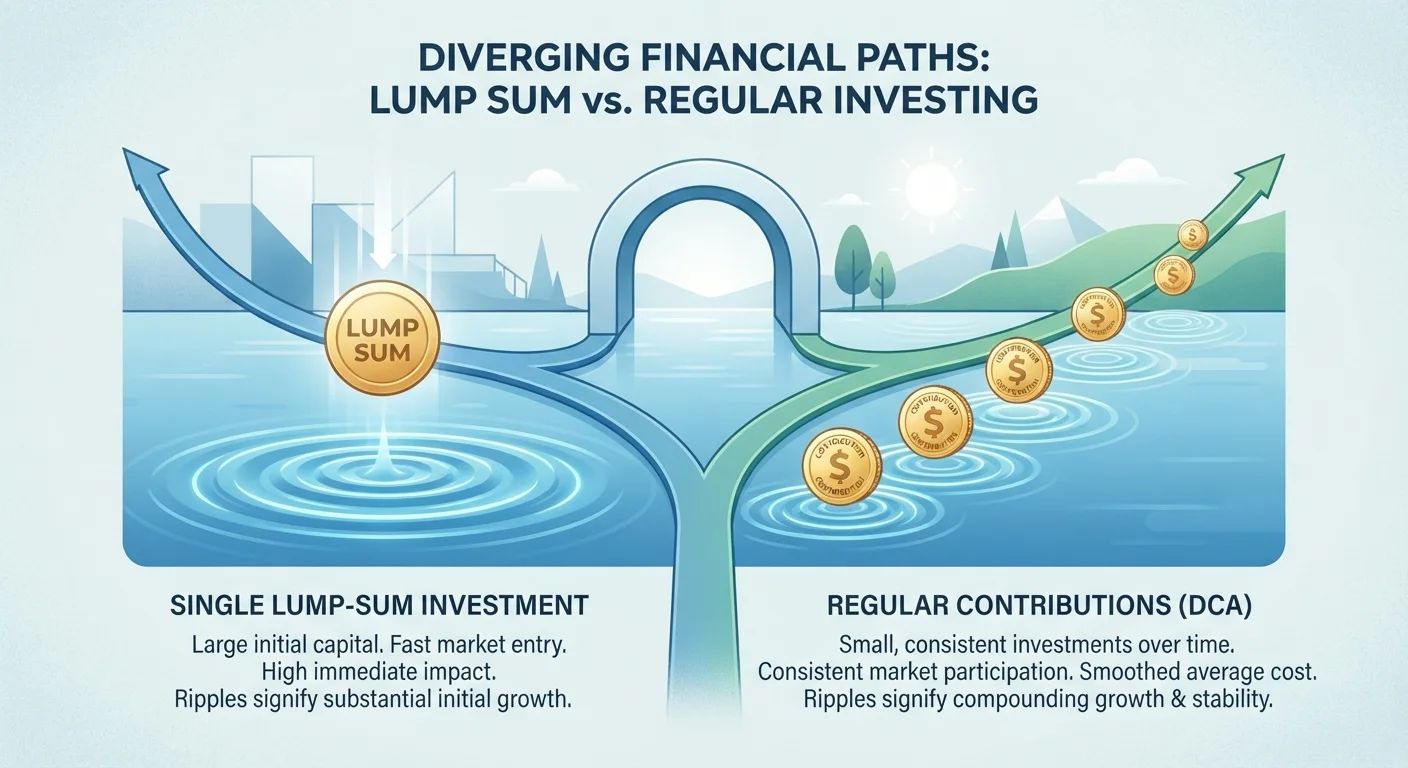
- Lump-sum investing deploys all available capital immediately, maximizing exposure to potential market growth.
- Dollar-cost averaging (DCA) spreads contributions over time, reducing the risk of investing everything at a market peak.
- Historical data generally favors lump-sum investing for long-term returns, but DCA can be psychologically easier to sustain.
- Your choice may depend less on strategy and more on what capital you actually have available right now.
- Both approaches are far more valuable than not investing at all - consistency matters most.
Option A
Lump-Sum Investing
The all-at-once approach that maximizes time in the market.
Best for: Investors who have a windfall or accumulated savings ready to deploy and can tolerate short-term volatility.
Option B
Dollar-Cost Averaging (DCA)
The steady, scheduled approach that smooths out market timing risk.
Best for: Investors who prefer to contribute regularly from income or who feel anxious about investing a large sum all at once.
If you've received a windfall - an inheritance, bonus, or proceeds from a home sale
Lump-Sum Investing
Time in the market has historically rewarded investors who deploy capital promptly rather than waiting. Holding cash carries its own opportunity cost.
If you invest from a regular paycheck or have limited savings on hand
Dollar-Cost Averaging (DCA)
DCA naturally fits an income-driven contribution pattern and removes the pressure of picking the 'right moment' to invest a large sum.
If market volatility causes you significant stress or impulsive decision-making
Dollar-Cost Averaging (DCA)
The emotional stability that DCA provides can prevent costly reactive moves - like selling during a downturn - that undermine long-term returns.
If you have a long investment horizon of 20 or more years
Lump-Sum Investing
Over long horizons, more time in the market means more compounding potential. The short-term entry-point risk diminishes over decades.
Understanding the Two Approaches
Before comparing these strategies, it helps to understand exactly what each one means. Lump-sum investing means taking all the money you intend to invest and putting it to work in the market at once. Dollar-cost averaging (DCA) - explained in depth in our dedicated DCA guide - means dividing that total amount into equal portions and investing on a fixed schedule, such as monthly or quarterly.
These two approaches are not mutually exclusive ways of life - they're decisions about how and when money moves into the market. In practice, many investors already use DCA without realizing it, because regular 401(k) contributions from each paycheck function exactly that way. If you're unsure whether you should be saving or investing at all right now, our article on saving vs. investing covers the foundations first.
| Criterion | Lump-Sum Investing | Dollar-Cost Averaging |
|---|---|---|
| How capital is deployed | All at once, immediately | Fixed amounts on a regular schedule |
| Market timing risk | Higher - entry point matters more | Lower - spread across multiple prices |
| Historical return advantage | Generally higher over long horizons | Slightly lower on average |
| Emotional ease | Can be stressful with large sums | Easier to manage psychologically |
| Best suited for | Windfalls or large accumulated savings | Regular income-based contributions |
| Compounding benefit | Maximized - money works sooner | Partial - later tranches start later |
What the Evidence Says About Returns
Research consistently shows that lump-sum investing tends to outperform DCA when measured over long periods. This is because markets have historically trended upward over time, meaning that money deployed earlier is exposed to more growth. Every day capital sits in cash waiting to be invested, it foregoes potential gains - a concept sometimes called the opportunity cost of waiting.
A widely cited Vanguard analysis found that lump-sum investing outperformed DCA roughly two-thirds of the time across various market conditions in the US, UK, and Australian markets. This pattern holds even when lump-sum investors experience a market dip shortly after investing - because given sufficient time, markets have generally recovered and continued climbing.
~2 in 3
Times lump-sum outperformed DCA historically
A Vanguard study analyzing US, UK, and Australian market data found lump-sum investing outperformed dollar-cost averaging approximately two-thirds of the time over 12-month periods.
~1.5%
Average annual return advantage of lump-sum over DCA
The same Vanguard research estimated that lump-sum investing delivered roughly 1.5 percentage points more in average annual returns compared to a 12-month DCA approach across the same markets.
That said, past performance does not guarantee future results, and no strategy eliminates investment risk. A lump-sum investor who puts everything in at a market peak and needs funds shortly after could face real losses. Your investment horizon and personal risk tolerance are critical inputs - consider consulting a qualified financial adviser for guidance tailored to your situation.
The Case for Dollar-Cost Averaging
Despite trailing lump-sum in historical return comparisons, DCA offers real advantages that matter in practice. First, it removes the burden of market timing. Trying to identify the 'right moment' to invest a large sum is notoriously difficult - even professional fund managers consistently fail to do it reliably. DCA sidesteps this entirely by making the timing decision irrelevant.
Second, DCA is often the only realistic option. Most people don't have a large windfall sitting idle - they invest from regular income. In that sense, DCA isn't a compromise; it's simply the approach that fits how money actually flows into most households. Our guide on investing on a tight budget explores how these principles scale regardless of contribution size.
Third, DCA can support better investor behavior. Behavioral finance research shows that emotional reactions - panic selling in downturns, euphoric buying at peaks - are among the greatest destroyers of long-term returns. A fixed, automatic contribution schedule reduces the temptation to react emotionally.
DCA Already Happens for Many Investors
If you contribute to a 401(k) or similar employer-sponsored plan through payroll deductions, you are already practicing dollar-cost averaging. Each paycheck contribution buys shares at whatever price the market offers that day. This automatic structure is one reason workplace retirement plans are widely regarded as effective savings tools - the discipline is built in.
Practical Considerations Before You Choose
In many cases, the choice isn't purely philosophical - it's practical. Ask yourself: do I actually have a lump sum to invest? If you're investing from income, DCA is your default, and the strategic question becomes how to invest consistently and in the right accounts. Our comparison of tax-advantaged accounts can help you decide where contributions should go.
If you do have a lump sum - from an inheritance, a property sale, or accumulated savings - consider your emotional readiness alongside the data. Investing 50% immediately and spreading the remainder over six months is a legitimate middle-ground that some investors find easier to commit to. What matters most is that money is invested and working, not sitting idle out of indecision.
Whichever approach you use, make sure your portfolio's asset mix reflects your goals and timeline. Our article on asset allocation provides a solid framework for thinking about that balance. And remember: the silent drag of investment fees applies to both strategies equally - minimizing costs matters regardless of how you contribute.
This article is for general informational and educational purposes only. It does not constitute personalized financial, investment, or tax advice. Please consult a qualified financial adviser before making investment decisions based on your individual circumstances.