

Key Takeaways
- Processing exists on a spectrum - canned beans and packaged cookies are not nutritionally equivalent.
- Ultra-processed foods are linked to higher intakes of sodium, added sugars, and refined fats.
- Whole and minimally processed foods generally retain more fiber, vitamins, and minerals.
- Reading ingredient lists is a more reliable guide than front-of-package claims.
- Practical healthy eating doesn't require eliminating all processed foods.
Option A
Whole Foods
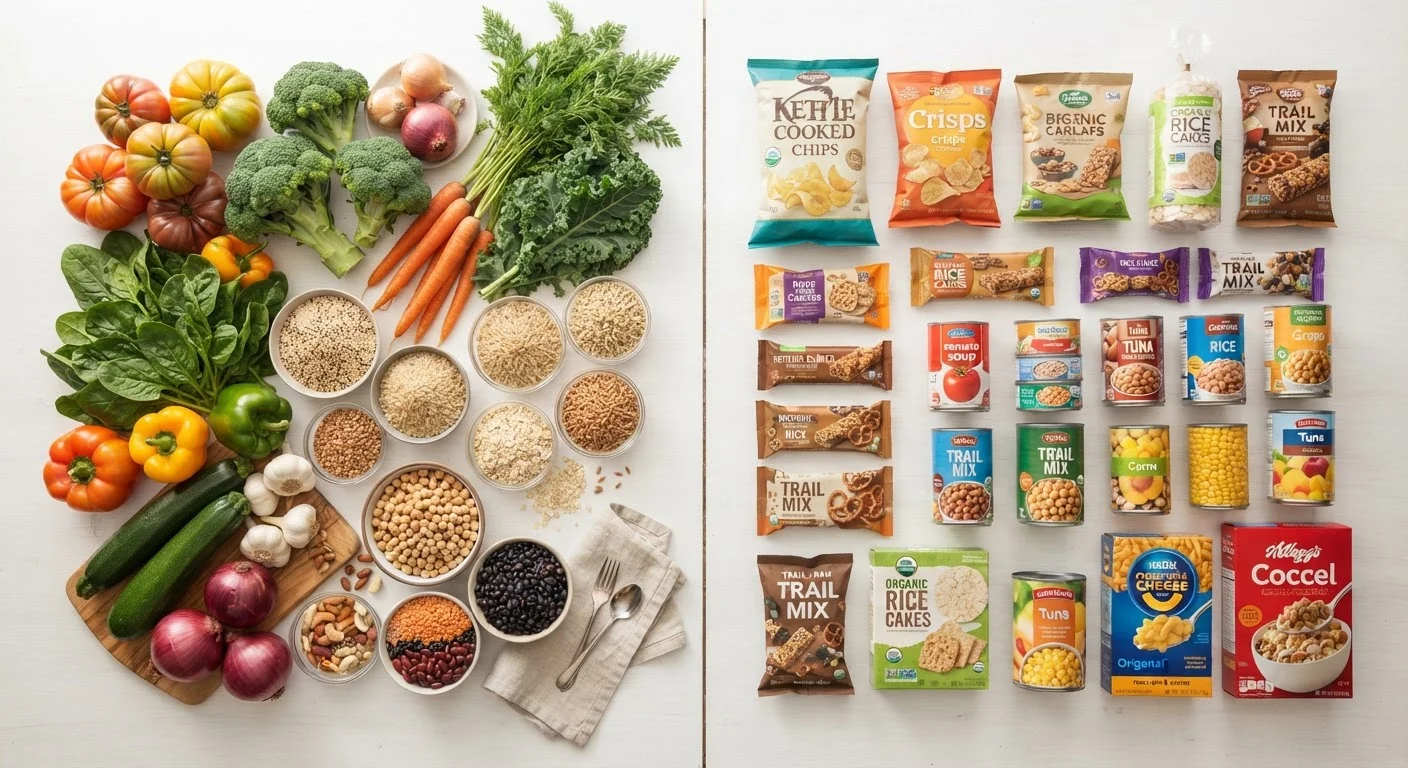
Closest to their natural state, minimally altered before eating.
Best for: People building a nutrient-dense foundation for long-term health and wellness.
Option B
Processed Foods
A broad spectrum - from lightly altered staples to highly engineered products.
Best for: Understanding the range helps consumers make more informed everyday food choices.
If you want a nutrient-dense diet with minimal additives
Whole Foods
Whole and minimally processed foods provide fiber, micronutrients, and phytonutrients that are often stripped or diluted during heavy processing.
If convenience is a priority without abandoning nutrition
Minimally Processed Foods
Items like canned legumes, frozen vegetables, and plain yogurt offer real nutritional value with the convenience of processing - a practical middle ground.
If you're trying to reduce added sugar, sodium, and artificial additives
Whole Foods
Ultra-processed products tend to contain significant amounts of added sugar, sodium, and preservatives that whole foods naturally lack.
What 'Processed' Actually Means
The word processed covers an enormous range - from washing and bagging spinach to engineering shelf-stable snack cakes with dozens of additives. Treating all processed food as equivalent oversimplifies a genuinely useful distinction.
Food scientists often rely on the NOVA classification, developed by researchers at the University of São Paulo, to categorize foods by the extent and purpose of processing. The four groups move from unprocessed or minimally processed foods (Group 1) through culinary ingredients and processed foods to ultra-processed food and drink products (Group 4). Most public health research on processed food uses this framework.
A whole food is one that has undergone little or no alteration - a raw apple, dried lentils, or a plain walnut. A minimally processed food has been cleaned, frozen, pasteurized, or otherwise prepared without substantially changing its nutritional character. Ultra-processed foods are industrial formulations that typically contain ingredients rarely found in a home kitchen - emulsifiers, flavor enhancers, colorants, and hydrogenated oils - added to extend shelf life, enhance palatability, or reduce cost.
| Criterion | Whole / Minimally Processed | Ultra-Processed |
|---|---|---|
| Ingredient list | Short; recognizable whole ingredients | Long; includes additives and industrial ingredients |
| Fiber content | Generally high; natural food matrix intact | Often low; fiber removed or fragmented |
| Added sugar & sodium | Naturally low to absent | Frequently high; added for flavor and preservation |
| Micronutrient retention | High; vitamins and minerals largely preserved | Variable; often supplemented artificially |
| Satiety | Tends to be higher due to food structure | Often engineered for high palatability, not satiety |
| Examples | Oats, frozen peas, plain yogurt, eggs | Packaged snack cakes, flavored chips, soda |
Why the Distinction Matters for Health
Research consistently links high consumption of ultra-processed foods to elevated intakes of added sugar, sodium, and saturated fat, as well as lower intake of fiber and key micronutrients. Studies published in journals such as The BMJ and JAMA Internal Medicine have associated ultra-processed food consumption with higher rates of cardiovascular disease, type 2 diabetes, and obesity - though these are observational findings, and diet quality is difficult to isolate from other lifestyle factors.
Whole and minimally processed foods, by contrast, tend to retain their natural matrix - the physical structure of food that influences digestion, satiety, and nutrient absorption. An oat groat, for example, is digested more slowly than instant oats rolled thin, which in turn behaves differently from an oat-flavored breakfast bar. Understanding carbohydrate quality is one useful lens for seeing why this structural difference matters.
57%
Share of US calories from ultra-processed foods
A study published in BMJ Open estimated that ultra-processed foods account for more than half of daily caloric intake among US adults.
~14g
Average daily fiber shortfall in US adults
Most Americans consume roughly 10-15 grams of fiber per day, well below the recommended 25-38 grams, partly due to reliance on low-fiber processed foods.
It's worth noting that not all processing is harmful. Pasteurization makes dairy safer. Fortification adds iodine to salt and vitamin D to milk. Freezing preserves vegetables at peak nutrition. The key question is what was added or removed, and why.
Reading Labels to Tell Them Apart
Front-of-package claims like "natural," "multigrain," or "made with real fruit" are not reliable signals of minimal processing. Regulatory definitions for many of these terms are limited, making the ingredient list a far more informative tool. Nutrition label claims decoded can help you interpret what these phrases actually mean under FDA guidelines.
A useful rule of thumb: if the ingredient list contains substances you wouldn't use when cooking at home - maltodextrin, carrageenan, artificial flavors, or interesterified oils - the product is likely ultra-processed. Shorter ingredient lists that name recognizable foods are a sign of lighter processing. For a full walkthrough of how to read nutrition panels, nutrition labels demystified offers a clear, practical guide.
A balanced approach to eating doesn't require eliminating every packaged food. Canned tomatoes, plain frozen edamame, and unsweetened Greek yogurt are all processed - and all nutritionally sound. The goal is to understand the spectrum so you can prioritize whole and minimally processed options most of the time, and make more intentional choices when convenience matters. For a broader framework on building awareness around food choices, see our guide to mindful eating.
Processing and Diet Quality Are Not Binary
Thinking in terms of a spectrum - rather than a clean whole vs. processed divide - is more accurate and more practical. Many nutritious, affordable staples like canned beans, frozen fish fillets, and plain nut butters involve some processing. What matters is the overall pattern of your diet, not the presence of any single ingredient or product. If you're uncertain how to build a balanced eating pattern, a registered dietitian can offer personalized guidance.
This article is for general informational and educational purposes only. It is not a substitute for professional medical or dietary advice. Consult a registered dietitian or qualified healthcare provider for guidance tailored to your individual health needs.