

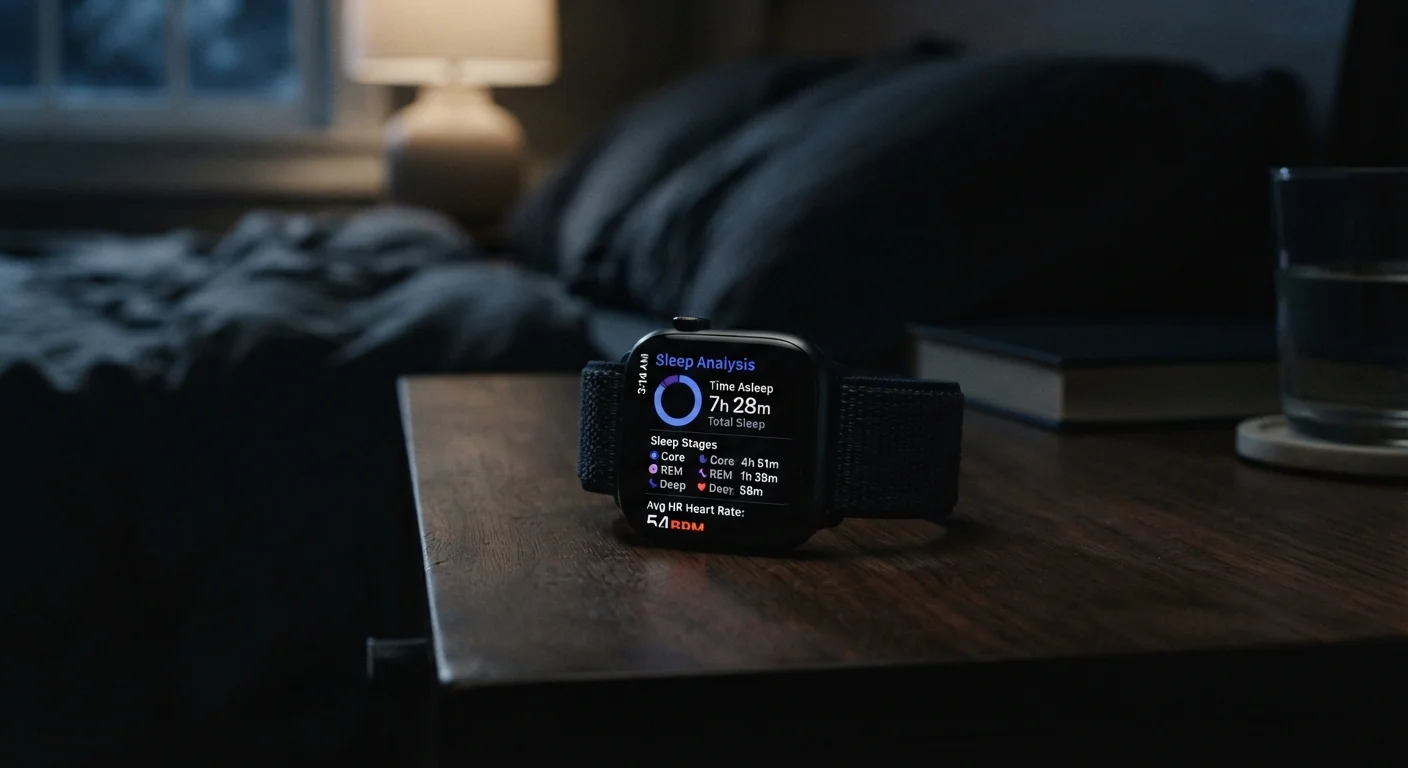
Key Takeaways
- Sleep trackers estimate sleep stages using movement and heart rate, not brain activity.
- Trend data over weeks is more meaningful than any single night's reading.
- Wearables cannot diagnose sleep disorders - only clinical sleep studies can.
- Obsessing over sleep scores may itself worsen sleep quality for some people.
- Useful metrics include total sleep time, resting heart rate, and consistency of sleep timing.
Tracks total sleep duration with reasonable accuracy
Studies show consumer devices generally perform best at distinguishing time asleep from time awake, making total sleep duration one of their more dependable outputs.
Reveals long-term behavioral sleep patterns
Weeks of trend data can clearly surface lifestyle habits - irregular schedules, alcohol use, or late meals - that disrupt sleep in ways that are hard to notice night to night.
Monitors resting heart rate during sleep
Elevated resting heart rate during sleep can indicate incomplete recovery or early illness, and most modern wearables capture this signal with reasonable consistency.
Encourages engagement with sleep hygiene
Having visible data motivates many people to prioritize consistent bedtimes and wind-down routines, translating passive awareness into deliberate habit change.
Accessible and non-intrusive to use nightly
Unlike clinical sleep studies, wearables require no special setup, lab visit, or attached sensors, making regular monitoring practical for everyday use.
Cannot measure brain activity or true sleep stages
Without EEG sensors, all sleep-stage classifications are estimates derived from movement and heart rate - not direct measurements of neural activity that define sleep stages clinically.
Deep sleep detection is particularly unreliable
Multiple independent studies have found that consumer devices struggle most with accurately identifying slow-wave (deep) sleep, often overestimating its duration.
Cannot diagnose sleep disorders
Conditions like obstructive sleep apnea, restless leg syndrome, or narcolepsy require clinical evaluation and polysomnography - a wearable score cannot rule them in or out.
May cause sleep-score anxiety (orthosomnia)
Some users become preoccupied with achieving high sleep scores, creating performance anxiety around sleep itself - which researchers have linked to worsened sleep outcomes.
Accuracy varies across devices and individuals
Algorithm performance differs significantly between manufacturers, and factors like skin tone, wrist positioning, and tattoos can affect PPG sensor accuracy in any device.
Our Verdict
Consumer sleep trackers are genuinely useful tools for building awareness of long-term sleep habits, but they are not medical instruments. Their estimates of sleep stages and quality carry meaningful error margins, and the data is best treated as a behavioral guide rather than a clinical assessment. Used with appropriate expectations, they can support healthier routines without replacing professional evaluation.
Sleep trackers are best suited to people who want to understand their general sleep patterns and identify lifestyle factors - such as late meals, alcohol, or inconsistent bedtimes - that affect how they feel the next day.
How Consumer Sleep Trackers Actually Work
Most wearable sleep trackers use two primary inputs: an accelerometer to detect body movement and a photoplethysmography (PPG) sensor to measure heart rate variability. From these signals, the device's algorithm estimates when you fell asleep, when you woke, and how long you spent in light, deep, and REM sleep stages.
This approach is fundamentally different from polysomnography (PSG) - the clinical gold standard for sleep analysis, which directly measures brain wave activity (EEG), eye movements, and muscle tone. PSG requires sensors attached to the scalp and is conducted in a sleep lab. Consumer wearables have no access to brain activity, so all sleep-stage estimates are inferences drawn from indirect physiological signals.
That distinction matters enormously. Movement and heart rate do correlate with sleep stages to a meaningful degree, but the relationship is imperfect. A person lying still with elevated heart rate from stress or illness may be misclassified as being in deep sleep. See what fitness trackers can reliably measure for a broader look at where wearable sensors perform well and where they don't.
Sleep Trackers vs. Clinical Sleep Studies
Polysomnography (PSG) remains the only validated method for diagnosing sleep disorders. It records brain waves, eye movements, blood oxygen, and muscle activity simultaneously across a full night. Consumer wearables do not replicate any of these measurements directly. If a healthcare provider suspects a sleep disorder, they will refer you for a clinical evaluation - a wearable readout is not a substitute for that process.
What Sleep Trackers Do Well
Despite their limitations, sleep trackers offer genuinely useful information when interpreted correctly.
Tracks total sleep duration with reasonable accuracy
Studies show consumer devices generally perform best at distinguishing time asleep from time awake, making total sleep duration one of their more dependable outputs.
Reveals long-term behavioral sleep patterns
Weeks of trend data can clearly surface lifestyle habits - irregular schedules, alcohol use, or late meals - that disrupt sleep in ways that are hard to notice night to night.
Monitors resting heart rate during sleep
Elevated resting heart rate during sleep can indicate incomplete recovery or early illness, and most modern wearables capture this signal with reasonable consistency.
Encourages engagement with sleep hygiene
Having visible data motivates many people to prioritize consistent bedtimes and wind-down routines, translating passive awareness into deliberate habit change.
Accessible and non-intrusive to use nightly
Unlike clinical sleep studies, wearables require no special setup, lab visit, or attached sensors, making regular monitoring practical for everyday use.
Total sleep duration is the metric trackers handle most reliably - devices generally agree with PSG within a reasonable margin on time-in-bed versus time-asleep estimates. Resting heart rate during sleep is also tracked with reasonable accuracy by most modern devices and can serve as a useful indicator of recovery and overall cardiovascular health trends.
Perhaps most valuably, wearables excel at revealing behavioral patterns over time. Seeing weeks of data can make it immediately obvious that late-night screen time, alcohol consumption, or irregular wake times are fragmenting sleep - insights that a single doctor's appointment might never surface.
Where Sleep Trackers Fall Short
The limitations are real and worth understanding before over-interpreting nightly scores.
Cannot measure brain activity or true sleep stages
Without EEG sensors, all sleep-stage classifications are estimates derived from movement and heart rate - not direct measurements of neural activity that define sleep stages clinically.
Deep sleep detection is particularly unreliable
Multiple independent studies have found that consumer devices struggle most with accurately identifying slow-wave (deep) sleep, often overestimating its duration.
Cannot diagnose sleep disorders
Conditions like obstructive sleep apnea, restless leg syndrome, or narcolepsy require clinical evaluation and polysomnography - a wearable score cannot rule them in or out.
May cause sleep-score anxiety (orthosomnia)
Some users become preoccupied with achieving high sleep scores, creating performance anxiety around sleep itself - which researchers have linked to worsened sleep outcomes.
Accuracy varies across devices and individuals
Algorithm performance differs significantly between manufacturers, and factors like skin tone, wrist positioning, and tattoos can affect PPG sensor accuracy in any device.
Research comparing consumer wearables with clinical PSG has found that devices tend to overestimate total sleep time and struggle most with accurately identifying deep (slow-wave) sleep. A 2019 analysis published in Nature and Science of Sleep found that consumer devices varied substantially in their ability to distinguish sleep stages, with deep sleep detection being particularly inconsistent across platforms.
Beyond accuracy, there is a psychological risk. Some individuals develop what researchers have termed orthosomnia - an anxiety-driven preoccupation with achieving perfect sleep scores that paradoxically worsens sleep. If checking your sleep data first thing in the morning creates stress rather than insight, that is a meaningful signal to recalibrate how you use the tool.
78%
Sleep time overestimated by wearables
A review of consumer sleep tracker studies found devices overestimated total sleep time in roughly 78% of comparisons with clinical polysomnography.
~50%
Accuracy for deep sleep stage detection
Research comparing wearable devices to PSG has found deep sleep identification accuracy can fall near chance level in some devices and testing conditions.
Using Sleep Data Constructively
The most productive way to use a sleep tracker is as a pattern-recognition tool, not a diagnostic one. A few practical principles help:
- Focus on trends, not nightly scores. A single poor reading is rarely meaningful. Consistent patterns across two to four weeks carry far more signal.
- Track behavioral context alongside sleep data. Note when you exercised, what you ate, or how stressed you were. This context transforms raw numbers into actionable insight. Recording behavioral context alongside workouts follows the same principle.
- Prioritize sleep consistency. Regular bed and wake times appear repeatedly in sleep research as one of the strongest modifiable factors for sleep quality.
- Recognize what the device cannot tell you. Symptoms like chronic loud snoring, gasping during sleep, or persistent daytime fatigue that doesn't improve with adequate sleep duration warrant evaluation by a healthcare provider - not a software update.
It is also worth being aware of how your health data is handled. Understanding how wearable health data is stored and accessed is a practical companion consideration for anyone using a connected device.
This article is for general informational purposes only and does not constitute medical advice. If you have concerns about your sleep health, consult a qualified healthcare professional.