

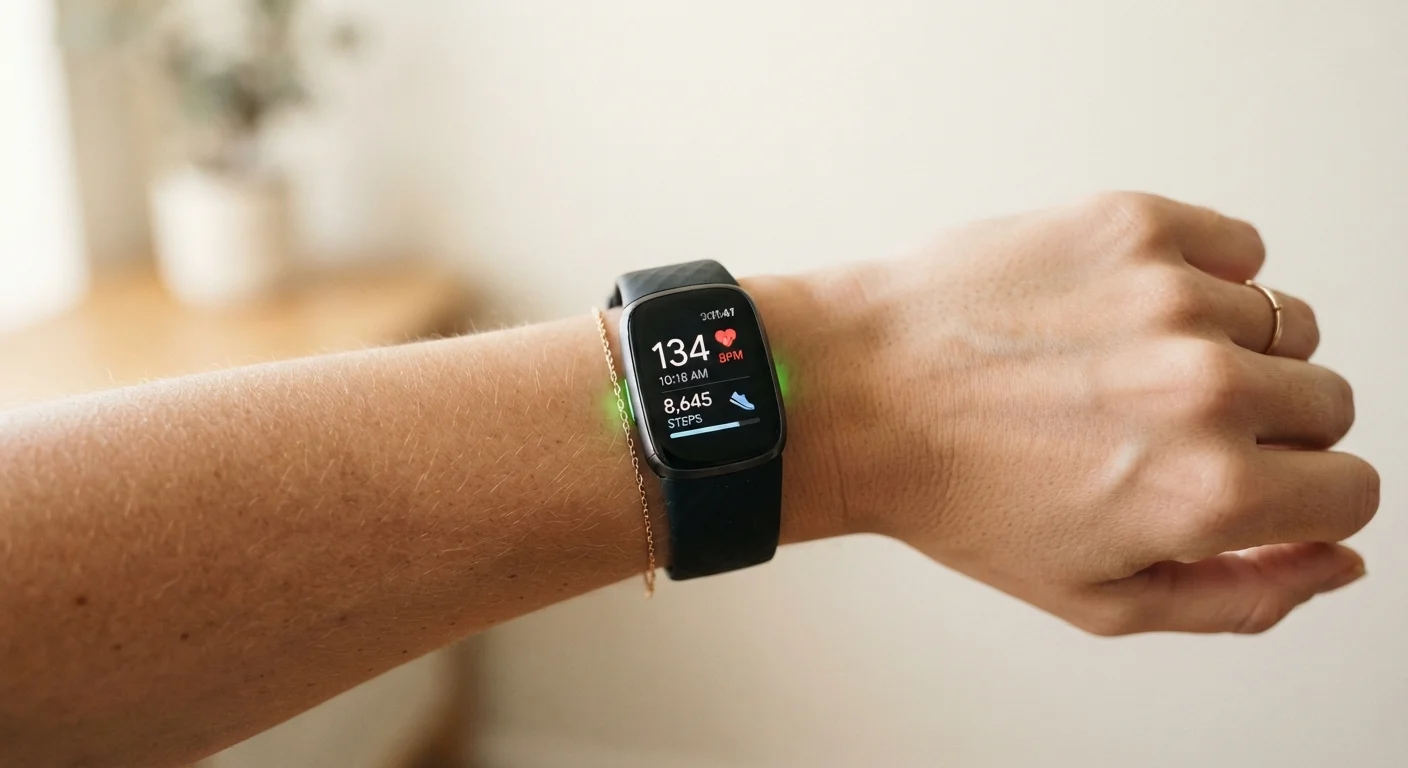
Key Takeaways
- Step counting is among the most reliable metrics fitness trackers consistently produce.
- Optical heart rate sensors can drift significantly during intense exercise or on darker skin tones.
- Sleep stage data is estimated, not measured, and should be treated as directional rather than diagnostic.
- SpO2 readings from consumer wearables are not clinical-grade and cannot replace medical pulse oximeters.
- Fitness trackers are most valuable as trend tools rather than sources of precise, individual data points.
Reliable step counting supports daily movement goals
Accelerometer-based step tracking typically falls within a 10% margin under normal walking conditions, making it useful for building and sustaining activity habits.
Resting heart rate trends reveal meaningful health signals
When measured during sleep or stillness, optical heart rate sensors produce consistent readings that can flag overtraining, early illness, or improving cardiovascular fitness over time.
Passive, continuous monitoring requires no user effort
Unlike manual logging, wearables collect data automatically throughout the day and night, capturing patterns that users would otherwise miss entirely.
Long-term trend data supports behavioral awareness
Weeks or months of logged activity, sleep consistency, and heart rate data create a personalized baseline that helps users notice meaningful shifts in their health habits.
Motivation and accountability benefits are well-documented
Research on wearable use in general populations consistently shows step-goal reminders and daily summaries increase overall physical activity, even when the data itself isn't perfectly precise.
Heart rate accuracy degrades sharply during intense exercise
Optical wrist sensors struggle with rapid movement and high-intensity effort, with some studies recording errors of 20 or more beats per minute compared to chest-strap monitors.
SpO2 readings are not clinically reliable
Consumer-grade blood oxygen sensors are affected by skin tone, device placement, and motion, and are not validated replacements for medical-grade pulse oximeters.
Sleep stage data is estimated, not measured
Without EEG brain-wave monitoring, wearables infer sleep stages from movement and heart rate patterns - a method that research consistently shows has limited agreement with clinical sleep studies.
Calorie burn estimates carry significant error margins
Energy expenditure calculations vary by algorithm, user profile, and activity type, and independent testing has found consumer tracker estimates can diverge from measured values by 15-40%.
Skin tone and device fit affect sensor performance
Studies have found that optical sensors can perform less accurately on darker skin tones due to how light absorption differs, raising equity concerns that manufacturers are still working to address.
Data volume can create false confidence or anxiety
Constant metric feedback without proper context can lead users to over-interpret normal daily variation as a health concern, or to trust inaccurate readings as clinical fact.
Our Verdict
Fitness trackers offer genuine utility for people who want to build movement habits, monitor resting heart rate trends, and get a rough picture of sleep consistency. Their limitations become significant when users treat the data as medically precise - a gap the devices themselves often fail to communicate clearly. Used with appropriate expectations, they are practical everyday tools; relied upon as diagnostic instruments, they can mislead.
Best for health-conscious consumers who want motivational feedback and long-term trend awareness, not those seeking clinical-grade health monitoring.
What Fitness Trackers Actually Do Well
Fitness trackers earned their place in millions of daily routines because several of their core functions genuinely hold up under scrutiny. Understanding where the technology is reliable helps users extract real value without over-interpreting the numbers.
Reliable step counting supports daily movement goals
Accelerometer-based step tracking typically falls within a 10% margin under normal walking conditions, making it useful for building and sustaining activity habits.
Resting heart rate trends reveal meaningful health signals
When measured during sleep or stillness, optical heart rate sensors produce consistent readings that can flag overtraining, early illness, or improving cardiovascular fitness over time.
Passive, continuous monitoring requires no user effort
Unlike manual logging, wearables collect data automatically throughout the day and night, capturing patterns that users would otherwise miss entirely.
Long-term trend data supports behavioral awareness
Weeks or months of logged activity, sleep consistency, and heart rate data create a personalized baseline that helps users notice meaningful shifts in their health habits.
Motivation and accountability benefits are well-documented
Research on wearable use in general populations consistently shows step-goal reminders and daily summaries increase overall physical activity, even when the data itself isn't perfectly precise.
Step counting remains the most validated feature. Accelerometer-based pedometry has been studied extensively, and modern trackers typically fall within a 10% margin of actual steps in normal walking conditions. That margin is wide enough to matter for clinical research but tight enough for everyday habit-building goals.
Resting heart rate (RHR) tracking is another area where consumer wearables perform reasonably well. Measured during sleep or during extended still periods, optical sensors tend to produce consistent readings that align with manual pulse checks. Monitoring RHR trends over weeks can reveal early signs of overtraining, illness onset, or improved cardiovascular fitness - a genuinely useful signal for everyday users. For more on how this data is captured and stored, see what gets logged and stored.
Active calorie estimation, while imperfect, provides useful relative data. If the tracker consistently shows higher burn on hard training days versus rest days, that directional information supports better decision-making even if the absolute numbers are off by 15-25%.
Where the Data Gets Unreliable
The marketing around fitness trackers frequently outruns the science. Several headline features are far less accurate than manufacturers imply.
Heart rate accuracy degrades sharply during intense exercise
Optical wrist sensors struggle with rapid movement and high-intensity effort, with some studies recording errors of 20 or more beats per minute compared to chest-strap monitors.
SpO2 readings are not clinically reliable
Consumer-grade blood oxygen sensors are affected by skin tone, device placement, and motion, and are not validated replacements for medical-grade pulse oximeters.
Sleep stage data is estimated, not measured
Without EEG brain-wave monitoring, wearables infer sleep stages from movement and heart rate patterns - a method that research consistently shows has limited agreement with clinical sleep studies.
Calorie burn estimates carry significant error margins
Energy expenditure calculations vary by algorithm, user profile, and activity type, and independent testing has found consumer tracker estimates can diverge from measured values by 15-40%.
Skin tone and device fit affect sensor performance
Studies have found that optical sensors can perform less accurately on darker skin tones due to how light absorption differs, raising equity concerns that manufacturers are still working to address.
Data volume can create false confidence or anxiety
Constant metric feedback without proper context can lead users to over-interpret normal daily variation as a health concern, or to trust inaccurate readings as clinical fact.
Heart rate during exercise is a notable weak point. Optical sensors - which read blood flow through the skin using light - struggle during high-intensity intervals, weightlifting, or activities with significant wrist movement. Studies published in peer-reviewed sports medicine journals have documented error rates exceeding 20 beats per minute during vigorous activity. Chest-strap monitors remain the reliable standard for training-zone precision.
The growing prevalence of SpO2 (blood oxygen) sensors in consumer trackers has created particular confusion. These sensors cannot produce clinical-grade readings; skin tone, device fit, and movement all introduce significant error. They are not substitutes for medical pulse oximeters, and users should not interpret a low reading as a health warning without medical guidance.
Sleep stage analysis - light, deep, REM - is perhaps the most overstated feature. Consumer wearables infer sleep stages from movement and heart rate variability, not from brain-wave activity (EEG), which is the clinical standard. Research comparing wearable sleep staging to polysomnography (formal sleep studies) consistently finds moderate-to-poor agreement for individual sleep stages, though total sleep duration estimates are more reliable.
For a broader look at the accuracy landscape across wearable sensors, the evolving role of wearable health tech provides useful context.
Using Tracker Data as a Trend Tool, Not a Diagnostic
The most practical reframe for fitness tracker data is this: individual readings are noisy; long-term patterns are informative. A single night's sleep score means little. A two-week decline in sleep quality scores alongside an increase in resting heart rate tells a more meaningful story.
Trend Patterns Matter More Than Single Readings
A single data point from a fitness tracker - one night's sleep score, one day's step count - carries limited meaning on its own. The real insight emerges over weeks, when consistent patterns or meaningful shifts become visible. Treat your wearable's data the way you'd treat a weather forecast: useful for planning, not a guarantee of exact conditions.
Pairing tracker data with a structured training log compounds its usefulness. Knowing that your average step count dropped the same week your recorded workouts became shorter and less frequent gives that data concrete context. Recording workout details alongside wearable metrics helps reveal patterns that neither source would show alone.
Users who understand what fitness trackers actually measure tend to get more from them precisely because they stop chasing precision and start watching for shifts. A device that shows your resting heart rate has climbed five beats per minute over three weeks is prompting a question worth asking - even if the exact number isn't laboratory-accurate.
~10%
Typical step count margin of error
Research on accelerometer-based pedometry suggests most modern trackers stay within roughly 10% of actual step counts under normal walking conditions.
20+ BPM
Heart rate error during intense exercise
Peer-reviewed sports medicine studies have documented optical wrist sensor errors exceeding 20 beats per minute during high-intensity activity compared to validated chest-strap monitors.
15-40%
Calorie burn estimation variance
Independent evaluations of consumer fitness trackers have found energy expenditure estimates can differ from laboratory-measured values by 15 to 40 percent depending on activity type.
The bottom line: fitness trackers are legitimate tools for behavior change and trend awareness. They are not medical devices, and treating them as such is where most user frustration - and occasional misjudgment - originates.
This article is for general informational purposes only and does not constitute medical advice. Consult a qualified healthcare professional for any health-related concerns or before making changes based on wearable health data.