

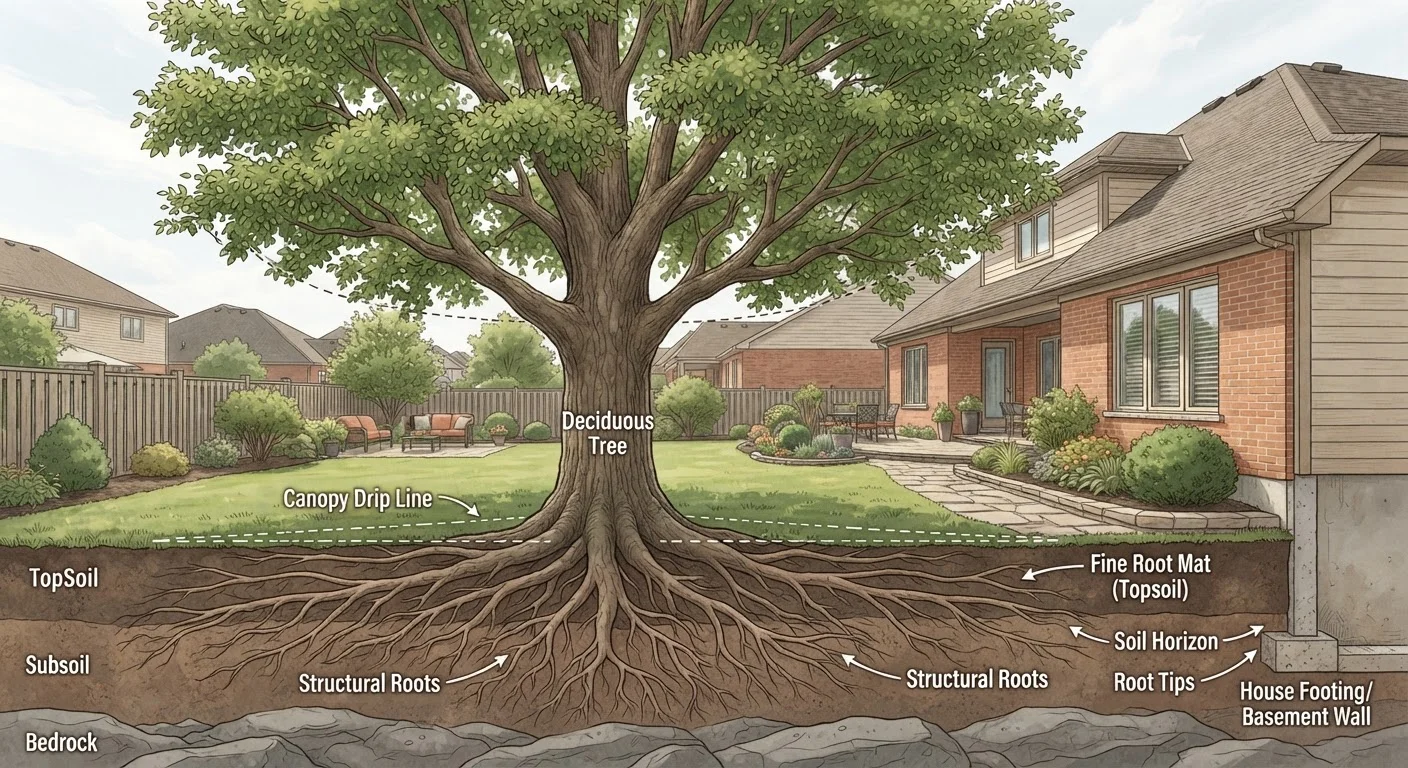
Key Takeaways
- Tree roots follow moisture and oxygen, not a predetermined path toward pipes or foundations.
- Most root damage exploits pre-existing cracks or weaknesses rather than forcing through intact materials.
- Species selection and planting distance are the most effective tools for preventing root conflicts.
- Clay soils increase root-related risks more than sandy or well-drained soils do.
- A certified arborist can assess risk and recommend removal or redirection strategies safely.
Why Root Behavior Is Widely Misunderstood
Most homeowners picture tree roots as a mirror image of the branches above - deep, downward-thrusting anchors that drill straight toward buried infrastructure. That mental model drives a lot of unnecessary anxiety and, just as often, a false sense of security. Actual root systems behave very differently, and understanding the difference helps you make smarter decisions about where and what to plant.
Roots grow where conditions favor them: loose, oxygenated soil, steady moisture, and available nutrients. Because the top 18 to 24 inches of soil tend to provide all three, most structural roots spread outward - sometimes two to three times the canopy's width - rather than downward. That lateral spread is what brings roots into contact with sidewalks, pipes, and foundations in the first place.
Balancing hardscape and softscape in your yard isn't just aesthetic - it directly affects where roots travel and how much damage they can cause over time.
Myth
Tree roots actively seek out and penetrate intact water pipes and foundations.
Fact
Roots follow existing cracks, gaps, or joints - they don't bore through solid, intact materials.
The idea that roots "hunt" for pipes is pervasive but inaccurate. Roots respond to moisture and oxygen gradients; they don't generate enough mechanical force to penetrate defect-free concrete or undamaged PVC. What actually happens is that roots encounter a pre-existing crack, joint, or gap - especially common in older clay or concrete pipes - and exploit that opening over time. Once inside, the moist environment accelerates growth, which then widens the damage. Keeping pipes and foundations in good repair is a meaningful preventive measure, not just maintenance for its own sake.
Myth
Only trees directly next to a structure pose a root threat.
Fact
Root systems commonly extend two to three times the canopy width, reaching structures far from the trunk.
A large tree planted 15 feet from a foundation can still have structural roots extending 30 to 50 feet outward. Because roots spread laterally and follow the path of least resistance, distance from the trunk is a starting point for risk assessment, not a definitive safety buffer. Species, soil conditions, and moisture availability all influence exactly how far roots travel. This is why utility marking and species-appropriate spacing guidelines exist - a tree that looks safely distant today may have roots at your sewer line within a decade.
Myth
Cutting visible surface roots eliminates the underground threat.
Fact
Surface root removal can destabilize the tree and rarely stops root growth from redirecting.
Surface roots that lift sidewalks or intrude on patios are tempting to cut, but removing significant structural roots - generally those thicker than 2 inches - can compromise a tree's stability and increase its risk of falling. Additionally, the remaining root system often compensates by sending new growth around the cut. A certified arborist can assess which roots can safely be pruned and whether root barriers or other interventions make more sense than cutting. Never cut major roots without professional input, particularly on large trees near structures.
Myth
All tree species pose roughly equal risk to underground infrastructure.
Fact
Root aggressiveness varies significantly by species; some present substantially higher risk near utilities.
Willows, silver maples, cottonwoods, and certain hybrid poplars produce fast-growing, moisture-seeking roots that arborists and municipal utility managers consistently flag as higher-risk near sewer lines and older pipes. By contrast, many ornamental trees - serviceberry, Japanese maple, redbud - have less aggressive root systems and are generally safer for smaller lots. Selecting species based on mature size and root habit, not just appearance, is one of the most cost-effective long-term decisions a homeowner can make. Local cooperative extension offices often publish region-specific planting guides with root-risk ratings.
Myth
Once roots damage a pipe, the only fix is full pipe replacement.
Fact
Trenchless repair methods can often restore pipe function without major excavation.
Pipe lining and pipe bursting are trenchless technologies that can rehabilitate root-damaged sewer lines with minimal disruption to landscaping and hardscape. Pipe lining inserts a resin-impregnated sleeve that hardens into a new interior surface, while pipe bursting fractures the old pipe and pulls a new one through in a single pass. These methods don't apply in every situation - pipe diameter, material, and extent of damage all matter - but they're worth discussing with a licensed plumber before assuming full excavation is necessary. Camera scoping first helps determine the best approach.
The Role of Soil, Species, and Siting
Not every tree is equal when it comes to root aggressiveness. Willows, silver maples, and certain poplars are well documented for producing fast-growing, wide-ranging roots that seek out moisture with particular tenacity - making them poor choices near sewer lines or older clay-tile pipes. Oaks and most ornamental trees tend to present lower risk when sited appropriately.
Soil type amplifies or dampens that risk. In compacted clay soils, roots are more likely to travel along the path of least resistance - often along buried pipes or beneath foundation footings - because those zones may offer better aeration or moisture. Sandy, well-drained soils reduce the incentive for roots to congregate near infrastructure. Proper yard grading and drainage can reduce the moisture differentials that attract roots toward utilities in the first place.
Planting distance guidelines from extension services and arborists typically recommend keeping large-maturing trees at least 10 feet from sewer lines and 20 feet or more from the foundation - though these numbers vary by species and local conditions. Root barriers, made of rigid plastic or geotextile fabric, can redirect growth when removal isn't desirable, but they require correct installation depth to be effective.
Never Dig Near Utilities Without Marking First
Excavating to inspect roots or install barriers without first having utility lines marked can result in serious injury or service disruption. In the US, call 811 at least a few business days before any digging to have underground lines marked at no cost. This is required by law and is a non-negotiable first step before any yard project involving soil disturbance.
If you suspect roots have already compromised a pipe or foundation, the appropriate first step is a professional inspection - camera scoping for pipes and a structural assessment for foundations - rather than DIY excavation, which can disturb roots and accelerate damage.
Practical Steps for Homeowners
Preventing root conflicts begins at planting time. Before adding any tree to your yard, locate underground utilities using your local one-call service (dial 811 in the US), which marks gas, electric, water, and sewer lines at no cost. Match the mature size of the species to the available space, not its size at the nursery. A tree that reaches 60 feet tall will have roots to match.
For existing trees, proper mulching around the root zone reduces soil compaction and helps distribute moisture more evenly, decreasing the likelihood that roots will migrate toward concentrated moisture sources like leaking pipes. Keep mulch pulled back from the trunk to avoid rot.
811
Free US utility-locate hotline
Dialing 811 before any digging connects homeowners to a free service that marks underground utility lines, required by law in all 50 states.
2-3×
Typical lateral root spread vs. canopy width
Research in urban forestry consistently shows that tree roots spread laterally well beyond the drip line, often two to three times the canopy radius.
Pre-1980
Era when clay sewer pipes were common
Homes built before 1980 are more likely to have clay or concrete tile sewer lines, which are more susceptible to root intrusion than modern PVC pipe.
Annual inspection of older pipes - particularly clay or concrete tile common in homes built before 1980 - is worth considering if large trees are present. Many municipalities offer subsidized camera inspections or have records of pipe material and age. Catching a hairline crack before roots exploit it is dramatically cheaper than full pipe replacement after the fact.
This article is for general informational purposes only and does not constitute professional arboricultural, structural, or plumbing advice. Consult a licensed arborist, contractor, or utility professional for assessments specific to your property.