

Key Takeaways
- Roof failure often begins with visible surface changes, not interior water stains or active drips.
- Granule loss, curling shingles, and sagging areas are among the earliest indicators of deterioration.
- Catching these signs early can reduce repair costs and prevent structural damage to the home.
- Most roof inspections from the ground or attic are safe for homeowners; climbing the roof requires caution.
- A licensed roofing contractor should assess any sign that spans a large area or involves structural concerns.
Why Waiting for a Leak Is the Wrong Strategy
Most homeowners think of a leak - water dripping through the ceiling - as the signal that something is wrong with the roof. By that point, the problem has often been developing for months or years. Water damage visible indoors typically means moisture has already compromised the roof deck, insulation, and potentially framing. The repair bill grows substantially once that happens.
Roofs communicate their decline in other ways long before a leak appears. Learning to read those signals lets you act during a window when repairs are simpler and less disruptive. Many of the signs below are visible from the ground with a pair of binoculars, or from inside the attic with a flashlight - no ladder on the roof required. For anything that looks serious or covers a large area, consult a licensed roofing professional rather than attempting an assessment from above.
Safety First: Stay Off the Roof
Walking on a residential roof without proper training and safety equipment carries a real fall risk. Most of the signs in this list are identifiable from the ground with binoculars, from inside the attic, or from a stable ladder at the eave level - none of these require stepping onto the roof surface itself. If an up-close look is necessary, that is a job for a licensed roofing professional with appropriate equipment.
Seven Warning Signs Worth Knowing
Granules collecting in gutters
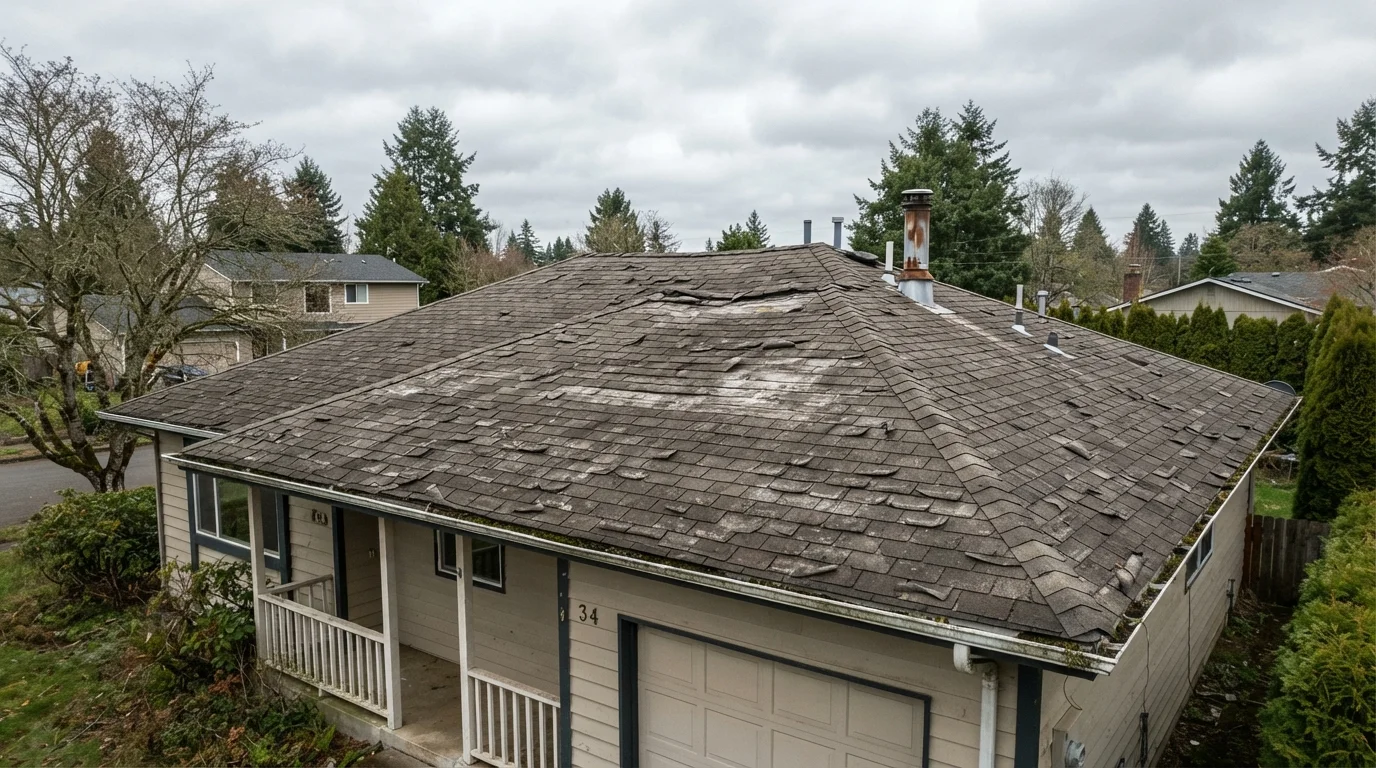
Asphalt shingles are coated with small mineral granules that protect the underlying mat from UV radiation. As shingles age, these granules loosen and wash into gutters. A modest amount after installation is normal, but ongoing accumulation - especially dark, gritty sediment lining the bottom of gutters - suggests the shingles are past their protective prime. Once granules are gone, the shingle surface degrades rapidly under sun exposure.
Ongoing granule buildup in gutters signals shingles are losing their UV protection.
Curling or cupping shingle edges
Shingles can curl in two ways: the edges bend upward (cupping) or the middle buckles while edges lie flat (clawing). Both forms indicate moisture imbalance, poor ventilation, or material aging. Curled shingles lose their ability to shed water cleanly and become vulnerable to wind uplift. Even moderate wind can catch a curled edge and tear the shingle loose, exposing the deck beneath.
Curled shingles are vulnerable to wind uplift and can expose the roof deck.
Sagging or uneven roof planes
A roof that looks wavy, dipped, or bowed when viewed from the ground is not just a cosmetic issue. Sagging often points to a weakened roof deck - the structural layer beneath the shingles - which may have been compromised by moisture infiltration, rot, or inadequate original construction. This is one of the most serious signs on this list. If you notice any area that appears to droop or flex, a structural assessment by a licensed contractor should be a priority.
A sagging roof plane may indicate structural weakness, not just surface wear.
Daylight visible from the attic
On a sunny day, go into the attic, turn off your flashlight, and look upward. If you see pinpoints or streaks of daylight coming through the deck boards or around penetrations, there are gaps in the roof assembly. Also scan for water staining, dark streaks, or mold on the underside of the deck - these indicate moisture entry even without an obvious active drip.
Daylight in the attic means your roof has gaps that water can exploit.
Missing or cracked shingles
Individual shingles can crack from thermal cycling - repeated expansion and contraction with temperature swings - or simply from old age and brittleness. Missing shingles are more obvious and create immediate exposure. Either condition leaves the underlayment (the layer beneath shingles) as the only barrier, and underlayment alone is not designed for long-term weather exposure. For more context on how cold temperatures affect this kind of damage, see what changes about roof repairs in winter.
Missing shingles leave only underlayment as the moisture barrier - a temporary fix at best.
Moss, algae, or lichen growth
Green or black biological growth on shingles is more than an aesthetic problem. Moss retains moisture against the shingle surface, accelerating deterioration of the granule layer and underlying mat. Lichen bonds more aggressively to shingles and can be difficult to remove without damaging the surface further. Biological growth tends to develop in shaded or north-facing areas first, so check those sections carefully during any exterior walkabout.
Moss and lichen trap moisture against shingles, speeding up material breakdown.
Flashing that is lifted, rusted, or separated
Flashing is the thin metal material (typically aluminum or galvanized steel) installed around chimneys, vents, skylights, and roof valleys to seal joints where shingles alone cannot provide a watertight barrier. When flashing lifts away from the surface, corrodes through, or has its sealant crack with age, water can enter at those joints without ever touching a damaged shingle. From the ground, look for visible metal that appears buckled, dark with rust, or noticeably separated from the surface it adjoins.
Damaged flashing is one of the most common entry points for water - even when shingles look fine.
Make a Habit of Seasonal Attic Checks
A quick attic inspection each spring and fall - before and after the harshest weather seasons - takes less than ten minutes and costs nothing. Bring a flashlight, look for staining, soft spots, or daylight, and document anything unusual with a photo and a date. This simple habit builds a record of your roof's condition over time and makes it easier to communicate changes to a contractor when one is needed.
Putting It Together: What to Do Next
If you spot one or two of these signs in isolation - say, a handful of granules in the gutter after a heavy storm - that alone may not call for immediate repairs. But patterns matter. Multiple signs appearing at once, or any single sign that covers a large portion of the roof, is a clear signal to get a professional evaluation. Keep in mind that resolving roof issues before tackling interior upgrades protects everything you invest elsewhere in the home.
When scheduling an inspection, ask the contractor to document conditions in writing and with photos. This creates a baseline for future comparisons and can also be useful for insurance purposes. For a deeper look at one of the more commonly missed failure points, see our article on how flashing failures cause water damage.