

Key Takeaways
- Cognitive biases are mental shortcuts that reliably distort purchasing decisions without you realizing it.
- Common shopping biases include anchoring, social proof, the sunk-cost fallacy, and scarcity bias.
- Retailers and e-commerce platforms often design experiences that deliberately activate these biases.
- Recognizing a bias in the moment is the most practical first step to neutralizing its effect.
- Slowing down a purchase decision - even by minutes - measurably reduces impulse-driven regret.
Cognitive Bias in Shopping
A cognitive bias is a systematic pattern of thinking that causes people to make decisions based on mental shortcuts rather than objective facts. In a shopping context, these biases influence which products you notice, how you evaluate price and value, and whether you feel satisfied after a purchase. They operate largely below conscious awareness, making them difficult to counteract without deliberate effort.
Cognitive biases are studied extensively in behavioral economics - a field that applies psychological research to understand why people deviate from purely rational economic decision-making.
Why Your Brain Takes Shortcuts at the Register
Every purchase decision - from a grocery run to a major appliance - involves your brain doing a rapid, mostly unconscious cost-benefit calculation. Because processing every data point fully would be exhausting, your brain relies on heuristics: mental shortcuts that produce fast, generally adequate answers. The problem is that these same shortcuts introduce predictable errors called cognitive biases.
Retail environments, and particularly e-commerce platforms, are engineered with a detailed understanding of how these shortcuts work. That's not a conspiracy theory - it's standard conversion optimization practice. Understanding a few key biases puts you back in the driver's seat. See also how these patterns quietly inflate online spending in digital retail specifically.
“A bias is not a flaw in reasoning - it is reasoning that worked well in one context applied carelessly in another. The supermarket is not the savanna, but your brain doesn't always know the difference.”
— Daniel Kahneman, Nobel laureate in Economic Sciences and author of 'Thinking, Fast and Slow'
The Six Biases Most Likely to Affect Your Cart
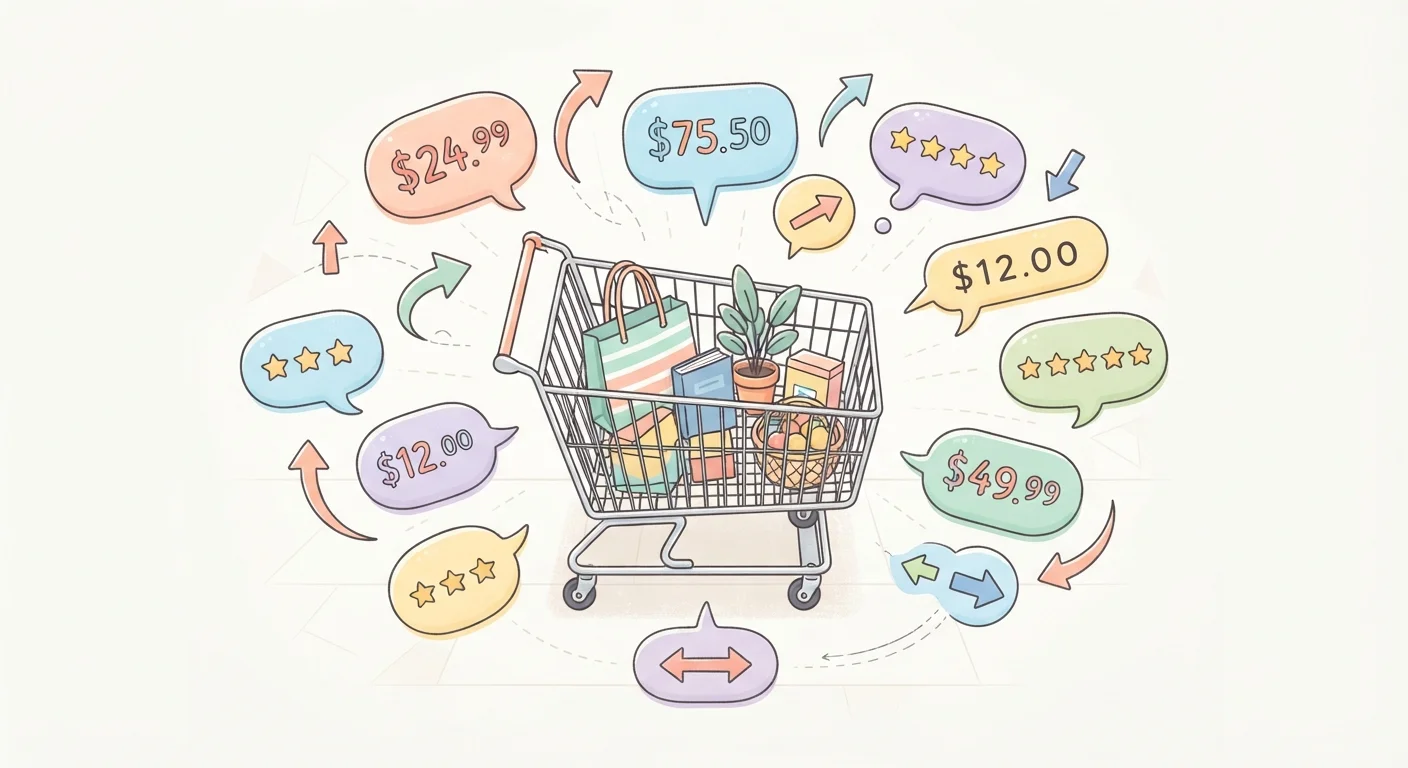
Anchoring: The first price you see for a product becomes your reference point. A $90 item marked down from $150 feels like a deal - even if $90 is the product's standard market price everywhere else. Your brain anchors to that $150 and never fully lets go.
Social proof: Seeing that 4,200 people have purchased or rated an item triggers an assumption that it must be good. This is social proof bias - borrowing the judgment of the crowd as a substitute for your own evaluation. Reviews carry real signal, but they're not a replacement for determining whether a product fits your needs.
Scarcity bias: "Only 3 left in stock" activates loss aversion - a well-documented tendency to weight potential losses more heavily than equivalent gains. Urgency nudges like these push decisions before you've had time to think clearly.
Sunk-cost fallacy: You signed up for a streaming service, rarely use it, but keep renewing because you've "already paid for it." This is sunk-cost thinking. Past spending is gone regardless of your next decision; only future value should matter.
The bandwagon effect: Related to social proof, this is the pull to want what's trending or widely discussed. It often overrides your genuine preferences in favor of what's culturally visible.
Choice overload: Counterintuitively, more options frequently leads to worse decisions and lower satisfaction. When overwhelmed, people default to shortcuts like picking the cheapest, the most reviewed, or simply giving up - none of which necessarily serves their actual needs.
95%
Purchasing decisions driven by subconscious factors
Consumer neuroscience research, including work cited by Harvard Business School, estimates that the vast majority of purchasing decisions involve subconscious processing rather than deliberate rational analysis.
~33%
Shoppers who report post-purchase regret
Surveys on consumer behavior consistently find that roughly one in three shoppers experience regret after a purchase, with impulse buying cited as a primary driver.
Practical Frameworks to Make Clearer Decisions
Awareness is necessary but not sufficient. Here are concrete approaches that disrupt bias-driven purchasing before it leads to regret.
Separate browsing from deciding. Add items to a cart or wishlist and revisit them after at least one sleep cycle. This interrupts the emotional momentum that biases like scarcity and social proof depend on. The concept overlaps significantly with emotional spending triggers - if you want a deeper look at that mechanism, understanding emotional spending is worth reading alongside this piece.
Anchor-proof your price research. Before you engage with a retailer's listed prices, look up independent price history data or search for the item without promotional framing. This gives your brain a more neutral starting anchor.
Write down what you actually need before you search. A specific, written-out set of requirements forces you to evaluate products against your criteria rather than against each other - which is where anchoring and bandwagon effects thrive.
Treat reviews as one signal, not a verdict. Read a sample of low-rated reviews alongside high-rated ones, and specifically look for reviewers whose use case matches yours. For broader frameworks on approaching significant purchases with more structure, a grounded introduction to smart shopping habits offers a solid foundation.
The 24-Hour Rule for Non-Essential Purchases
Before completing any unplanned purchase above a threshold you set for yourself - say, $30 or $50 - close the tab and wait until the next day. Research on impulse buying consistently shows that the desire to complete the purchase drops significantly after the emotional activation fades. If you still want the item after 24 hours, the decision is likely more considered.
When Biases Compound: The Bigger Picture
In isolation, each bias produces a small distortion. In a typical shopping session, several operate simultaneously - anchoring sets your price expectation, social proof validates the product, scarcity creates urgency, and sunk-cost keeps you loyal to a store you've already spent money with. The cumulative effect is a decision that feels autonomous but is substantially shaped by forces outside your conscious reasoning.
The same cognitive patterns affect higher-stakes financial decisions. The psychology of financial decision-making shows how fear and overconfidence create equally predictable errors in investment contexts. Shopping and investing are different domains, but the underlying cognitive machinery is the same.
None of this means you're making bad decisions constantly - heuristics are efficient and often adequate. The goal isn't to eliminate shortcuts but to apply them consciously, particularly when the stakes or the price tag are significant. Recognizing that a purchase feels urgent or popular as distinct from whether it's actually the right fit for you is the clearest lens behavioral economics can offer a consumer.