

Key Takeaways
- Emotions like fear and greed are among the most powerful forces shaping investor behavior.
- Cognitive biases - systematic mental shortcuts - cause predictable financial mistakes.
- Loss aversion means people feel losses roughly twice as intensely as equivalent gains.
- Awareness of your own biases is the first practical step toward more disciplined investing.
- Consulting a qualified financial adviser can help counteract emotionally driven decisions.
Behavioral Finance
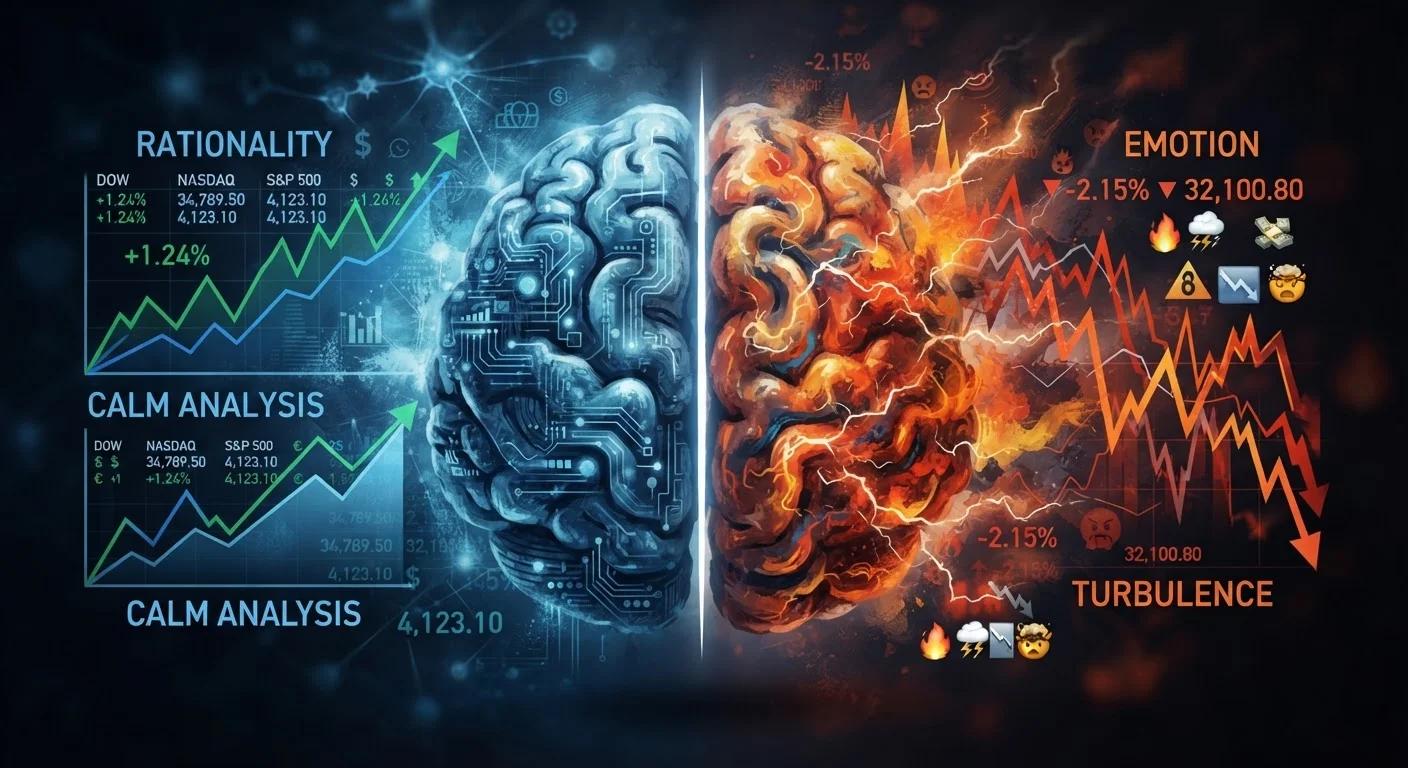
Behavioral finance is the study of how psychological factors - like emotions, mental shortcuts, and biases - influence how people make financial decisions. Unlike traditional finance, which assumes people always act rationally, behavioral finance acknowledges that fear, greed, and cognitive blind spots routinely lead investors astray. Understanding this field helps everyday people recognize patterns in their own decision-making.
Behavioral finance draws on both psychology and economics, and was significantly advanced by researchers Daniel Kahneman and Amos Tversky, whose work on cognitive biases earned a Nobel Prize in Economics in 2002.
Why Emotions and Money Are Inseparable
Most people imagine investing as a purely logical exercise - study the numbers, make a rational choice, wait for results. In practice, investing is deeply emotional. Markets rise and fall, headlines alarm, neighbors brag about gains, and suddenly it feels nearly impossible to stay calm and stick to a plan.
The field of behavioral finance exists precisely because human decision-making consistently departs from the cool rationality that classical economic theory assumed. Two dominant emotions - fear and greed - drive much of this departure. Fear causes investors to sell at market lows, locking in losses. Greed pushes them to chase surging assets long after sensible entry points have passed.
These emotional responses are not character flaws. They are products of how the human brain is wired. Understanding them is far more productive than trying to eliminate them entirely. For a closer look at how emotions affect spending outside of investing, see our piece on emotional triggers in spending.
“The investor's chief problem - and even his worst enemy - is likely to be himself.”
— Benjamin Graham, Economist and author widely regarded as the father of value investing
Common Cognitive Biases That Shape Investor Behavior
Beyond raw emotion, investors are subject to cognitive biases - systematic mental shortcuts the brain uses to simplify complex decisions. While useful in everyday life, these shortcuts frequently misfire in financial contexts.
Loss Aversion
Perhaps the most studied bias in finance, loss aversion describes the finding that losses feel psychologically heavier than equivalent gains. Losing $500 typically feels worse than gaining $500 feels good. This asymmetry pushes investors toward decisions designed to avoid loss rather than build long-term wealth - sometimes causing them to sell sound investments the moment they dip.
Confirmation Bias
Investors with confirmation bias seek out information that validates what they already believe and unconsciously dismiss evidence that contradicts it. Someone convinced a particular sector will thrive might read only bullish analysis, leaving themselves blind to genuine warning signs.
Overconfidence
Studies consistently find that individual investors tend to overestimate their ability to pick winning investments or time the market correctly. Overconfidence can lead to excessive trading, concentrated positions, and underestimating risk - all of which can erode returns over time.
Herd Mentality
When markets surge, the fear of missing out becomes almost physical. Herd mentality describes the tendency to follow the crowd, buying assets because others are buying them rather than because of solid underlying reasoning. The forces behind market volatility are often amplified when herd behavior takes hold.
2x
How much more painful losses feel than gains
Research by Kahneman and Tversky found that losses are felt approximately twice as intensely as equivalent gains, a core finding underpinning loss aversion theory.
66%
Individual investors who underperform the market
Academic research on individual investor returns has repeatedly found that most retail investors underperform broad market indices, partly due to behavioral factors like overtrading and poor market timing.
48-72 hrs
Recommended cooling-off period before reacting to market news
Financial planning practitioners commonly recommend a waiting period before acting on emotionally charged market events to reduce impulsive decision-making.
Anchoring and the Sunk-Cost Trap
Two additional biases deserve specific attention because they are especially common among newer investors.
Anchoring occurs when a person fixates on a specific number - often the price they paid for an investment - and uses it as a reference point for all future decisions. If you bought shares at $80 and they drop to $55, you might refuse to sell until they "get back to $80," even if the fundamentals no longer support that price. The original purchase price has no bearing on what the investment is worth today.
The sunk-cost fallacy is closely related: continuing to hold or add money to a losing investment simply because you've already committed funds to it. The amount already spent or invested cannot be recovered regardless of what you do next - decisions should be based on current and future prospects, not past costs. This same trap appears in everyday purchases too, as explored in our article on cognitive biases in shopping decisions.
Write It Down Before Markets Move
One of the simplest defenses against emotional investing is a written investment policy statement - a short document outlining your goals, risk tolerance, and the conditions under which you would consider changing your strategy. When markets get turbulent, referring to this document can anchor you to your original reasoning rather than your current emotions. Even a few sentences written in a calm moment carry weight.
Building Awareness and Smarter Habits
Awareness is the most practical tool available to individual investors. You cannot eliminate bias, but you can create systems that reduce its influence on consequential decisions.
- Write your strategy down before markets move. A documented plan gives you a reference point that is not colored by today's headlines.
- Automate contributions where possible. Automating regular investments into diversified accounts removes the decision - and therefore the emotion - from the equation.
- Create a cooling-off rule. Before making any significant portfolio change in response to market news, wait 48 to 72 hours. Most panic-driven impulses fade with time.
- Seek outside perspective. A qualified financial adviser can serve as a check on emotionally driven decisions. They are not personally attached to your portfolio the way you are.
New investors in particular are vulnerable to several well-documented traps - many rooted in the biases described here. Our overview of traps new investors frequently fall into provides a practical companion to this topic. Understanding the relationship between risk and reward is also essential - see risk and return explained for a grounded introduction.
This article is for general informational and educational purposes only and does not constitute personalized financial, investment, or tax advice. Please consult a qualified, licensed financial professional before making decisions about your own investments or financial situation.