

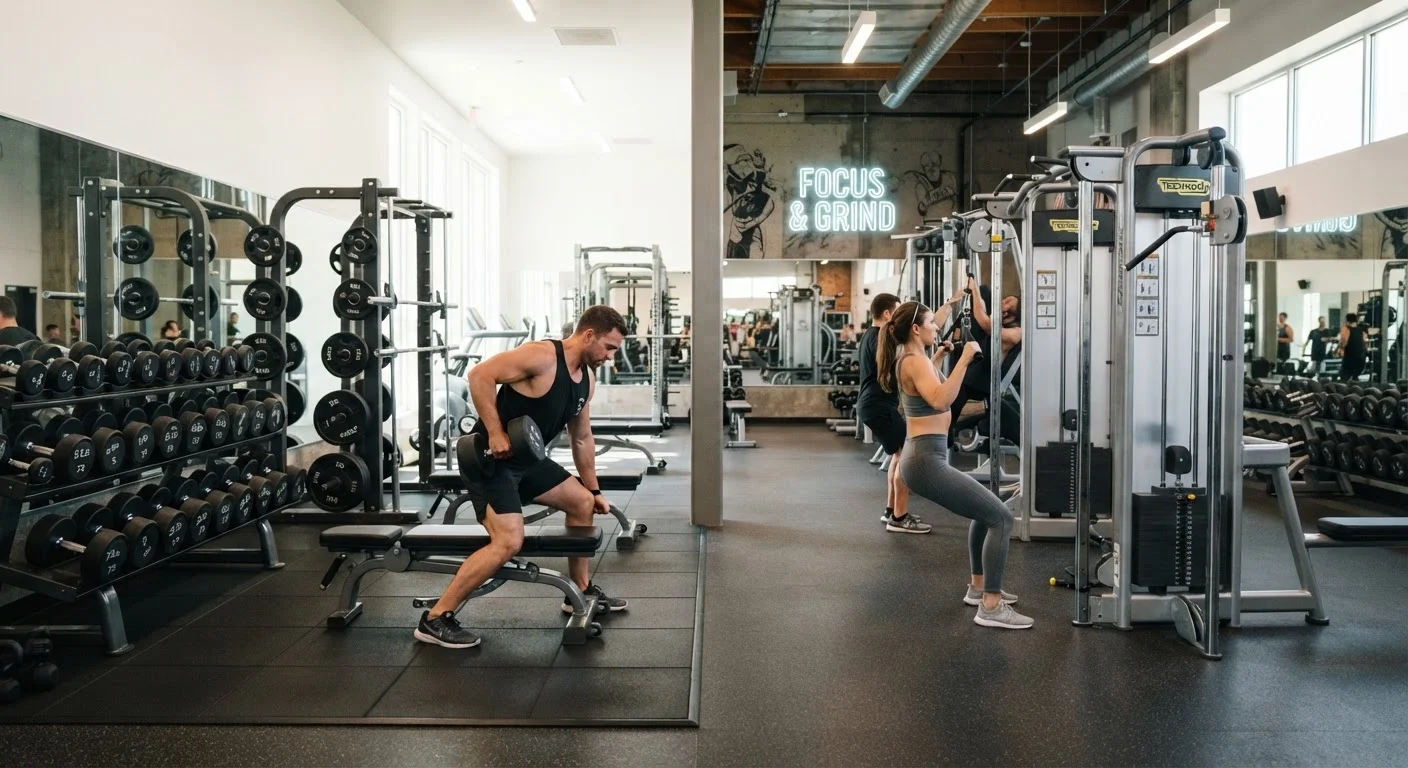
Key Takeaways
- Free weights activate more stabilizer muscles and transfer well to real-world movement patterns.
- Resistance machines guide your range of motion, making them safer for beginners and injury recovery.
- Neither option is universally superior - the best choice depends on your goals, experience, and access.
- Many effective programs incorporate both free weights and machines strategically.
- Proper form matters far more than equipment type for long-term results and injury prevention.
Option A
Free Weights
The functional, versatile classic for full-body strength.
Best for: Lifters seeking compound movement patterns, maximum muscle recruitment, and adaptable programming.
Option B
Resistance Machines
The guided, controlled option for targeted muscle work.
Best for: Beginners learning movement patterns or those isolating specific muscles with reduced injury risk.
If you're brand new to strength training
Resistance Machines
Machines guide your movement and reduce the technical demands, letting you build muscle awareness and confidence before tackling free-weight form.
If you want functional strength for everyday life or sport
Free Weights
Barbells and dumbbells train the stabilizer muscles and multi-joint coordination that carry over to athletic performance and daily movement.
If you're training around an injury or recovering from one
Resistance Machines
Machines allow targeted muscle work within a fixed, controlled path, reducing strain on vulnerable joints - always consult a qualified professional first.
If you want maximum programming flexibility on a budget
Free Weights
A modest set of dumbbells or a barbell and plates can replicate hundreds of exercises; machines are expensive and purpose-specific.
If muscle hypertrophy with precise isolation is your priority
Resistance Machines
Cable and plate-loaded machines maintain constant tension throughout the movement arc, which research suggests is beneficial for muscle growth in specific muscle groups.
How Each Tool Actually Works
Understanding the mechanical difference between free weights and resistance machines helps you make smarter training decisions. Free weights - dumbbells, barbells, kettlebells - rely entirely on gravity as resistance. Because the load can move in any direction, your body must actively recruit stabilizing muscles alongside the primary movers to keep the weight under control.
Resistance machines use a fixed movement path, either via a cable-and-pulley system or a guided lever arm. That structure reduces the stabilization demand but allows you to load the target muscle in isolation with more precision. Cable machines are especially useful because they can deliver resistance from multiple angles, unlike plate-loaded machines that are locked to one plane.
For a broader look at how resistance training fits alongside cardiovascular exercise, see our breakdown of cardio vs. strength training.
| Criterion | Free Weights | Resistance Machines |
|---|---|---|
| Stabilizer Muscle Activation | High - full-body coordination required | Low - fixed path handles stability |
| Learning Curve | Steep; technique takes time | Gentle; guided movement is intuitive |
| Injury / Beginner Safety | Higher risk if form breaks down | Lower risk; controlled range of motion |
| Functional Carryover | Strong - mirrors real-world movement | Limited to trained plane of motion |
| Muscle Isolation Precision | Moderate; neighboring muscles assist | High; target muscle stays loaded |
| Programming Flexibility | Virtually unlimited exercise variety | Limited to machine's intended use |
| Cost / Space (home setup) | Relatively affordable and compact | Expensive; large footprint per machine |
The Real Trade-Offs: Stability, Safety, and Skill
The learning curve is one of the starkest differences between these two tools. A barbell squat requires coordinating balance, bracing, and bar positioning simultaneously - skills that take deliberate practice to develop safely. A leg press machine removes most of that complexity; you sit down, push, and the movement guides itself.
That guided path is not a weakness. For people returning from injury, older adults managing joint issues, or beginners still building proprioception (body position awareness), machines provide a controlled environment that reduces the risk of compensating with poor form. However, because machines remove instability, they also train fewer muscles per set. That trade-off matters when efficiency is a goal.
43%
Greater stabilizer muscle activation with free weights
A study published in the Journal of Human Kinetics found that free-weight exercises produced meaningfully higher activation of stabilizing muscles compared to equivalent machine exercises.
~60%
Of gym beginners report feeling more confident on machines
Industry surveys from fitness organizations consistently show that newer exercisers perceive machines as less intimidating and easier to use without instruction.
Free weights, meanwhile, demand more from the nervous system. Compound lifts like the deadlift and overhead press train movement patterns that mirror real-world activities - picking up groceries, pushing overhead, carrying loads. This functional carryover is why free weights anchor most sport-performance and general strength programs.
If you're just getting started, our beginner strength training framework outlines how to structure your first months safely, regardless of which tool you choose.
Building a Program That Uses Both Wisely
The most effective training programs rarely choose a side - they combine both. A common structure uses free-weight compound movements (squats, presses, rows) early in a session when energy and focus are highest, then shifts to machines for accessory and isolation work later. This approach captures the functional benefits of free weights while using machines to add volume to specific muscles without additional coordination fatigue.
For example, a back session might start with barbell deadlifts and dumbbell rows, then finish with cable pull-downs and a machine rear-delt fly. The compound work builds overall strength; the machine work fills gaps and adds targeted stimulus.
Understanding when to use compound vs. isolation exercises will help you design that balance intelligently. Similarly, if you're deciding whether a gym membership is necessary at all, our home vs. gym training comparison covers the practical equipment trade-offs in detail.
This article is for general informational and educational purposes only. It is not a substitute for advice from a qualified fitness or healthcare professional. If you have existing injuries or health conditions, consult an appropriate professional before beginning or modifying any exercise program.
Neither Tool Replaces Good Programming
The equipment you use matters far less than consistency, progressive overload (gradually increasing the challenge over time), and adequate recovery. A well-designed program using only machines can outperform a poorly structured free-weight routine. Focus first on building sustainable habits, then optimize your tool selection around your specific goals. If you're uncertain how to structure your training, working with a certified personal trainer - even briefly - can pay significant long-term dividends.