

Key Takeaways
- Compound exercises recruit multiple muscle groups simultaneously, making them efficient for building strength and burning calories.
- Isolation exercises target a single muscle group and are valuable for correcting imbalances or developing specific areas.
- Most well-rounded programs benefit from a combination of both movement types, not an either-or approach.
- Your training goals, experience level, and available time all influence the right balance between compound and isolation work.
- Neither type is universally superior - context determines which serves you better at any given stage.
Our Verdict
Compound exercises form the backbone of efficient, functional strength training, while isolation movements fill important gaps that multi-joint lifts leave behind. For most everyday fitness goals, anchoring your sessions around compound lifts and supplementing with targeted isolation work delivers the most complete results.
| Best for | Recommended |
|---|---|
| Those with limited time who want maximum training efficiency | Compound exercises |
| Athletes or gym-goers addressing a specific muscle weakness or imbalance | Isolation exercises |
| Beginners building a general fitness foundation | Compound exercises |
| Intermediate trainees looking to round out their physique or prevent injury | A balanced mix of both |
What Sets These Two Movement Types Apart
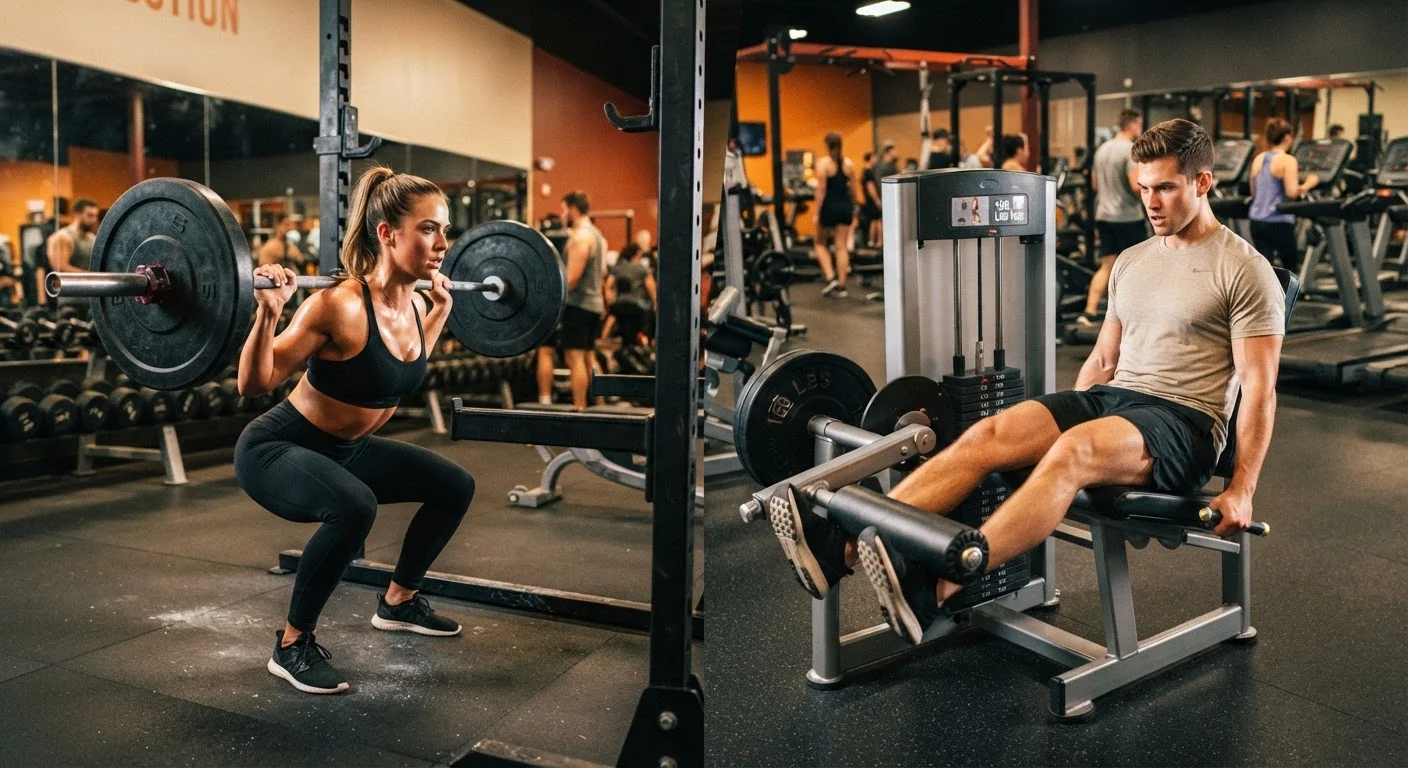
At their core, the distinction is about how many joints - and therefore how many muscles - are involved in a movement. Compound exercises cross two or more joints at once. A squat, for example, involves the ankle, knee, and hip simultaneously, calling on the quads, hamstrings, glutes, and core as a coordinated unit. A deadlift, bench press, pull-up, and overhead press all fall into this category.
Isolation exercises, by contrast, move a single joint and focus the workload on one primary muscle. A bicep curl isolates the elbow joint and the biceps brachii. A leg extension isolates the knee and the quadriceps. A lateral raise targets the deltoid with minimal involvement from anything else.
Understanding this mechanical difference helps explain why each type earns a place in thoughtful programming - and why defaulting entirely to one at the expense of the other often leads to gaps in fitness or physique. For a broader look at how resistance training fits within an overall active lifestyle, see our breakdown of cardio vs. strength training.
The Case for Compound Movements
Compound lifts offer an unmatched return on investment for training time. Because they recruit large muscle groups across multiple joints, they stimulate more total muscle tissue per set, trigger a greater hormonal response, and carry over more directly to real-world movement patterns like lifting, pushing, and climbing stairs.
For beginners especially, compound exercises provide an efficient foundation. Rather than spending an hour cycling through eight isolation movements, three or four well-chosen compound lifts can address the entire body. Research in exercise science consistently supports multi-joint movements as the cornerstone of strength and hypertrophy programs.
| Compound Exercises | Isolation Exercises | |
|---|---|---|
| Joints involved | Two or more joints | Single joint |
| Muscles recruited | Multiple muscle groups | One primary muscle |
| Training efficiency | High - more work per set | Lower - targeted stimulus |
| Best for | Strength, function, time efficiency | Imbalances, detail, rehab |
| Skill requirement | Higher - more coordination needed | Lower - simpler movement pattern |
| Program placement | Early in session | Later in session |
Compound movements also tend to develop what coaches call functional strength - the ability to generate and transfer force across multiple joints in coordination. This quality matters for athletic performance and injury resilience alike. If you're weighing whether to train at home or at a gym, compound exercises are worth factoring in, since many require specific equipment; our article on home workouts vs. gym training explores those trade-offs.
Where Isolation Exercises Earn Their Place
Compound lifts are foundational, but they don't address every need. Isolation exercises become especially valuable in three scenarios: correcting muscle imbalances, rehabilitating after injury, and developing a specific muscle that compound work underloads.
Consider that a pressing movement like the bench press works the chest, shoulders, and triceps together - but if the triceps are significantly weaker than the other two, they become the limiting factor on the lift. Adding targeted triceps work allows that lagging muscle to catch up without overloading the others.
Pair Isolation Work With a Weak Link
Identify which muscle consistently limits your compound lifts - often the triceps in pressing or the hamstrings in pulling movements - and add one or two isolation exercises targeting that muscle. This approach raises your compound performance over time without simply adding more heavy sets to an already taxing lift.
Isolation exercises also shine in training around an injury. If a shoulder issue prevents overhead pressing, bicep curls and lateral raises may remain pain-free, allowing continued arm and shoulder development during recovery. Always consult a qualified healthcare or sports medicine professional before training through or around an injury.
For those focused on physique goals, isolation work allows finer control over which muscles receive additional volume - something compound lifts alone cannot deliver with precision. The free weights vs. resistance machines comparison digs into which tools best support isolation training specifically.
Building a Program That Uses Both Strategically
A practical and well-supported approach is to structure sessions around compound lifts first, when energy and focus are highest, then finish with isolation work targeting areas you want to develop further. This sequencing is common in both strength-focused and hypertrophy-focused programming.
A sample lower-body session might open with squats and Romanian deadlifts, then close with leg curls and calf raises. An upper-body day might lead with bench press and rows, then finish with curls, triceps pushdowns, and rear delt flyes. The compound work builds the base; the isolation work fills the gaps.
How much of each you need depends on your goals. Beginners benefit most from prioritizing compound movements and keeping isolation work minimal. Intermediate and advanced trainees typically add more isolation volume as their programs grow more specialized. The core strength vs. core aesthetics discussion is a useful companion here - it illustrates how targeted, specific training differs from broad functional work, much the same way isolation and compound lifts do.
This article is for general informational purposes only and does not constitute medical or professional fitness advice. Consult a qualified fitness or healthcare professional before beginning or significantly changing an exercise program.