

Key Takeaways
- Both home and gym training can deliver meaningful fitness results when practiced consistently.
- Home workouts win on convenience and cost savings; gyms offer equipment variety and structured environment.
- Motivation style and available space are often the deciding factors for long-term adherence.
- Hybrid approaches - combining both settings - work well for many everyday exercisers.
No commute - train whenever time allows
Removing travel to and from a facility can save 30-60 minutes per session, making it far easier to stay consistent across a busy week.
Lower long-term financial cost
Once basic equipment is purchased, ongoing costs are minimal compared to monthly membership fees that can range from modest to substantial depending on the facility.
Full privacy and personal comfort
Training at home removes social self-consciousness, which research suggests can be a meaningful barrier for beginners in public gym environments.
Flexible scheduling with no wait times
Popular gym equipment can have queues during peak hours; at home, every piece of equipment is always available, which keeps sessions efficient.
Limited equipment range caps progression
Advanced strength goals typically require heavier loads and greater variety than most home setups can economically provide, which can slow progress over time.
Higher upfront cost for quality equipment
Adjustable dumbbells, a power rack, or a quality cardio machine represent significant one-time purchases that can run into hundreds or thousands of dollars.
Fewer built-in accountability structures
Without trainers, class schedules, or workout partners nearby, motivation must be entirely self-generated - a genuine challenge for many people on low-energy days.
Home distractions compete for attention
Family demands, household chores, and the general comfort of home can interrupt or mentally undermine a workout in ways a gym environment typically does not.
Our Verdict
Neither setting holds an automatic edge - results come down to consistency, effort, and programming quality. Home training suits those who value flexibility and low friction, while gym environments benefit people who thrive on structure, social energy, and access to specialised equipment. Many exercisers find that using both settings strategically gives them the best of each world.
Home workouts are ideal for time-pressed individuals or beginners building a habit, while gym training fits those chasing specific performance or physique goals that require heavier loads or specialised machines.
Why the Setting Actually Matters
The fitness world spends a lot of energy debating what to do - cardio, strength, HIIT - but not enough on where the work happens. Yet your training environment shapes habit formation, equipment access, and psychological readiness in ways that directly affect whether you stick with a routine. Understanding the real trade-offs helps you choose the setup that fits your life rather than an idealized version of it. For a broader look at exercise type decisions, see our piece on cardio vs. strength training.
The Case for Home Workouts
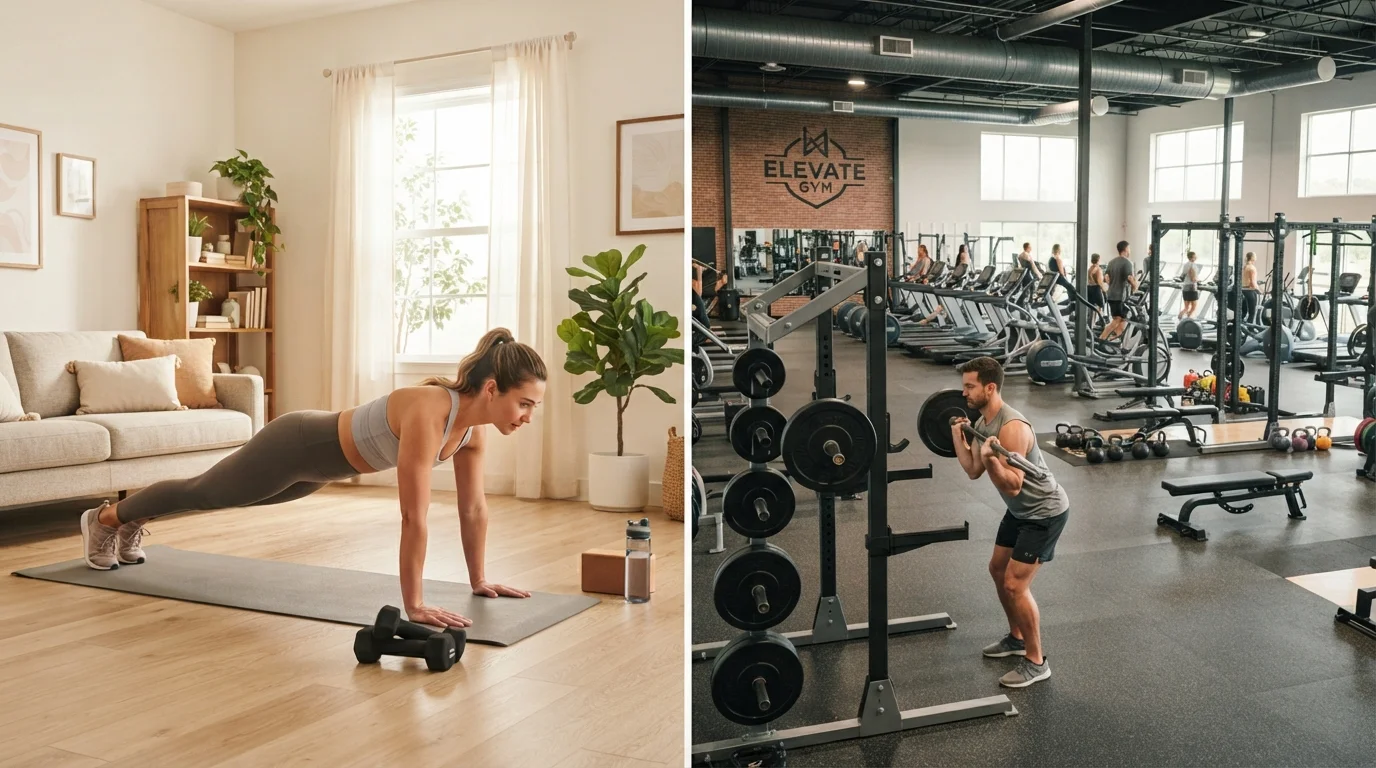
Home training has matured well beyond floor exercises and dusty treadmills. Bodyweight protocols, resistance bands, adjustable dumbbells, and on-demand video platforms now make it possible to run genuinely varied programs without leaving the house.
No commute - train whenever time allows
Removing travel to and from a facility can save 30-60 minutes per session, making it far easier to stay consistent across a busy week.
Lower long-term financial cost
Once basic equipment is purchased, ongoing costs are minimal compared to monthly membership fees that can range from modest to substantial depending on the facility.
Full privacy and personal comfort
Training at home removes social self-consciousness, which research suggests can be a meaningful barrier for beginners in public gym environments.
Flexible scheduling with no wait times
Popular gym equipment can have queues during peak hours; at home, every piece of equipment is always available, which keeps sessions efficient.
The convenience factor is hard to overstate. Removing the commute alone eliminates one of the most common reasons people skip sessions. For anyone juggling work, childcare, or an unpredictable schedule, that friction reduction can be the difference between training four days a week and training zero. If you're working with limited time, our guide to shorter, more efficient sessions pairs well with a home setup.
The Case for Gym Training
A well-equipped gym provides access to tools that are genuinely difficult to replicate at home - power racks, cable systems, plate-loaded machines, dedicated cardio equipment, and the floor space to use them safely. For anyone pursuing progressive overload across a wide load range, that variety matters.
Limited equipment range caps progression
Advanced strength goals typically require heavier loads and greater variety than most home setups can economically provide, which can slow progress over time.
Higher upfront cost for quality equipment
Adjustable dumbbells, a power rack, or a quality cardio machine represent significant one-time purchases that can run into hundreds or thousands of dollars.
Fewer built-in accountability structures
Without trainers, class schedules, or workout partners nearby, motivation must be entirely self-generated - a genuine challenge for many people on low-energy days.
Home distractions compete for attention
Family demands, household chores, and the general comfort of home can interrupt or mentally undermine a workout in ways a gym environment typically does not.
Beyond equipment, gyms offer an ambient social structure. Training alongside others - even strangers - can raise effort levels and reinforce the identity of someone who shows up regularly. If you're weighing machine-based training against free weights once you're at the gym, this breakdown of free weights vs. resistance machines is worth reading.
~$58/mo
Average US gym membership cost
According to fitness industry research aggregated by Statista and similar sources, the average American pays roughly $50-65 per month for a gym membership.
~23%
Gym members who use their membership regularly
Industry estimates suggest a significant share of gym members attend infrequently or not at all, highlighting the adherence gap that environment alone cannot solve.
Key Factors to Weigh for Your Situation
Rather than declaring a winner, consider these practical dimensions:
- Consistency history: If past gym memberships went unused, a lower-barrier home setup may produce better adherence. If you need external accountability, a gym environment or group class structure may serve you better.
- Training goals: Bodyweight and light resistance work can build and maintain solid fitness. Maximal strength or hypertrophy at advanced levels typically benefits from heavier, more varied load progressions that gyms facilitate. See our piece on compound vs. isolation exercises to understand how exercise selection interacts with your goals.
- Space and budget: Home setups require upfront equipment investment and dedicated space. Gym memberships distribute cost monthly but accumulate over time.
- Lifestyle fit: Early risers or those with irregular hours often benefit most from home training. Commuters who pass a gym may find it easy to incorporate gym sessions without adding travel time.
The Hybrid Approach Is Worth Considering
Many exercisers find that defaulting to home training on weekdays - when time is tight - and using a gym on weekends for heavier or more varied sessions captures the advantages of both environments. This kind of flexible structure can improve adherence without requiring a rigid either-or commitment. There's no rule that says you must choose exclusively one setting.
There is no single correct answer - and staying active without a gym is a legitimate, evidence-supported approach for many people, especially when life gets busy.
This article is for general informational purposes only and is not a substitute for advice from a qualified fitness or healthcare professional. Consult a professional before beginning any new exercise program, particularly if you have an existing health condition.