

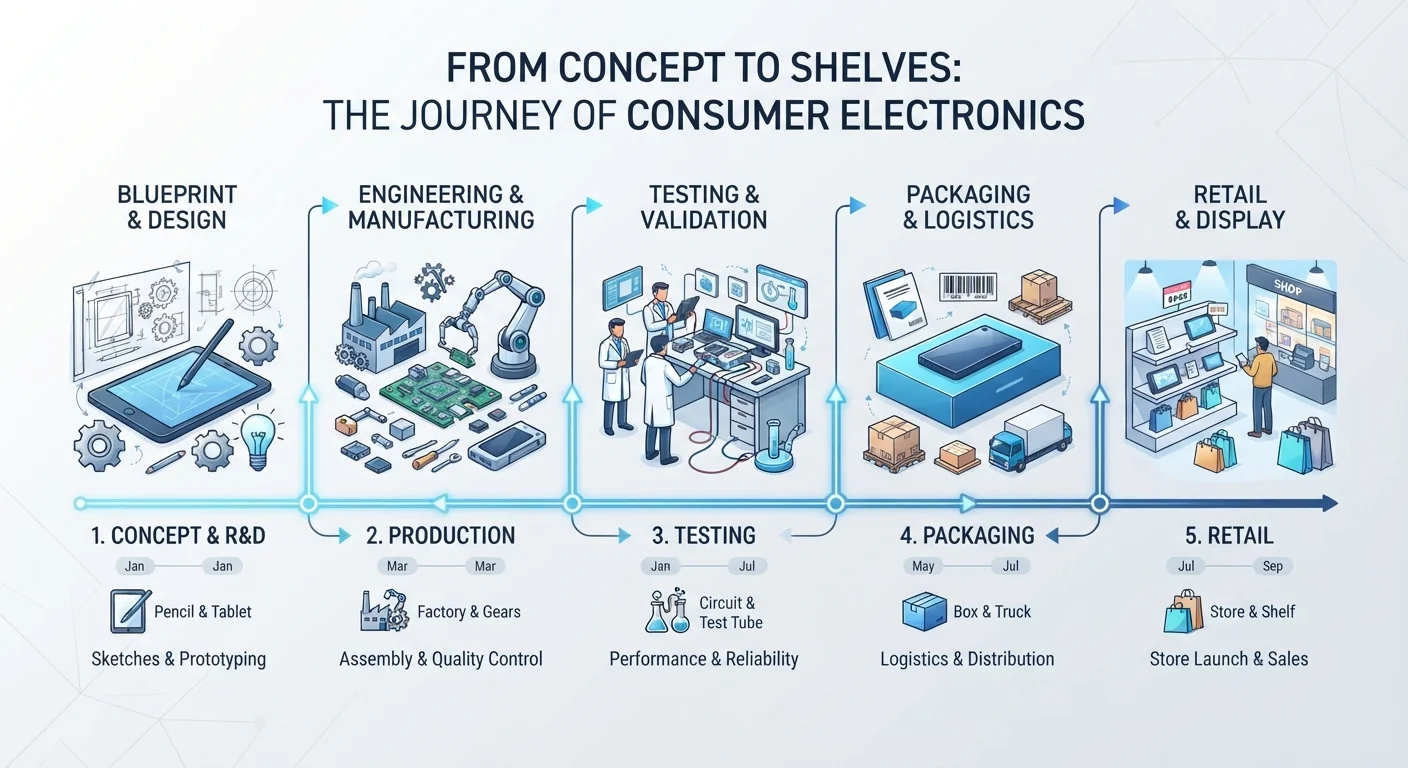
Key Takeaways
- Most gadgets follow a predictable cycle: development, announcement, launch, maturity, and replacement.
- Announcements often precede actual availability by weeks or months - sometimes longer.
- Price and feature value both shift as a product moves through its cycle.
- Knowing cycle patterns helps consumers time decisions without relying on marketing pressure.
- Model generations typically follow annual or biannual rhythms in most major categories.
Consumer Gadget Product Cycle
The consumer gadget product cycle refers to the predictable sequence of stages a device goes through - from internal development and public announcement, through manufacturing and retail launch, to eventual discontinuation or replacement. Each stage follows recognizable timing patterns that repeat across product categories. Understanding where a device sits in this cycle can help you decide whether to act now or wait.
Product cycles are shaped by supply chain lead times, component availability, and competitive release windows - factors that have become more visible to consumers following global semiconductor shortages.
The Five Stages Every Gadget Goes Through
Behind every gadget on a store shelf is a journey that most consumers never see - and one that follows a strikingly consistent structure. Understanding this structure is more useful than any single product review, because it applies across categories and repeats with every new generation.
The five core stages are: development, announcement, launch, maturity, and end-of-life. Each phase carries different implications for consumers.
- Development: Engineering, prototyping, and component sourcing happen behind closed doors. Leaks sometimes surface here, but no consumer-facing information is official.
- Announcement: The manufacturer reveals the product publicly - typically at a press event or via a media release. This stage is often weeks or months ahead of actual availability.
- Launch: The device becomes available for purchase. Demand often peaks here, and inventory can be constrained early on.
- Maturity: Supply stabilizes, early software issues are patched, and pricing tends to settle. This is frequently where value peaks for consumers who aren't chasing the newest release.
- End-of-life: A successor is announced or the product is quietly discontinued. Active support windows begin winding down.
12-24 months
Typical gadget generational cycle length
Industry tracking of major consumer electronics categories shows most flagship devices refresh within this window, with smartphones skewing toward the shorter end.
3-6 months
Common announcement-to-launch gap
Analysis of major consumer electronics reveals that most products become available to consumers within this range after their public reveal, though outliers exist.
~30%
Price drop observed near end-of-cycle
Retail price tracking across categories suggests prior-generation devices commonly see meaningful discounting once a successor is formally announced.
The Gap Between Announcement and Availability
One of the most consistent patterns in the gadget cycle is the announcement-to-availability gap. Companies reveal products before they're ready to ship for competitive and marketing reasons - but this gap can range from a few weeks to well over a year in some categories.
For consumers, this creates a decision point: reacting to announcements as if a product is immediately available is a common timing mistake. A device announced at a major event in the fall may not reach widespread retail availability until the following year.
Track Category Calendars, Not Just Products
Instead of monitoring a single device, follow the announcement patterns of a product category. Most manufacturers hold predictable annual or biannual events. Knowing when those windows are means you're rarely caught off-guard by an announcement that makes your planned purchase feel premature.
This gap also affects the previous generation of devices. When a successor is announced - even before it ships - the prior model often experiences pricing shifts in the secondary and retail markets. Tracking the full cycle of a product category, not just individual releases, reveals these patterns clearly. The research on price cycles shows how these patterns can be fairly predictable across categories.
How Model Generations Create Predictable Windows
Most major gadget categories operate on recognizable generational rhythms. Flagship smartphones in leading categories have followed annual cycles for over a decade. Laptops and tablets tend toward 18-to-24-month intervals. Audio hardware and smart displays update less consistently, though major platform shifts often reset those timelines.
These rhythms mean that patient, informed consumers can develop a working sense of when a new generation is likely to arrive - and calibrate decisions around that. A device launched eight months ago in a category that refreshes annually is closer to end-of-cycle than a device launched two months ago in a biennial category.
For a broader look at how gadget categories have shifted over the past decade, including how release cadences evolved, see the evolution of consumer gadgets. And as subscription-based hardware models grow, the traditional cycle is also being complicated by ongoing service layers - something explored in how gadget subscriptions changed the electronics landscape.
What the Cycle Means for Your Decisions
Reading the product cycle doesn't require insider knowledge - it requires awareness of a few consistent signals. When a manufacturer schedules a major event, what the current product's age is, and how long software support commitments typically last are all publicly available inputs.
The maturity phase often delivers the most practical value: a device that's been available for six to twelve months has usually received meaningful software updates, has a clearer picture of real-world performance, and may have adjusted in price without yet facing obsolescence pressure. That said, individual needs and category specifics matter - there's no universally correct point in the cycle to act.
Software Support Timelines Matter Too
A device's hardware cycle is only part of the picture. How long a manufacturer commits to security updates and OS compatibility significantly affects real-world longevity. Before acting at any stage of the product cycle, checking a device's stated support window gives a clearer picture of its useful life.
Once you own a device, understanding the cycle doesn't stop being useful. How you use and maintain a gadget affects how long it remains useful relative to its generation's lifespan. The habits that extend device life article covers how everyday choices - charging practices, storage, and update management - compound over a product's lifetime. Pair that awareness with cycle literacy, and you're better equipped to get genuine value from the devices you own.