

Key Takeaways
- Electronics contain both valuable recoverable metals and materials that are hazardous in landfills.
- Most US states have e-waste laws or manufacturer take-back programs that make responsible disposal accessible.
- A working device should be wiped of personal data before recycling or donation.
- Informal or overseas e-waste processing can expose workers and communities to serious health risks.
- Buying fewer, longer-lasting devices reduces e-waste at the source more effectively than recycling alone.
E-Waste (Electronic Waste)
E-waste refers to discarded electronic devices and their components - everything from old smartphones and laptops to televisions and kitchen appliances with circuit boards. Because electronics contain a mix of valuable metals and toxic substances, they can't safely go into regular household trash. Proper recycling channels exist to recover useful materials and contain hazardous ones.
Formally classified as WEEE (Waste Electrical and Electronic Equipment) in regulatory frameworks, e-waste is one of the fastest-growing solid waste streams globally, generating tens of millions of metric tons annually according to UN data.
Why Electronics Don't Belong in the Trash
A discarded smartphone is more chemically complex than it looks. Inside a typical device are dozens of materials: copper wiring, aluminum chassis parts, a lithium battery, a glass screen, and a circuit board containing trace amounts of gold, silver, and palladium alongside potentially harmful substances like lead solder, cadmium, and flame-retardant compounds.
When electronics end up in landfills, those hazardous materials can leach into soil and groundwater over time. Incineration releases toxic compounds into the air. Neither outcome is benign - which is why e-waste is regulated differently from regular household trash in most US states.
The scale of the problem is significant. The United Nations' Global E-waste Monitor has documented that the world generates tens of millions of metric tons of e-waste each year, with formal recycling capturing only a fraction of that total. The gap between what's discarded and what's responsibly processed remains one of the larger unsolved environmental challenges in consumer technology.
62M+
Metric tons of e-waste generated globally per year
According to the UN's Global E-waste Monitor, global e-waste volumes have grown substantially each year as device adoption increases.
~22%
Share of global e-waste formally recycled
The UN's Global E-waste Monitor estimates that only roughly a fifth of global e-waste is processed through documented, formal recycling systems.
60+
Elements found in a modern smartphone
Research from materials scientists has identified more than 60 elements from the periodic table present in a typical consumer smartphone.
What Actually Happens During E-Waste Processing
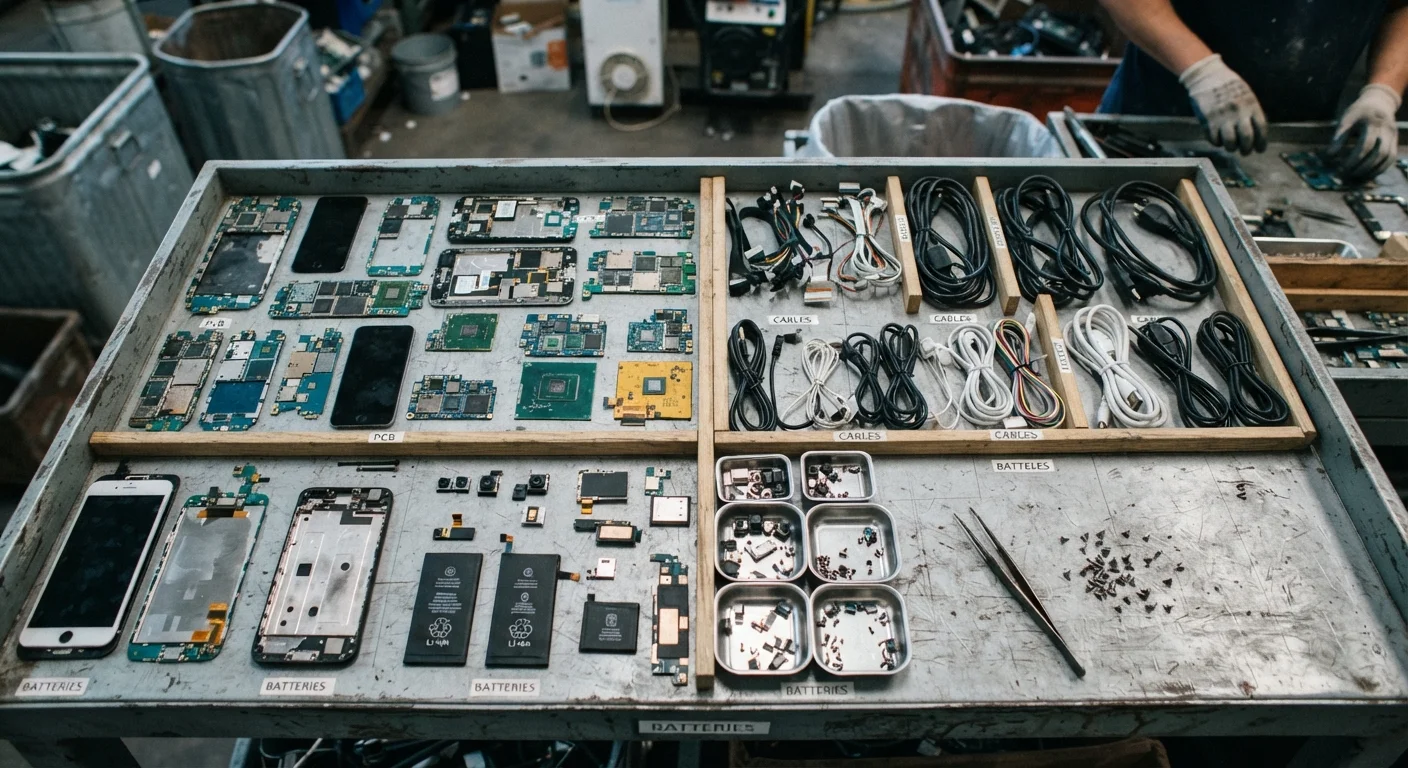
Responsible e-waste recycling is an industrial process, not a simple sort-and-melt operation. Once a device reaches a certified facility, it typically goes through several stages:
- Intake and sorting: Devices are logged and separated by category - phones, laptops, monitors, batteries - since each requires different handling.
- Data destruction: Storage media like hard drives and flash memory may be shredded, degaussed, or overwritten to ensure no recoverable data remains. Certified recyclers often provide documentation of this step.
- Disassembly: Technicians or automated systems remove batteries (which require separate handling due to fire risk), screens, and other major components before shredding occurs.
- Material separation: Shredded material passes through magnetic separators, eddy current systems, and optical sorters to divide ferrous metals, non-ferrous metals, plastics, and glass.
- Refining: Recovered metals are sent to smelters that further purify them into raw material streams that manufacturers can reuse.
The quality of this process varies significantly. Facilities certified under the R2 (Responsible Recycling) or e-Stewards standards are audited against environmental, data security, and worker-safety benchmarks. Uncertified handlers offer fewer guarantees.
“E-waste is the fastest growing solid waste stream in the world, and a very small percentage of it is being recycled in an environmentally sound manner.”
— Ruediger Kuehr, Head of the Sustainable Cycles Programme, United Nations University
The Problem With Informal Recycling
A significant portion of global e-waste - estimates vary, but researchers and NGOs have documented substantial volumes - is exported to lower-income countries where it is processed informally. Workers in these settings may burn circuit boards to extract metals, use open acid baths to dissolve components, or manually disassemble devices without protective equipment.
The health consequences for those workers, and for surrounding communities whose soil and water become contaminated, are serious and well-documented by environmental health researchers. This is why the country of origin for a recycler's downstream processing matters - something that certifications like e-Stewards specifically address by prohibiting export of hazardous e-waste to countries that lack adequate regulatory oversight.
For consumers, the practical implication is that handing a device to an uncertified collector - including some informal drop-boxes in retail parking lots - doesn't guarantee responsible outcomes. Checking for certification before choosing a recycler is a meaningful step.
For broader context on how the electronics industry is grappling with its environmental footprint, see sustainable tech and environmental responsibility.
How to Check if a Recycler Is Certified
Look for facilities certified under R2 (Responsible Recycling) or e-Stewards - the two main US audit standards for e-waste processors. Both programs maintain public directories of certified facilities on their websites, searchable by location. Certification means the facility has been independently audited for environmental, data security, and worker-safety practices.
What Consumers Can Do
Responsible disposal starts well before a device leaves your hands. A few practical steps make a meaningful difference:
- Back up and wipe your data first. A factory reset combined with removing SIM and memory cards is the baseline. For devices holding sensitive information, check whether the manufacturer provides a certified erasure process. This matters not just for recycling but for any resale or donation scenario - see also our guidance on securing your devices.
- Find a certified recycler. The EPA's Sustainable Materials Management program maintains resources on certified collectors, as do many state environmental agencies. Major retailers with take-back programs often route to certified partners.
- Consider donation if the device works. A functional device that gets a second life delays new manufacturing demand. Schools, libraries, and nonprofits often accept working electronics.
- Think upstream. Recycling is the last resort, not the primary solution. Buying devices you'll use longer, and resisting unnecessary upgrades, reduces e-waste more effectively than any end-of-life program. Our gadget self-assessment questions can help evaluate whether a new device genuinely adds value.
Battery packs - including those from laptops, phones, and increasingly EVs - warrant special mention. Lithium batteries present fire hazards if damaged and cannot go into standard e-waste streams without proper handling. For context on how larger battery systems are managed, EV battery end-of-life processes follow a similar but more complex parallel.
Lithium Batteries Require Separate Handling
Lithium-ion batteries - found in phones, laptops, tablets, and wireless earbuds - are a fire hazard if punctured or improperly handled. Never place them in standard trash or recycling bins. Many retailers that sell consumer electronics accept lithium batteries for separate collection, and Call2Recycle maintains a public locator for battery drop-off sites across the US.