

Key Takeaways
- A retired EV battery still holds significant energy and is rarely simply discarded.
- Second-life applications, such as stationary energy storage, can extend a battery's useful life by a decade or more.
- Recycling processes can recover lithium, cobalt, nickel, and manganese for reuse in new batteries.
- The EV battery recycling industry in the US is still maturing, and infrastructure gaps remain.
- Battery degradation happens gradually; understanding it helps owners make informed decisions about used EVs.
EV Battery End of Life
An EV battery reaches its "end of life" for vehicle use when it can no longer hold enough charge to meet a driver's range needs - typically when capacity falls to around 70-80% of the original rating. At that point, the battery isn't dead; it still holds significant energy. End-of-life batteries can enter a second-life application or go through a recycling process to recover valuable materials.
Lithium-ion cells degrade through calendar aging and cycle aging, driven by chemical changes inside the cell. Capacity fade is gradual, not sudden, so determining an exact end-of-life threshold depends on the use case.
When Does an EV Battery Reach End of Life?
EV batteries don't fail like a light bulb. Capacity fades gradually over years of charging cycles and calendar time. Most automakers and researchers use a threshold of roughly 70-80% of original capacity as the practical end-of-life point for vehicle use - meaning a battery that once delivered 250 miles of range might now deliver 175-200 miles.
What triggers retirement varies. For some drivers, reduced range becomes inconvenient. For fleet operators, it affects operational efficiency. Physical damage or a failed cell module can also accelerate the decision. For a deeper look at how that degradation unfolds, see what research actually shows about EV battery degradation over time.
The key point: a retired vehicle battery is not a dead battery. It still stores and delivers electricity - just not enough for demanding driving ranges.
Second-Life Applications: Putting Retired Batteries Back to Work
One of the most promising outcomes for a retired EV battery is a second career in stationary energy storage. Utilities, commercial facilities, and even residential solar setups can use batteries that no longer meet automotive standards but still have substantial storage capacity.
In a stationary role, batteries don't face the same stress as in a vehicle - no rapid acceleration demands, more controlled temperature environments, and slower discharge rates. This gentler duty cycle means a battery could serve another decade or more in a storage role after leaving a car.
Several automakers and energy companies have explored second-life programs. The practical challenge is that repurposing requires testing each retired pack, disassembling modules, and reconfiguring them - all labor-intensive steps that affect the economics of the approach.
Maximizing Battery Longevity Before Retirement
Keeping an EV battery within a moderate state of charge - avoiding frequent charging to 100% or depleting to near zero - can slow capacity fade. Thermal management systems also play a significant role; following manufacturer guidance on charging in extreme temperatures helps preserve long-term health.
Battery Recycling: Recovering What's Inside
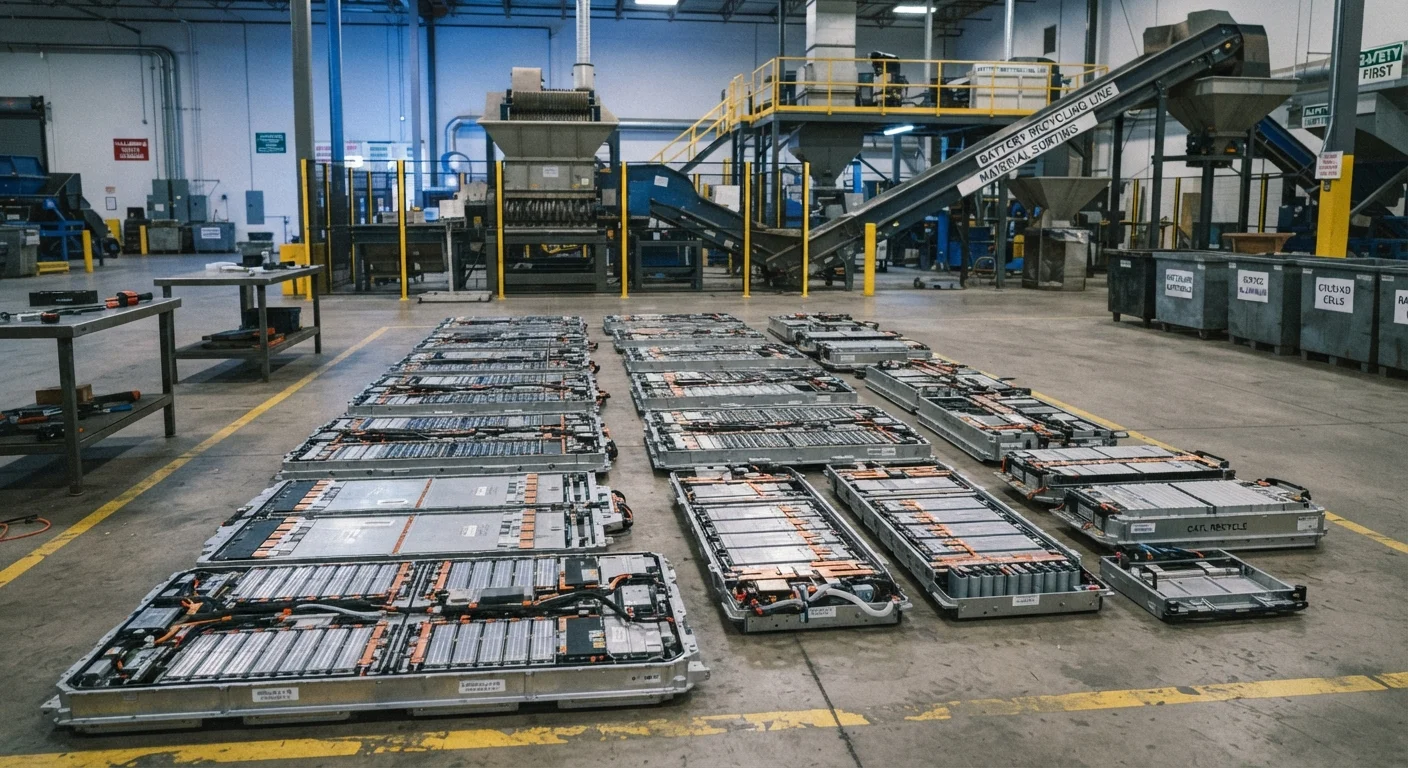
When a battery is too degraded for second life, recycling is the next step. EV batteries contain lithium, cobalt, nickel, manganese, and other materials that are both economically valuable and environmentally significant to keep out of landfills.
~70-80%
Typical capacity threshold for vehicle retirement
Industry and research generally cite this range as the practical end-of-life point for automotive use, though exact thresholds vary by manufacturer and application.
10+ years
Potential second-life storage service
Researchers and industry analysts have suggested stationary applications can extend a retired battery's useful life by a decade or more, depending on duty cycle and condition.
95%+
Material recovery rate in advanced hydrometallurgy
Leading hydrometallurgical processes have demonstrated high recovery rates for key metals including lithium, cobalt, and nickel in controlled conditions.
Two main recycling methods are in use today. Hydrometallurgy uses water-based chemical processes to dissolve and extract metals - it's energy-efficient and yields high-purity materials. Pyrometallurgy uses high-temperature smelting to recover metals, though it consumes more energy and may require additional processing steps.
A newer approach called direct recycling aims to recover cathode materials with their chemical structure largely intact, potentially reducing the energy needed to produce new battery materials. Research is ongoing, and commercial-scale direct recycling remains limited as of this writing.
The US battery recycling infrastructure is still developing. Government programs and private investment are working to close gaps, but collection logistics - getting batteries from end-users to processors safely - remain a practical challenge. For broader context on electronics recycling, how e-waste processing works offers useful parallel perspective.
What This Means for EV Owners and Buyers
For current and prospective EV owners, battery end-of-life considerations touch several practical areas. Battery health affects EV resale value - a pack closer to its end-of-life threshold will typically reduce what a used vehicle commands on the market.
Warranty Coverage Varies by Manufacturer
Federal regulations require automakers to warrant EV batteries for at least 8 years or 100,000 miles for certain defects and capacity loss. Coverage specifics differ by brand and model year, so reviewing the warranty documentation for any vehicle you own or are considering is worthwhile.
If you're considering a used EV, understanding the battery's state of health is essential. Many modern EVs display this data through onboard menus or third-party apps. The full picture on buying a used EV covers what to scrutinize before purchasing.
From an environmental standpoint, the lifecycle of an EV battery - manufacture, use, second life, and recycling - is central to calculating the vehicle's overall footprint. Lifecycle emissions analysis examines where the evidence points and where genuine uncertainty remains.
The bottom line: EV batteries at end of vehicle life are a resource, not just a waste problem. How well the industry develops second-life and recycling pathways will shape the long-term sustainability case for electric vehicles in the US.