

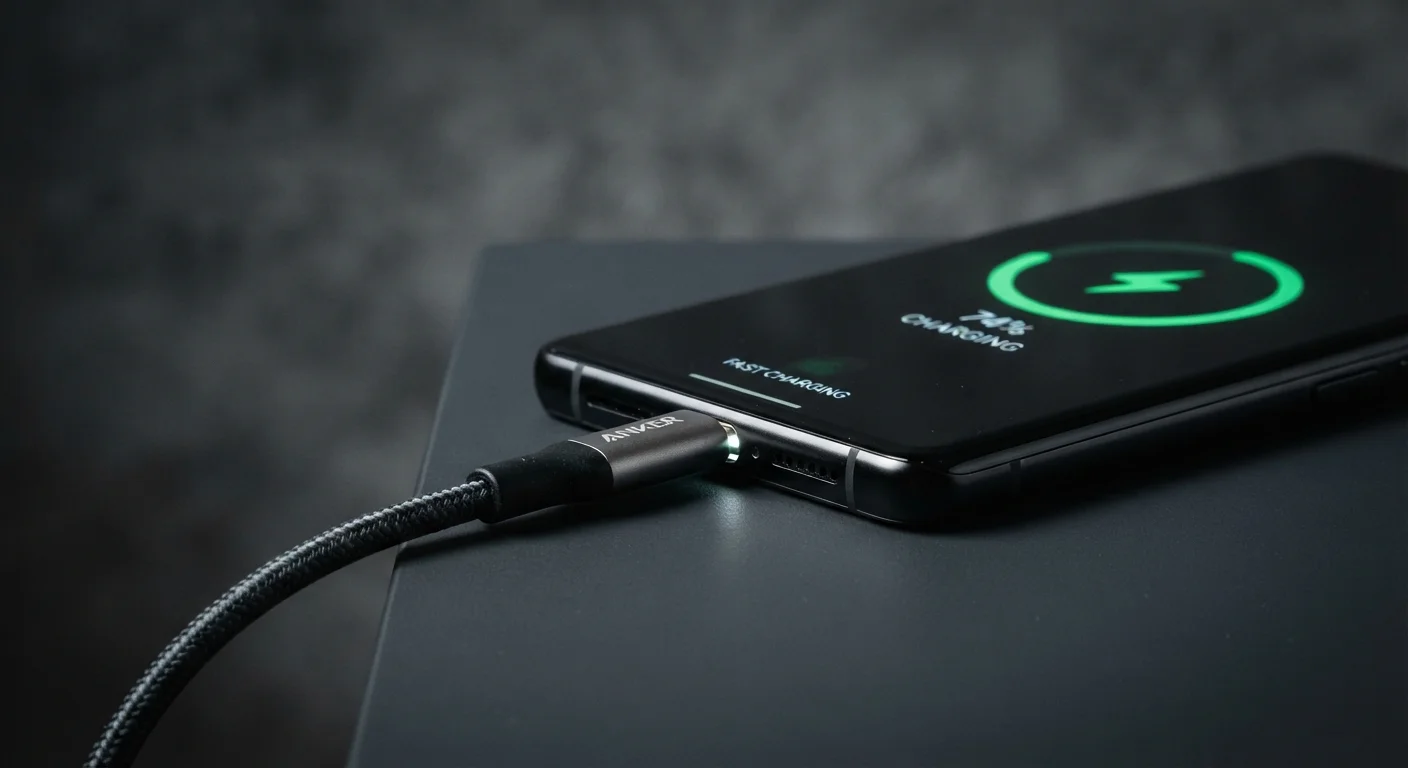
Key Takeaways
- A charger's wattage rating reflects its maximum output - not what your device will actually receive.
- Fast charging speed depends on the phone, cable, adapter, and battery level all working in sync.
- Peak wattage is only sustained for a short window, typically in the first 20-30% of a charge cycle.
- Higher wattage does not always mean faster full-charge times or less battery wear.
- Charging slows deliberately as the battery fills to protect long-term cell health.
What Wattage Actually Tells You
When a charger or phone box advertises "65W fast charging" or "120W SuperCharge," it's stating a ceiling, not a guarantee. That number represents the maximum power transfer the hardware is rated to handle under ideal conditions - a full agreement between the charger, cable, and device using the same fast-charging protocol.
In practice, power delivery is negotiated dynamically. When you plug in, the charger and phone exchange signals to determine what both ends can safely support. If anything in that chain - the cable, the wall adapter, or even the phone's current temperature - falls short, the negotiated rate drops accordingly. A 65W charger paired with a standard USB-A cable, for instance, may deliver as little as 5W to 18W.
For a practical breakdown of how wattage ratings interact with real-world output across portable power products, see our guide to portable charger specs.
Myth
A charger rated at 65W will always deliver 65W to my device.
Fact
The charger only delivers its rated maximum when the device, cable, and charging protocol all match - a rare combination outside of controlled testing.
Power delivery is a negotiated handshake. If your phone's charging controller tops out at 25W, or your cable isn't rated for high-speed data and power transfer, the actual wattage delivered drops to the lowest common denominator in that chain. Always verify that the cable and adapter are rated to match the phone's fast-charging specification.
Myth
A higher wattage charger will charge my phone faster from start to finish.
Fact
Peak wattage is only sustained during the early phase of charging; speed tapers significantly as the battery approaches full capacity.
Lithium-ion batteries use a constant-current phase (where speed is highest) followed by a constant-voltage phase (where current drops to protect the cells). A 100W charger won't deliver 100W for an entire hour - it may hit peak output only for the first 15-20 minutes, then step down. Total charge time can be surprisingly similar across chargers with different peak ratings once this taper is factored in.
Myth
Any USB-C cable works for fast charging.
Fact
USB-C is a connector standard, not a performance standard - cables vary widely in their power and data transfer capabilities.
A USB-C cable can be rated for anywhere from 3W to well over 100W depending on its internal wiring and certification. Cheap or uncertified cables may lack the e-marker chip required to support high-wattage delivery, defaulting to 5V/0.9A (about 4.5W). Using the wrong cable is one of the most common reasons a fast charger performs no better than a standard one.
Myth
Fast charging damages your battery more quickly than slow charging.
Fact
Modern fast charging is engineered with protective limits; heat - not speed alone - is the primary risk factor for battery degradation.
Phone manufacturers and charging chip designers build thermal management and voltage protection into fast-charging systems specifically to limit cell stress. The real concern is sustained heat. If a device gets noticeably hot during charging, it may be a sign the charger or phone is exceeding safe thermal limits. Occasional fast charging in normal temperature conditions is unlikely to cause measurable degradation beyond normal long-term wear.
Myth
The fast charging speed shown in ads reflects what you'll experience day to day.
Fact
Advertised speeds are typically measured from 0% in controlled lab conditions - not from typical mid-use starting points.
Marketing demonstrations often start from a fully drained, cool battery with an OEM cable and adapter. Most real-world charging sessions begin at 20-50% battery, with a phone that's already warm from use, often using a third-party charger. These factors all reduce the delivered wattage. Treating advertised times as a best-case ceiling rather than an average is a more reliable frame of reference.
Why the Clock Doesn't Match the Box
Manufacturers often demonstrate fast charging with a device battery that starts at or near zero, in a cool room, using proprietary cables and certified adapters. Those are the conditions that produce headline numbers like "0 to 50% in 15 minutes."
Real charging sessions rarely match that setup. A phone that's already at 40%, warm from use, plugged into a third-party adapter won't charge at peak rate. More importantly, fast charging doesn't maintain its top speed throughout - it tapers as the battery fills. This is intentional. Lithium-ion chemistry requires a two-stage charging approach: fast current early, then a slower "top-off" phase. The result is that the last 20-30% of a charge can take as long as the first 70%.
~15 min
Typical peak fast-charging window
Independent charging analyses consistently show that peak wattage is sustained for only 15-20 minutes before thermal and voltage limits trigger a deliberate speed reduction.
Up to 40%
Potential charge-speed drop from cable mismatch
Testing by hardware reviewers has found that using a non-certified or lower-rated cable can reduce effective charging wattage by 30-40% compared to a certified, spec-matched cable.
Understanding this taper effect matters especially for EV drivers. Our article on why fast charging slows after 80% explains the electrochemistry in detail, and what the 80% charge ceiling really means covers when that guideline is worth following.
Heat Is the Real Enemy of Battery Life
If your phone becomes uncomfortably hot during fast charging, consider switching to a lower-wattage charger or removing the case to improve heat dissipation. Repeated high-heat charging cycles are more likely to degrade battery capacity over time than the charging speed itself. Most modern phones will automatically throttle charging speed when temperatures rise - if yours doesn't seem to, check whether a software update is available.
Making Smarter Decisions About Charging Gear
The gap between marketing claims and real-world results isn't necessarily deceptive - it's a product of testing under optimal, controlled conditions. But it does mean consumers need to ask a different set of questions. Instead of comparing peak wattage numbers alone, look at whether the charger and phone share a common fast-charging protocol (such as USB Power Delivery or Qualcomm Quick Charge), whether the included or recommended cable is rated for the full wattage, and what independent reviewers measure as real-world charge times.
High wattage also doesn't automatically mean better battery longevity. Faster charging generates more heat, and sustained heat is one of the primary factors in long-term lithium-ion degradation. Some phones actively throttle charging speed in warm conditions to protect battery health - which is a feature, not a flaw. For EV owners navigating similar trade-offs, see our explainer on charging habits that accelerate battery wear.
The most useful metric is often the simplest: how many minutes does it take to reach 80% from near-empty under typical conditions? That's the number that reflects a real charging session - not the theoretical peak printed on the box.