

Key Takeaways
- Most smart home devices are designed around closed ecosystems, which limits how well they work with competing brands.
- Different wireless protocols (Wi-Fi, Zigbee, Z-Wave, Bluetooth) create compatibility gaps that frustrate consumers.
- Matter, a newer industry standard, aims to create a common language for smart devices across major platforms.
- Even with emerging standards, full interoperability remains a work in progress - not a solved problem.
- Understanding these limitations before buying helps set realistic expectations for a connected home.
Smart Home Interoperability
Interoperability is the ability of different smart home devices - made by different companies, using different technologies - to communicate and work together without special workarounds. When interoperability works well, a smart bulb from one brand responds reliably to a voice assistant from another. When it breaks down, you end up managing multiple apps, isolated devices, and a system that feels more complicated than helpful.
Interoperability depends on shared communication protocols and data standards. Devices that speak incompatible protocols - such as Zigbee, Z-Wave, or proprietary Wi-Fi stacks - cannot natively exchange commands or status without a bridging layer.
The Problem in Plain Terms
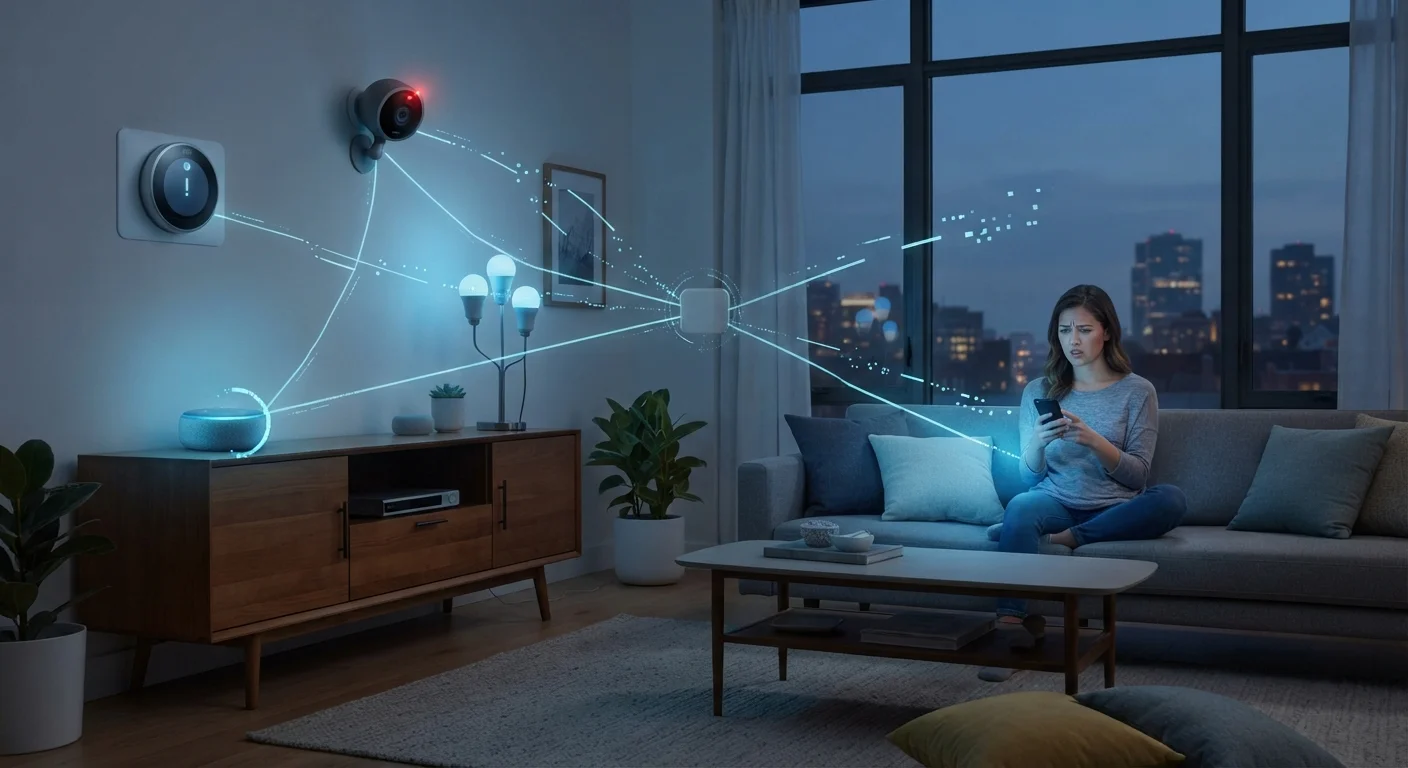
Imagine buying a smart thermostat, a set of smart bulbs, and a video doorbell - only to discover each requires its own app, and none of them share information with the others. That frustration is interoperability failure, and it's far more common than the sleek marketing for smart home products suggests.
If you're new to connected devices, our beginner's guide to smart home devices covers how these gadgets work at a foundational level. The interoperability problem builds on top of that foundation - it's what happens when individual devices that work fine on their own can't work together as a system.
This Is an Industry-Wide Issue, Not a Device Defect
When a smart home device doesn't work with another brand's products, it's usually not because the device is broken or poorly made. The limitation is structural - rooted in incompatible standards and ecosystem boundaries. Recognizing this distinction helps consumers troubleshoot more effectively and set realistic expectations from the start.
Why Devices End Up in Silos
The root cause is competitive product design. When the smart home industry was developing rapidly, companies built proprietary ecosystems to lock in customers. Amazon's devices worked best with Alexa. Google's products favored Google Home. Apple built around HomeKit. Each ecosystem has its own rules, and those rules weren't designed with rivals in mind.
The wireless protocols devices use compound the problem. Zigbee, Z-Wave, Wi-Fi, and Bluetooth are all legitimate communication technologies - but they're not mutually compatible. A Zigbee-based sensor and a Wi-Fi thermostat can't directly exchange data without an intermediary hub that translates between them. As this explainer on connected device communication outlines, the protocol layer is where many compatibility problems actually originate.
480M+
Smart home devices shipped globally in recent years
Industry analysts tracking smart home growth have estimated hundreds of millions of devices shipping annually, underscoring the scale of the compatibility challenge.
3+
Separate apps used by average multi-brand smart home owners
Consumer research on smart home usage consistently finds that households mixing brands end up managing multiple control apps, fragmenting the experience.
200+
Companies involved in developing the Matter standard
The Connectivity Standards Alliance, which oversees Matter, counts over 200 member companies participating in developing and certifying the interoperability standard.
The Promise - and Limits - of Matter
Matter, a standard developed by the Connectivity Standards Alliance with support from Apple, Google, Amazon, and Samsung, represents the most serious industry attempt at solving interoperability. The idea is straightforward: certify devices to a shared specification so that a Matter-compliant bulb works with a Matter-compliant hub, regardless of brand.
In practice, Matter has delivered real progress. Devices certified under the standard can communicate across supported platforms without proprietary bridges. But several important caveats apply. Not all device categories are included - smart lawn systems, some security cameras, and niche appliances remain outside the spec. Older devices generally can't be updated to Matter compatibility through software alone. And voice assistant ecosystems still vary in how fully they embrace the standard in everyday use.
Check for Matter Certification Before You Buy
When shopping for new smart home devices, look for the Matter logo or certification label on the packaging or product listing. Matter-certified devices have a significantly higher chance of working across different platforms and hubs. This doesn't guarantee perfect compatibility with every system, but it's currently the strongest signal of broad interoperability support available to consumers.
What This Means for Everyday Consumers
Understanding interoperability before purchasing makes a meaningful difference. Buying all devices from within one ecosystem tends to produce a smoother experience, but creates long-term dependency on that platform. Mixing brands offers more flexibility but requires more setup work, and occasionally some features simply won't work across brands even when devices are nominally compatible.
Privacy is also part of the picture. Devices that communicate across multiple platforms create more data-sharing touchpoints. Our related coverage on smart home privacy trade-offs explores this dimension in depth.
The interoperability challenge isn't a reason to avoid smart home technology - it's a reason to go in with clear expectations. Checking for Matter certification, confirming protocol compatibility with existing devices, and planning around a central hub where needed are practical steps that reduce friction significantly. The promise of a truly seamless smart home is real; the industry just isn't fully there yet.