

Key Takeaways
- Every vehicle has at least four blind spot zones: front corners, rear corners, and behind the vehicle.
- Mirrors reduce but do not eliminate blind spots - a brief shoulder check is still essential before lane changes.
- Large trucks have substantially bigger blind zones; avoid lingering alongside them.
- Blind spot monitoring systems assist awareness but should not replace active mirror use and head checks.
- Proper mirror adjustment is the first line of defense and takes only seconds to set correctly.
Vehicle Blind Spot
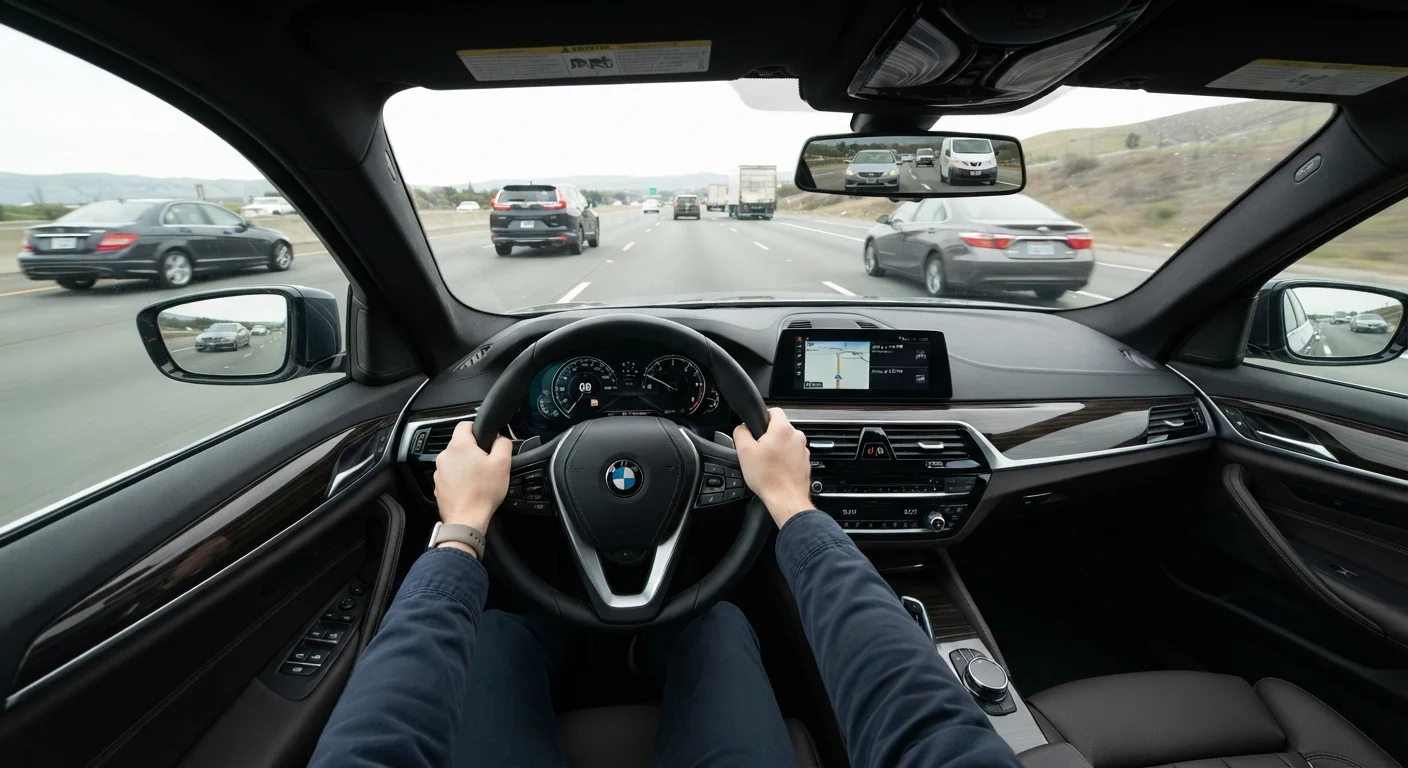
A blind spot is any area around your vehicle that you cannot see through your mirrors alone while sitting in a normal driving position. These zones exist because mirrors have physical limits - they reflect only part of the space surrounding your car. Objects, pedestrians, or other vehicles located in a blind spot are invisible to the driver without an additional head check or assistive technology.
Blind spot size varies significantly by vehicle type: SUVs, trucks, and vans have larger blind zones than sedans, particularly at the rear and sides, due to their higher ride height and body design.
Where Blind Spots Form on a Typical Vehicle
No mirror setup - no matter how well adjusted - can show you every inch of the space around your vehicle. Blind spots exist because mirrors reflect at fixed angles, and the human field of view from the driver's seat has natural limits set by the car's body structure.
On a standard passenger sedan, the primary blind spots are the rear left and rear right quarters - the diagonal zones behind each shoulder. A vehicle traveling in an adjacent lane can sit squarely in this area and be invisible in both the side and rearview mirrors simultaneously.
Secondary blind spots include the area directly behind the vehicle (especially relevant when reversing) and a narrow zone at the front corners of the hood. Taller vehicles - SUVs, pickup trucks, and minivans - tend to have larger and more pronounced blind zones due to thicker pillars and higher seating positions that change sightlines.
For a deeper look at how blind zones compound in specific conditions, see how nighttime driving affects visibility.
Blind Spots Are Larger at Higher Speeds
At highway speeds, a vehicle can travel through your mirror's coverage zone and enter your blind spot in well under a second. The faster traffic moves, the more quickly a following vehicle can appear in - and disappear from - your side mirror's field of view. Increasing your shoulder-check frequency during lane changes at highway speeds compensates for this effect.
How Mirrors Help - and Where They Fall Short
Mirrors are your first and most important tool. Setting them correctly before every drive is worth the effort. For side mirrors, the goal is to angle each one far enough outward that you see only a thin sliver of your own vehicle's side panel - most drivers angle them too far inward, showing more of their own car than the road beside it.
The rearview mirror should frame the full rear window. Together, a well-adjusted three-mirror setup creates a near-continuous band of coverage from one side of the vehicle to the other - but near-continuous is not the same as complete. The gaps between mirror coverage zones are precisely where blind spots live.
This is why a shoulder check - a quick glance over the appropriate shoulder before changing lanes or merging - remains a core driving technique regardless of how good your mirrors are. It takes roughly one to two seconds and closes the coverage gap mirrors cannot address.
Quick Mirror Reset After Passengers Adjust Your Seat
If someone else drives your vehicle and changes the seat position, your mirror angles shift too - even if the mirrors weren't physically moved. Always re-check all three mirrors whenever the seat position changes. It takes under a minute and ensures your coverage zones are accurate for your height and seating position.
Developing good scanning habits is part of broader road awareness. Experienced drivers scan for more than just what's directly ahead - blind spot awareness is one component of that larger skill set.
Blind Spot Monitoring Technology: A Useful Supplement
Many vehicles produced in recent years include blind spot monitoring (BSM) systems, which use radar sensors or cameras mounted near the rear bumper to detect vehicles entering the side blind zones. When a vehicle is detected, a warning light - usually in or near the side mirror housing - illuminates, and some systems add an audible chime if you engage a turn signal while a vehicle is present.
BSM is a genuine safety benefit, but it has real limitations. Sensor range and detection angles vary by system. Motorcycles, bicycles, and pedestrians may not always trigger alerts. Road debris or sensor blockage can reduce effectiveness. Treat BSM as a backup layer, not a replacement for mirror use and shoulder checks.
Understanding how large trucks manage their own far larger blind zones adds useful context - truck BSM systems, where equipped, face even greater coverage challenges.
Practical Habits for Managing Blind Spots Every Drive
Managing blind spots is a repeatable process, not a one-time adjustment. A few consistent habits cover most situations drivers encounter:
- Set mirrors before moving. Adjust all three mirrors at the start of every trip, especially if others drive the same vehicle.
- Signal first, then check. Activating your turn signal before checking mirrors and performing a shoulder look gives nearby drivers time to react.
- Don't linger in others' blind spots. When passing another vehicle, move through the blind zone quickly rather than cruising alongside it. This matters most with large trucks - semi-trucks have blind zones extending 20 feet in front and up to 200 feet behind.
- Slow-speed awareness counts too. Blind spots are just as relevant when parking or reversing. Parallel parking requires careful use of mirrors and spatial judgment precisely because the rear blind zone expands at low speeds.
~840,000
Blind spot-related crashes per year in the US
The National Highway Traffic Safety Administration has estimated that hundreds of thousands of crashes annually involve blind spot-related factors, with lane-change maneuvers being the most common scenario.
20-30 ft
Rear blind zone on large semi-trucks
Federal Motor Carrier Safety Administration guidance notes that large trucks carry no-zone areas directly behind the trailer where following vehicles are invisible to the driver.
Weather also compounds blind spot risk - reduced contrast and altered depth perception make it harder to detect vehicles in your peripheral zones. Adapting your mirror-check frequency in poor visibility conditions is a practical extension of this awareness.