

| AC charging connector (non-Tesla US standard) | SAE J1772 (SAE International) |
| NACS formalized as open standard | 2023 (SAE J3400) (SAE International, 2023) |
| CCS maximum power output | Up to 350 kW (theoretical) (CharIN e.V. specification) |
| CHAdeMO typical power output | 50-100 kW (common US deployments) (CHAdeMO Association) |
| NACS maximum power output | Up to 250 kW (Tesla Supercharger V3) (Tesla engineering documentation) |
| J1772 maximum power output | Up to 19.2 kW (Level 2) (SAE J1772 specification) |
Why the US Has Multiple Connector Standards
Unlike a household power outlet, there is no single universal plug for electric vehicle charging in the United States. The market developed quickly and in parallel across multiple continents, producing several competing standards before any single format could dominate. The result is a patchwork of connectors that depends on your vehicle's brand, its model year, and the type of charging involved.
Understanding the four main connector types - J1772, CCS, CHAdeMO, and NACS - helps you know what charging options are available to you and what equipment or adapters a given vehicle can use. For a broader look at how AC and DC charging differ technically, see our explainer on AC vs. DC charging.
| AC charging connector (non-Tesla US standard) | SAE J1772 (SAE International) |
| NACS formalized as open standard | 2023 (SAE J3400) (SAE International, 2023) |
| CCS maximum power output | Up to 350 kW (theoretical) (CharIN e.V. specification) |
| CHAdeMO typical power output | 50-100 kW (common US deployments) (CHAdeMO Association) |
| NACS maximum power output | Up to 250 kW (Tesla Supercharger V3) (Tesla engineering documentation) |
| J1772 maximum power output | Up to 19.2 kW (Level 2) (SAE J1772 specification) |
J1772: The AC Charging Standard
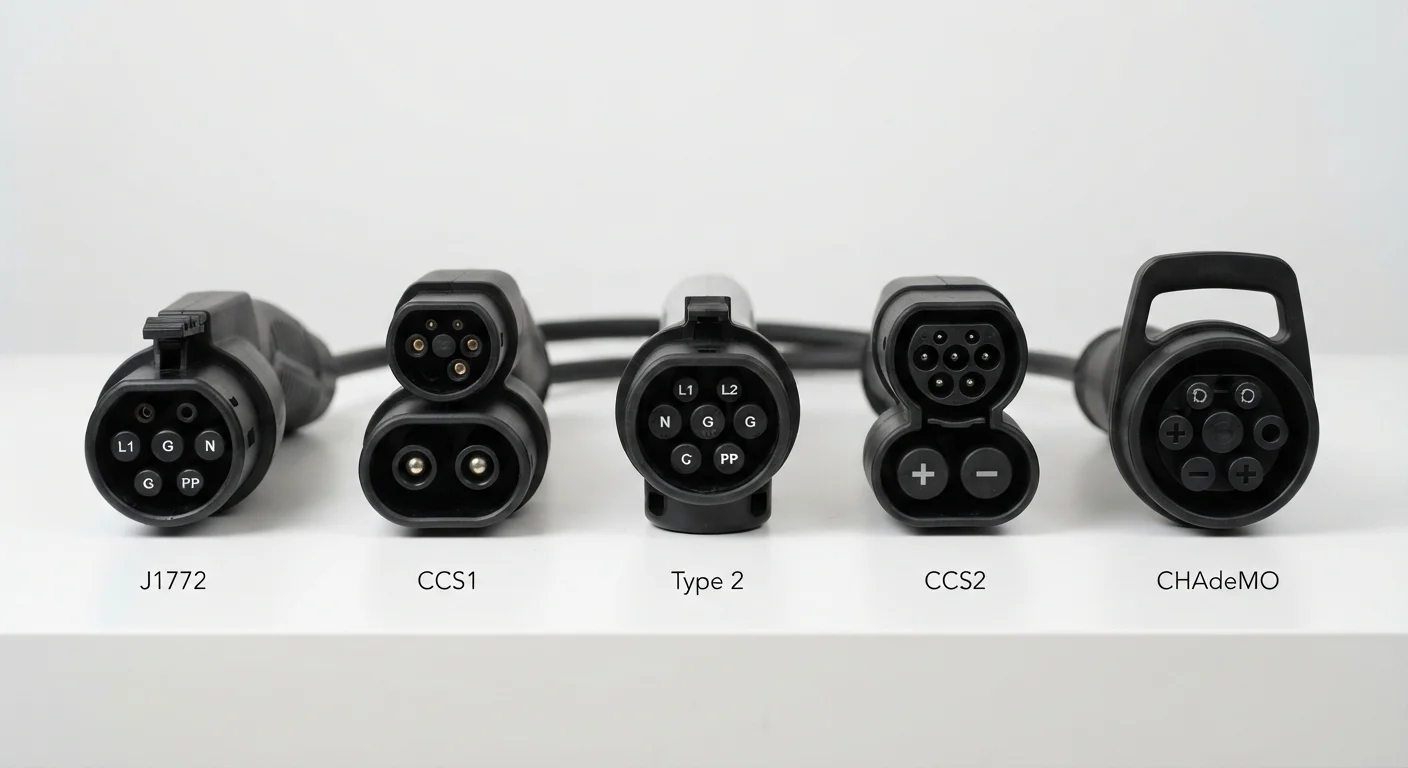
The SAE J1772 connector - often called a "J-plug" - is the standard for Level 1 and Level 2 AC charging in the United States. It has five pins: two for AC power, one for ground, and two for communication between the vehicle and the charging equipment (called the pilot and proximity signals).
Almost every non-Tesla EV sold in the US has a J1772 inlet. Even vehicles with CCS ports use J1772 for AC charging - CCS is physically built on top of the J1772 design, with two additional DC pins added below. Level 2 home chargers and public AC stations universally use this connector. If you're exploring home charging setup, our home EV charging guide covers outlet types and installation considerations.
CCS: The Dominant DC Fast-Charging Standard
CCS (Combined Charging System) extends the J1772 inlet by adding two large DC pins beneath it, allowing the same vehicle port to handle both AC and DC fast charging. This "combo" design is why it's called a combined system. CCS is supported by most major US and European automakers and currently represents the largest share of DC fast-charging ports at public stations in America.
CCS is governed by SAE (as SAE J1772 DC extension) and the CharIN consortium. Charging speeds vary widely by station and vehicle, ranging from around 50 kW at older stations to 350 kW at newer high-power installations - though most current production EVs accept less than the theoretical maximum. For a practical comparison of charging speeds by level, see Level 1, Level 2, and DC fast charging compared.
~60%
US public fast chargers using CCS (2024 estimate)
CCS accounts for the largest share of DC fast-charging ports at US public stations, per industry tracking data.
12+
Major automakers committing to NACS
As of 2024, more than a dozen automakers announced plans to adopt NACS ports on future US EV models.
~6,000
CHAdeMO ports remaining in the US
CHAdeMO port counts have declined steadily as automakers and networks shift toward CCS and NACS.
CHAdeMO: A Declining but Present Standard
CHAdeMO is a DC fast-charging standard originating from a Japanese industry group. It uses a large, round connector with a proprietary locking mechanism and was among the first DC fast-charging formats widely deployed in the US, particularly in earlier Nissan and Mitsubishi models.
CHAdeMO and CCS competed for market share through much of the 2010s. As of the mid-2020s, CHAdeMO is in clear decline in North America - most new EVs no longer support it, and charging networks have slowed new CHAdeMO installations. Existing CHAdeMO ports remain at some stations, but drivers with CHAdeMO vehicles should map out availability carefully on longer routes. The Nissan LEAF remains the most common CHAdeMO vehicle on US roads.
Adapters Can Bridge the Gap
Many EVs can use adapters to access charger types that don't match their native port. For example, CCS-to-NACS adapters allow some vehicles to use Tesla Superchargers, and NACS-equipped vehicles can use CCS stations with an adapter. Adapter compatibility depends on both the vehicle and the charging network - check your vehicle's documentation before relying on an adapter for a long trip.
NACS: Tesla's Standard Goes Open
NACS (North American Charging Standard) - standardized by SAE as J3400 in 2023 - started as Tesla's proprietary connector design used across its entire US Supercharger network. The connector is notably slim and handles both AC and DC charging through the same port, unlike the physically larger CCS design.
In 2022, Tesla submitted the NACS design to SAE for standardization, and the industry response was substantial. More than a dozen major automakers subsequently announced plans to adopt NACS ports on future US models, and major charging networks began adding NACS hardware. Vehicles with CCS ports can still access Superchargers using a CCS-to-NACS adapter where supported, and vice versa. The rapid industry shift makes NACS likely to become the dominant US standard over the next several years, though the transition will be gradual. See the current state of EV charging infrastructure for how the network is evolving.
CCS (Combined Charging System)
A DC fast-charging standard that combines an AC J1772 inlet with two additional DC power pins below it. It is currently the dominant fast-charging format for non-Tesla vehicles sold in North America and Europe.
CHAdeMO
A DC fast-charging connector standard developed by a Japanese industry consortium. It was widely deployed in early EVs but is largely being phased out in the US market as of the mid-2020s.
NACS (North American Charging Standard)
Originally Tesla's proprietary connector, NACS was submitted to SAE International as an open standard in 2022 and has since been adopted by most major automakers for future US vehicles.
J1772
The SAE-standardized AC charging connector used for Level 1 and Level 2 charging. Nearly every non-Tesla EV sold in the US uses a J1772 port for AC charging.
DC Fast Charging (DCFC)
A charging method that delivers direct current at high power directly to the vehicle's battery, bypassing the onboard AC charger. This enables significantly faster charge sessions compared to Level 1 or Level 2 AC charging.
SAE International
A global standards-developing organization for engineering and transportation. SAE maintains J1772 and has standardized NACS as SAE J3400.