

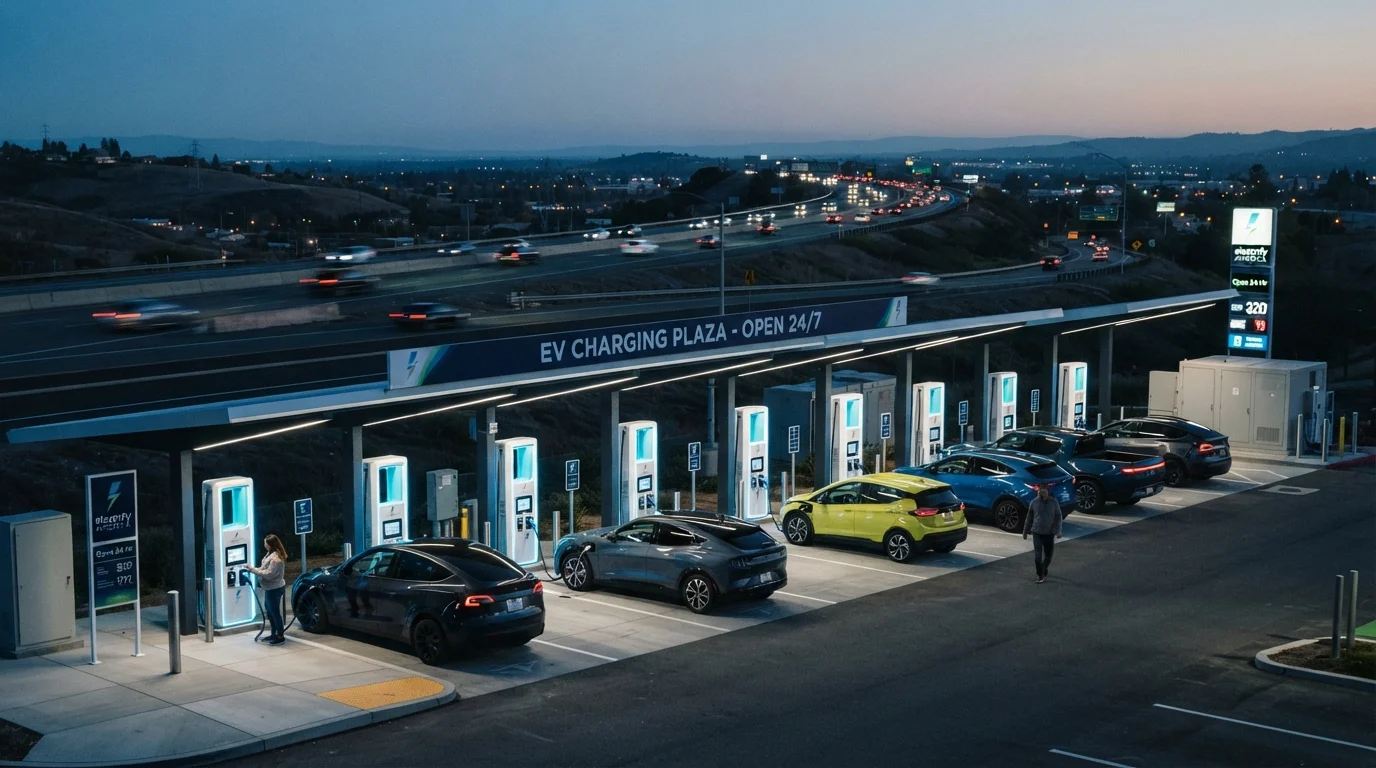
| Public charging stations (US) | 60,000+ (US DOE Alternative Fuels Station Locator) |
| Total public charging ports (US) | 160,000+ (US DOE Alternative Fuels Station Locator) |
| Share of ports that are DC fast chargers | ~20-25% (DOE data, approximate) |
| NEVI program total funding | $5 billion (Infrastructure Investment and Jobs Act, 2021) |
| NEVI minimum required uptime | 97% (Federal NEVI program standards) |
| NEVI minimum port power output | 150 kW per port (Federal NEVI program standards) |
How Many Public Chargers Exist in the US Today
As of data published by the US Department of Energy's Alternative Fuels Station Locator, the United States had surpassed 60,000 public EV charging stations and more than 160,000 individual charging ports. That figure has grown substantially year over year, driven by private investment and federal funding programs alike.
| Public charging stations (US) | 60,000+ (US DOE Alternative Fuels Station Locator) |
| Total public charging ports (US) | 160,000+ (US DOE Alternative Fuels Station Locator) |
| Share of ports that are DC fast chargers | ~20-25% (DOE data, approximate) |
| NEVI program total funding | $5 billion (Infrastructure Investment and Jobs Act, 2021) |
| NEVI minimum required uptime | 97% (Federal NEVI program standards) |
| NEVI minimum port power output | 150 kW per port (Federal NEVI program standards) |
The distinction between stations and ports matters. A single station may house two ports or twenty. When comparing networks or regional coverage, port counts offer a more accurate picture of actual charging capacity. For a breakdown of what different charger types deliver in speed and use case, see Level 1, Level 2, and DC Fast Charging compared.
DC fast chargers - the type capable of adding meaningful range in under 30 minutes - represent roughly 20-25% of total public ports. The majority of public infrastructure remains Level 2, which is better suited to destination charging at workplaces, hotels, and retail locations than to intercity travel.
Regional Distribution: Where the Gaps Are
Charging infrastructure is heavily concentrated in a handful of states. California alone accounts for a disproportionate share of public ports nationally. Other high-density states include New York, Texas, Florida, and Washington. Meanwhile, large portions of the rural Midwest, Great Plains, and Deep South have comparatively sparse coverage.
60,000+
Public EV charging stations nationwide
According to the US Department of Energy's Alternative Fuels Station Locator database.
~30%
Share of US public ports located in California
California's leading policy environment and EV adoption rate have concentrated infrastructure there disproportionately.
$5B
Federal NEVI program funding commitment
Allocated over five years through the Infrastructure Investment and Jobs Act for highway corridor charging buildout.
This geographic imbalance creates a real friction point for EV adoption outside urban cores. Rural drivers face longer gaps between stations on many routes, and the challenge goes beyond inconvenience - it affects range planning for long-distance travel. The practical realities of owning an EV in underserved areas are covered in detail in Going Electric in a Rural Area.
Interstate corridor coverage has improved as federal programs prioritize highway routes, but "coverage" doesn't always mean adequate density. A single fast charger at a rest stop serving a high-traffic route can result in queuing during peak travel periods.
Reliability: The Data Behind the Complaints
Station availability is one thing; station reliability is another. A study published by researchers at the University of California, Berkeley found that a meaningful percentage of public fast chargers surveyed in the San Francisco Bay Area were non-functional at the time of visit - with issues ranging from broken payment systems to unresponsive screens. While that study covered a specific region and point in time, industry observers broadly agree that uptime inconsistency remains a legitimate concern across networks.
Uptime Standards Are Now a Federal Requirement
NEVI-funded stations must maintain 97% uptime as a condition of receiving federal dollars - a standard that does not apply retroactively to existing privately funded stations. This creates a two-tier landscape where newer federally supported sites may outperform older network infrastructure. Drivers should check real-time availability through network apps or aggregator tools before relying on a specific station along a route.
Network operators have responded with improved monitoring systems, and some have published uptime commitments. Federal funding programs have also begun to include reliability requirements as conditions of grant eligibility, which is intended to raise the floor on station performance over time.
For practical guidance on navigating public networks - including how to locate working stations and what to expect at each stop - see EV Charging on the Road.
Federal Investment and the NEVI Program
The National Electric Vehicle Infrastructure (NEVI) Formula Program, established under the Infrastructure Investment and Jobs Act, allocated $5 billion over five years to build out charging along designated Alternative Fuel Corridors - primarily the interstate highway system. States are required to submit deployment plans and meet federal standards for charger spacing, power output, payment systems, and uptime.
NEVI-funded stations must include at least four DC fast charging ports capable of simultaneously delivering 150 kW or more, accept credit card payment without requiring an app or membership, and maintain a minimum 97% uptime. These requirements address several of the most common public complaints about existing infrastructure.
Funding disbursement and actual construction have lagged initial timelines in some states, partly due to permitting, utility interconnection delays, and supply chain factors. The broader question of whether the grid can absorb rapidly growing EV demand is addressed in The Grid Readiness Question.
DC Fast Charger (DCFC)
A charger that uses direct current to deliver high power - typically 50 kW to 350 kW - directly to an EV's battery, enabling significant range recovery in 20-45 minutes depending on the vehicle.
Level 2 Charger
An AC charger operating at 240 volts, typically delivering 7-19 kW. Common at workplaces, hotels, and retail locations; adds roughly 10-30 miles of range per hour of charging.
NEVI (National Electric Vehicle Infrastructure)
A federal formula program providing $5 billion to states to build EV charging along designated highway corridors, with specific standards for charger power, uptime, and payment accessibility.
NACS (North American Charging Standard)
A connector and charging protocol originally developed by one automaker and now widely adopted across the US industry as a common standard, replacing the need for multiple adapter types at many stations.
Charging Port
A single connection point at a charging station where one vehicle can plug in. A station may have multiple ports, meaning multiple vehicles can charge simultaneously.
Alternative Fuel Corridor
Federally designated highway routes prioritized for alternative fuel infrastructure, including EV charging, under the NEVI program and earlier DOT designations.
Connector standards also play a role in infrastructure planning. The industry shift toward NACS (North American Charging Standard) - originally developed by one major automaker and now adopted broadly - is reshaping which plugs stations need to support. See EV Connector Standards in the US for a full comparison. For drivers weighing the cost side of public versus home charging, The Real Cost of Charging an EV breaks down the math.