

Key Takeaways
- Standard auto insurance coverage types apply to EVs, but how they price out can differ from gas vehicles.
- Battery replacement costs are a significant driver of higher EV repair and total-loss calculations.
- Charging equipment at home may require separate coverage - check your homeowners policy too.
- Fewer qualified EV repair shops can mean longer claim timelines and higher labor costs.
- Asking your insurer the right EV-specific questions upfront can prevent coverage surprises later.
EV Insurance
EV insurance refers to auto insurance policies applied to battery-electric vehicles. While the fundamental coverage types - liability, collision, comprehensive, and uninsured motorist - are the same as for gas-powered cars, the way those coverages play out can differ due to EV-specific factors like high-voltage battery replacement costs, specialized repair requirements, and charging equipment. Understanding these differences helps EV owners ask more informed questions when shopping for or reviewing a policy.
Some insurers have begun offering EV-specific endorsements or riders that address battery degradation, charging equipment, and roadside assistance tailored to range-related scenarios - though availability varies by insurer and state.
Why EVs Introduce Different Insurance Considerations
Electric vehicles use the same legal framework for auto insurance as gas-powered cars - you still need liability, collision, and comprehensive coverage in most states. But the underlying economics of insuring an EV differ in ways that can affect your premium and your coverage experience. Understanding those differences is a practical part of EV day-to-day ownership that often gets overlooked until after purchase.
The biggest driver is cost. EVs generally carry higher vehicle prices, and their repair costs can be substantially greater than comparable gas vehicles. Specialized components, high-voltage systems, and a still-developing repair network all contribute. When an insurer calculates your premium, these factors feed into their risk models - which is one reason EV insurance can trend higher than coverage for an equivalent internal combustion vehicle.
Standard Coverage Types Still Apply
EVs are insured under the same fundamental categories as any other vehicle: liability, collision, comprehensive, medical payments, and uninsured/underinsured motorist coverage. What changes is how costs are calculated within those categories - not the structure of coverage itself. For more on uninsured motorist protection, see uninsured and underinsured motorist coverage.
The Battery Factor: Why It Matters for Coverage
The traction battery pack is the most expensive single component in an electric vehicle, often representing a third or more of the vehicle's total value. This has meaningful implications for insurance in two scenarios: repairs after a collision and total-loss determinations.
If a battery is damaged in an accident, replacement or repair can be extraordinarily expensive - sometimes running into five figures. Insurers calculating actual cash value (ACV) for a total-loss settlement must account for this, which can affect how quickly a vehicle is declared a total loss relative to a gas car. Knowing how your insurer handles battery valuation is a question worth raising explicitly.
It's also worth distinguishing between battery damage (which may be covered) and battery degradation (which generally is not). Normal capacity loss over time is a warranty matter, not an insurance matter. For more context on what EV ownership involves mechanically, see how EV maintenance differs from gas cars.
~30-40%
Share of EV value the battery pack can represent
Industry estimates suggest the traction battery accounts for roughly a third or more of an EV's total vehicle cost, making it the single most expensive component to replace after a collision.
Higher
Average EV collision repair costs vs. gas vehicles
Insurance industry data has consistently shown that EV collision claims tend to cost more to settle than comparable gas-vehicle claims, driven by parts costs, specialized labor, and supply chain factors.
Growing
EV share of the U.S. vehicle fleet
Electric vehicles have grown from a negligible share to a meaningful slice of new vehicle sales in the U.S., prompting insurers to develop more EV-specific underwriting and coverage options.
Charging Equipment and Home Coverage Gaps
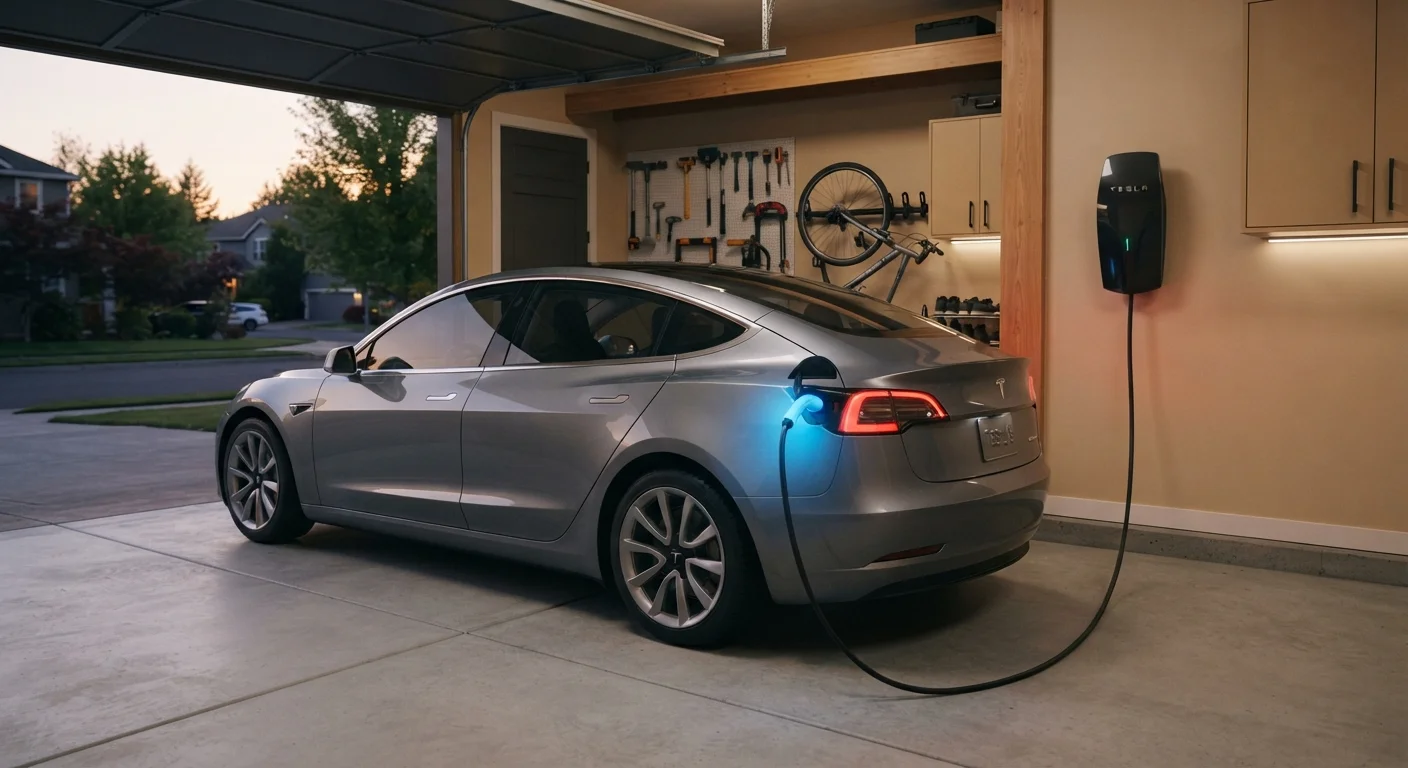
Many EV owners install a Level 2 charger - a 240-volt home charging unit - in their garage. This equipment typically costs several hundred to over a thousand dollars installed, yet it often falls outside standard auto insurance coverage. Whether it's covered depends on your homeowners or renters policy, and even there, it may be subject to sub-limits or exclusions.
Some auto insurers offer endorsements that extend limited coverage to home charging equipment. If you have or plan to install a home charger, ask both your auto and homeowners insurer directly how it's treated. Don't assume coverage exists. This is part of the broader EV cost picture that first-time EV buyers often discover only after the fact.
Review Both Your Auto and Homeowners Policies
If you have a home charging station, check with both your auto insurer and your homeowners or renters insurer to clarify coverage. Ask specifically about the charger unit itself, installation, and any related electrical damage. Getting this in writing - or as a policy endorsement - removes ambiguity before a claim arises.
Repair Networks, Labor Costs, and Claim Timelines
When an EV is damaged, it needs technicians trained and equipped to handle high-voltage systems safely. Not every body shop qualifies. The result is a more limited repair network compared to gas vehicles, which can translate to longer wait times for appointments and potentially higher labor costs - both of which can affect how a claim resolves.
This is less of a concern in large metropolitan areas where EV-certified shops are more established, but in rural or smaller markets, the nearest qualified facility may require a significant tow. It's worth asking your insurer whether they have certified EV repair shops in your area and how out-of-network repair situations are handled.
These dynamics also intersect with resale value. EV resale value can be affected by accident history and battery condition - making thorough coverage more consequential than it might seem upfront.
“The biggest shift for insurers isn't the technology itself - it's that the cost structure of an EV loss is fundamentally different. Batteries are expensive, repair networks are still catching up, and total-loss thresholds are reached faster.”
— Insurance Industry Analyst, Auto Insurance Market Commentator, paraphrasing common industry consensus
Questions to Ask Your Insurer Before You Finalize Coverage
Being an informed EV owner means asking specific questions rather than assuming your policy handles EVs the same way it handles gas vehicles. Consider raising the following when reviewing or comparing policies:
- How is the traction battery valued in a total-loss settlement?
- Is home charging equipment covered under this auto policy, or do I need a separate endorsement?
- Does roadside assistance include out-of-charge scenarios, or only mechanical breakdown?
- Are there EV-certified repair facilities in my area within your network?
- Does this policy offer any usage-based discounts that account for lower average annual mileage?
Auto insurance is general financial protection, not a guarantee of any specific outcome. For a broader picture of how premiums are calculated and what can cause them to shift, see why car insurance premiums change. And if you're still weighing EV ownership overall, coverage is just one piece - essential vehicle ownership knowledge covers the full picture.
This article is for general informational and educational purposes only and does not constitute insurance, financial, or legal advice. Coverage terms, availability, and pricing vary by insurer and state. Consult a licensed insurance professional to evaluate your specific situation.