

Key Takeaways
- EVs eliminate oil changes, spark plugs, timing belts, and transmission fluid entirely.
- Regenerative braking significantly reduces brake pad and rotor wear compared to gas vehicles.
- Battery health, coolant systems, and cabin air filters still require periodic attention in EVs.
- EV maintenance costs are generally lower overall, but battery-related repairs can be expensive.
- Tire wear may be higher on EVs due to added vehicle weight and instant torque delivery.
Our Verdict
EVs require meaningfully less routine maintenance than internal combustion vehicles, primarily because they have far fewer moving parts subject to wear. However, they are not maintenance-free - battery health, thermal management, and tires all demand attention. The right choice depends on your driving patterns, access to service, and comfort with a different maintenance rhythm.
| Best for | Recommended |
|---|---|
| Drivers who want to minimize routine service visits | Electric vehicles |
| Those comfortable with established service networks and familiar upkeep tasks | Gas vehicles |
| High-mileage commuters seeking lower per-mile operating costs | Electric vehicles |
| Owners in areas with limited EV-certified service centers | Gas vehicles |
What Gas Cars Need That EVs Simply Don't
The most significant maintenance difference between electric and internal combustion engine (ICE) vehicles comes down to mechanical complexity. A conventional gas engine contains hundreds of moving parts - pistons, valves, crankshafts, timing components - each requiring lubrication, adjustment, or eventual replacement.
EVs eliminate entire categories of service:
- Engine oil and filter changes - No combustion means no motor oil to degrade. The oil change debate simply doesn't apply.
- Spark plugs and ignition components - Electric motors don't ignite fuel; there's nothing to fire or foul.
- Transmission fluid - Most EVs use a single-speed reduction gear, not a multi-speed automatic transmission with complex fluid requirements.
- Timing belt or chain service - No valvetrain, no timing components to replace.
- Exhaust system maintenance - No combustion byproducts means no catalytic converter, muffler, or O2 sensors to service.
For a typical gas car owner, these items collectively represent a substantial portion of lifetime maintenance costs and shop visits. Their absence is one of the most tangible day-to-day differences in EV ownership.
| Maintenance Item | Gas Vehicle | Electric Vehicle | |
|---|---|---|---|
| Engine oil changes | Required every 5,000-10,000 miles | Not applicable - no combustion engine | |
| Spark plugs | Replace every 30,000-100,000 miles | Not applicable | |
| Transmission service | Fluid changes per schedule | Single-speed reducer; minimal service | |
| Brake wear | Moderate to high; friction braking primary | Lower; regenerative braking reduces pad wear | |
| Tire rotation | Every 5,000-7,500 miles typical | Every 6,000-7,500 miles; weight adds wear | |
| Coolant / thermal system | Engine coolant per schedule | Battery thermal coolant; long intervals | |
| 12V battery | Replace every 3-5 years | Auxiliary 12V battery; similar lifespan | |
| Exhaust / emissions components | Catalytic converter, O2 sensors, muffler | Not applicable - no exhaust system | |
| Software updates | Dealer-only ECU updates if any | OTA updates possible; adds new dimension |
What Still Needs Attention in an EV
Eliminating the engine doesn't mean eliminating maintenance entirely. Several systems in an EV require periodic inspection or service.
Brakes
Regenerative braking - where the electric motor acts as a generator to slow the vehicle and recapture energy - does most of the decelerating work in normal driving. This dramatically reduces wear on friction brake pads and rotors. However, brakes still need inspection. In fact, because they're used less frequently, rotors can develop surface rust in humid climates. Most manufacturers still recommend periodic brake fluid replacement, typically every two years, as the fluid absorbs moisture over time regardless of pad wear.
Tires
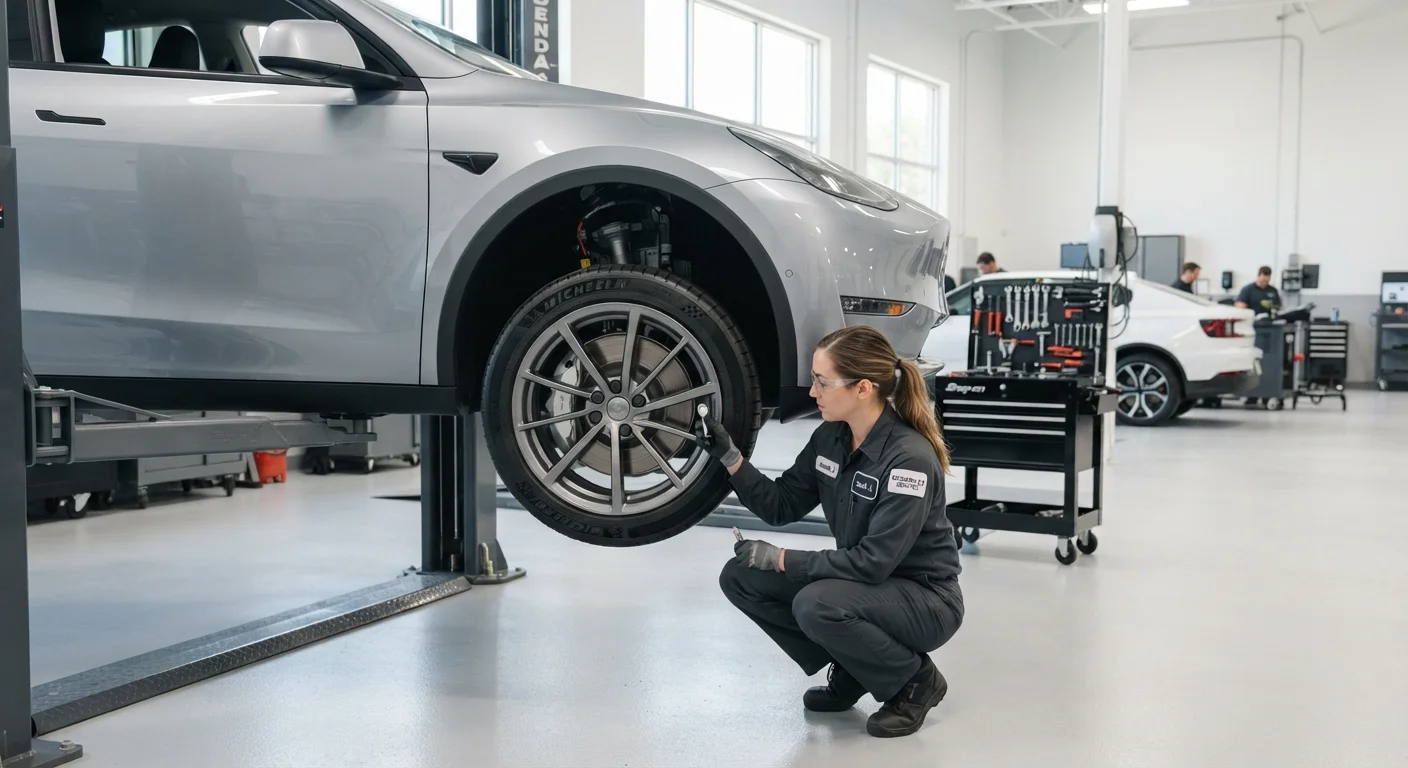
EVs tend to be heavier than comparable gas vehicles due to battery pack weight, and instant torque from electric motors can accelerate tire wear if drivers use aggressive acceleration regularly. Rotation intervals remain important - many EV manufacturers recommend rotating tires every 6,000 to 7,500 miles. First-time EV owners are sometimes surprised to find tires are among their most frequent maintenance items.
Cabin Air Filter
EVs still circulate air through a cabin filtration system. Replacement intervals vary by model and environment but typically fall in the 15,000-25,000 mile range.
Thermal Management and Coolant
Battery packs generate heat during charging and discharging, and most EVs use liquid cooling systems to manage battery temperature. These systems use coolant that degrades over time, with many manufacturers recommending inspection or replacement around 150,000 miles or on a time-based schedule - check your vehicle's owner's manual for specifics.
Check Your Owner's Manual First
EV maintenance schedules vary significantly by make and model. Rather than relying on general rules, consult your vehicle's owner's manual or manufacturer app for the specific intervals that apply to your car. Some automakers also provide maintenance minders through the vehicle's infotainment system that adapt to your driving patterns.
12-Volt Auxiliary Battery
Separate from the main traction battery, most EVs carry a conventional 12-volt battery to power accessories and control systems. This battery has a finite lifespan similar to that in a gas car and may need replacement every three to five years.
Battery Health: The Unique Long-Term Consideration
The traction battery pack is the most consequential long-term maintenance and ownership factor unique to EVs. Battery capacity gradually decreases over time through a process called degradation - the chemistry inside lithium-ion cells becomes less efficient at holding a full charge. This affects real-world range, though the rate varies by vehicle model, climate, and charging habits.
Research into long-term battery behavior is still accumulating. For a detailed look at what studies have found, see our article on EV battery degradation over time. Most manufacturers offer battery warranties covering a defined number of years or miles - typically eight years or 100,000 miles - with a minimum capacity guarantee. Battery degradation can also influence EV resale value, making it a factor worth understanding before purchase.
~40%
Lower routine maintenance costs for EVs
U.S. Department of Energy studies have estimated EV maintenance costs are roughly 40% lower than comparable gas vehicles on a per-mile basis, driven largely by eliminated engine service.
8 years / 100,000 mi
Typical federal battery warranty minimum
U.S. federal regulations require automakers to warranty EV battery packs for at least 8 years or 100,000 miles, with state-specific extensions in some markets.
Charging behavior matters too. Consistently charging to 100% or frequently using DC fast charging at maximum rates can accelerate degradation in some battery chemistries. Most manufacturers and experts suggest charging to around 80% for daily use, reserving full charges for longer trips.
Battery replacement, if ever required outside warranty, is one of the most expensive repairs in the EV world. This is distinct from routine maintenance but worth factoring into long-term cost planning. For insurance implications, our overview of EV insurance basics covers how battery replacement costs can affect policy structures.
Software: A New Kind of Maintenance
Modern EVs are software-intensive in ways gas vehicles generally are not. Many manufacturers push over-the-air (OTA) updates that can adjust charging behavior, improve efficiency algorithms, or patch safety-related software issues - without a shop visit. This represents a genuinely new dimension of vehicle upkeep. Our explainer on OTA software updates covers what these updates can and cannot address.
However, software complexity also means that some repairs or diagnostics require specialized tools and trained technicians. Not every independent shop is equipped to service all EV models, which is a practical consideration for owners in areas with limited certified service infrastructure.
Not All Shops Can Service Every EV
High-voltage systems in EVs require specialized training and equipment to service safely. Attempting repairs on or near the traction battery without proper certification is dangerous. When in doubt, use a manufacturer-authorized service center or an independent shop with documented EV-specific training and certification.
Overall, the maintenance picture for EVs favors lower routine costs and fewer service visits, balanced against the need for informed attention to tires, brakes, thermal systems, and battery health over the vehicle's life. For a broader view of what daily EV operation looks like beyond the service schedule, the day-to-day EV ownership guide is a useful companion resource.