

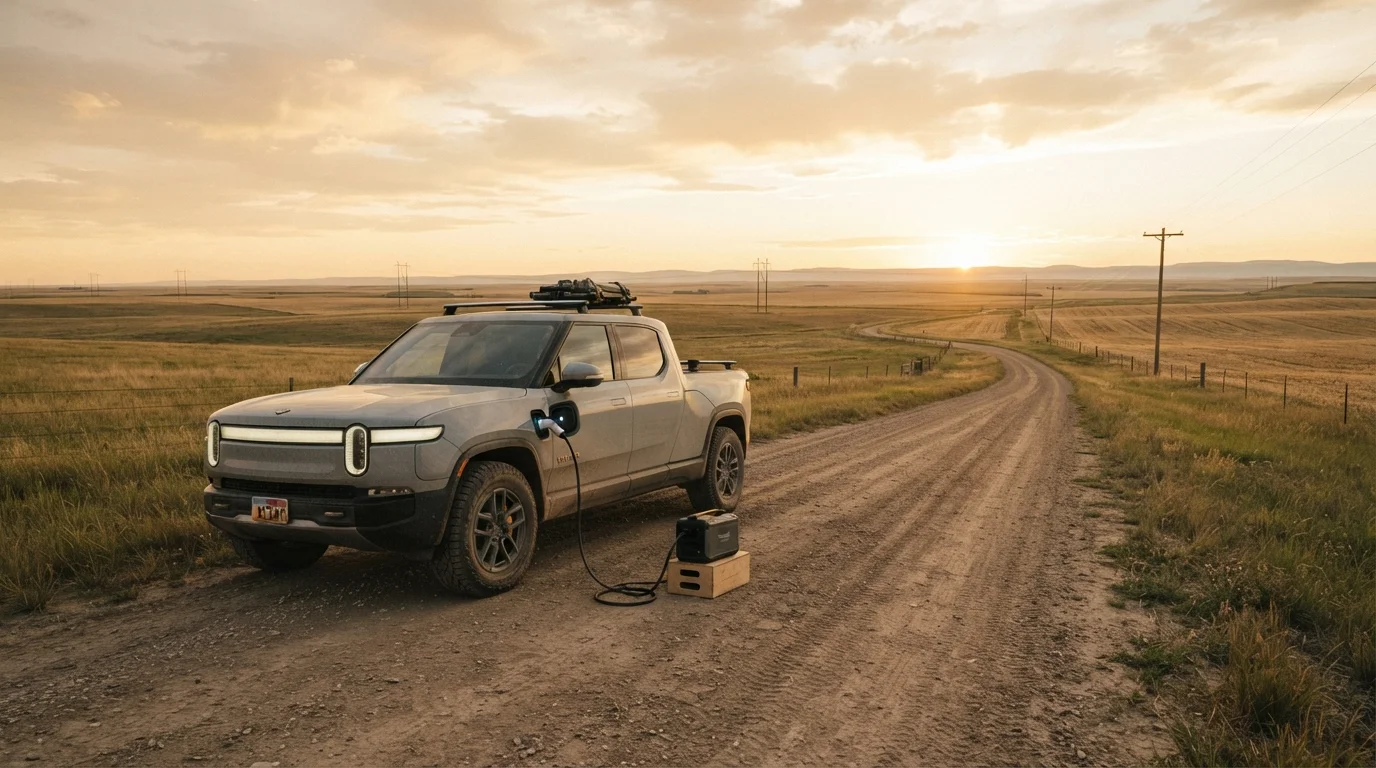
Key Takeaways
- Public fast-charger coverage is significantly thinner in rural America than in urban or suburban areas.
- Home charging - ideally a Level 2 setup - is the practical foundation of rural EV ownership.
- Longer daily driving distances on rural routes can strain range expectations, especially when towing or hauling.
- Cold winters and hot summers in rural regions can meaningfully reduce usable battery range.
- Plug-in hybrids may offer a lower-stress transition path for rural drivers not yet ready to go fully electric.
Home charging eliminates most routine fuel stops
Rural drivers who install a Level 2 home charger can start every day with a full battery, making the absence of nearby public chargers largely irrelevant for daily driving.
Lower per-mile energy cost versus gasoline
Electricity typically costs less per mile than gasoline, a meaningful advantage for rural drivers who often log higher annual mileage than their urban counterparts.
Reduced reliance on distant gas stations
Rural areas with few gas stations can see fuel prices run higher than urban averages; home charging sidesteps that dependency entirely.
Quieter, smoother ride on rural roads
EV drivetrains have fewer moving parts and no engine noise, which can make long stretches of rural highway driving noticeably more relaxed.
Lower routine maintenance demands
No oil changes, fewer brake replacements due to regenerative braking, and a simpler drivetrain reduce the burden of servicing a vehicle far from a dealership.
Sparse public fast-charging infrastructure
DC fast chargers are concentrated along interstates and in urban areas; rural counties can lack any fast-charging option within a practical range, limiting flexibility on longer drives.
Cold weather noticeably reduces usable range
Battery efficiency drops in freezing temperatures, and with no nearby backup charger, rural drivers in northern climates may find real-world winter range significantly below rated figures.
Towing and hauling cut range sharply
Aerodynamic drag and added weight from trailers or heavy payloads hit EV range harder than gas engines, complicating work or recreational use that rural drivers depend on.
Home electrical upgrades may be required
Older rural homes with dated panels may need costly electrical work before supporting a Level 2 charger, adding upfront costs that urban renters in newer buildings don't face.
Service and repair access can be limited
EV-trained technicians and authorized service centers remain less common in rural regions, potentially meaning long drives for warranty work or complex repairs.
Power outage vulnerability affects charging
Rural areas tend to experience more frequent and longer grid outages than cities; a prolonged outage can leave an EV owner unable to charge without a backup generator or battery system.
Our Verdict
Going electric in a rural area is genuinely feasible for many drivers, but it demands more upfront planning than it does in cities. The key variables - home charging capability, daily mileage, and access to occasional public fast chargers - determine whether an EV fits comfortably or requires constant compromise. For those whose driving is largely predictable and home-based, rural EV ownership can work well; for those with unpredictable long hauls or no reliable home charging, the trade-offs are steeper.
Rural drivers who own their home, drive mostly predictable local routes, and can install a Level 2 charger will get the most from an EV; those who frequently tow heavy loads or drive long, unplanned distances may want to consider a plug-in hybrid first.
Why Rural EV Ownership Is a Different Conversation
Most EV discussions center on city and suburban drivers - commuters with short, predictable routes and ready access to public charging infrastructure. Rural America operates on different terms. Trips to a hardware store, a medical appointment, or a farm supply outlet can cover 40 to 80 miles round-trip without hitting a single fast charger. That reality reshapes what EV ownership actually requires.
For rural drivers, the question isn't just "can an EV handle my range?" It's a cluster of interrelated concerns: grid access at home, the nearest public charger in an emergency, what happens to range when towing a trailer in January, and whether a service center is realistically reachable. Understanding these specifics - rather than treating rural EV ownership like an urban story with more miles - is the starting point for an honest evaluation. See the broader vehicle ownership hub for context on managing any vehicle in demanding conditions.
The Real Challenges of Going Electric in Rural Settings
Home charging eliminates most routine fuel stops
Rural drivers who install a Level 2 home charger can start every day with a full battery, making the absence of nearby public chargers largely irrelevant for daily driving.
Lower per-mile energy cost versus gasoline
Electricity typically costs less per mile than gasoline, a meaningful advantage for rural drivers who often log higher annual mileage than their urban counterparts.
Reduced reliance on distant gas stations
Rural areas with few gas stations can see fuel prices run higher than urban averages; home charging sidesteps that dependency entirely.
Quieter, smoother ride on rural roads
EV drivetrains have fewer moving parts and no engine noise, which can make long stretches of rural highway driving noticeably more relaxed.
Lower routine maintenance demands
No oil changes, fewer brake replacements due to regenerative braking, and a simpler drivetrain reduce the burden of servicing a vehicle far from a dealership.
Sparse public fast-charging infrastructure
DC fast chargers are concentrated along interstates and in urban areas; rural counties can lack any fast-charging option within a practical range, limiting flexibility on longer drives.
Cold weather noticeably reduces usable range
Battery efficiency drops in freezing temperatures, and with no nearby backup charger, rural drivers in northern climates may find real-world winter range significantly below rated figures.
Towing and hauling cut range sharply
Aerodynamic drag and added weight from trailers or heavy payloads hit EV range harder than gas engines, complicating work or recreational use that rural drivers depend on.
Home electrical upgrades may be required
Older rural homes with dated panels may need costly electrical work before supporting a Level 2 charger, adding upfront costs that urban renters in newer buildings don't face.
Service and repair access can be limited
EV-trained technicians and authorized service centers remain less common in rural regions, potentially meaning long drives for warranty work or complex repairs.
Power outage vulnerability affects charging
Rural areas tend to experience more frequent and longer grid outages than cities; a prolonged outage can leave an EV owner unable to charge without a backup generator or battery system.
The charging infrastructure gap is the most cited obstacle, and the data supports the concern. DC fast chargers - the stations capable of adding significant range in 20 to 45 minutes - are concentrated along interstate corridors and in population centers. Rural counties often have none within a practical distance. For navigating public charging networks, urban drivers have many fallback options; rural drivers typically have far fewer.
Range anxiety is amplified in areas where the next charger might be 60 miles away rather than 6. Cold weather compounds this: battery capacity can drop noticeably in freezing temperatures, reducing real-world range below the EPA-rated figure. Drivers in northern rural states need to account for this seasonal variability in their planning. Similarly, towing with an EV dramatically reduces range, which matters more when farm, livestock, or recreational hauling is a regular task rather than an occasional one.
Electrical grid access presents another layer. Older rural homes may have panels that require upgrades before supporting a Level 2 charger. Remote properties on well or propane systems - or those subject to frequent outages - need contingency thinking that city-dwellers rarely face.
Practical Workarounds That Rural EV Drivers Use
Grid Outages and Charging Backup
Rural areas experience grid outages more frequently and for longer durations than urban areas, according to the US Energy Information Administration. EV owners in these regions may want to explore whole-home backup batteries or a properly installed generator connection as a contingency. Any backup power setup involving the home electrical panel should be handled by a licensed electrician to meet local code requirements.
The most durable workaround is treating home charging as the primary - and often only - fueling source. A Level 2 charger (240V) installed in a garage or carport can replenish most EV batteries overnight. For most rural drivers whose daily mileage stays below 150 miles, this eliminates the need for public fast charging on ordinary days. Setting up home EV charging covers what panel capacity and outlet types are typically involved, and when a licensed electrician is the right call.
Route-mapping tools built into most modern EVs - and available through third-party apps - allow drivers to identify the nearest fast chargers before any longer trip, rather than discovering a gap mid-journey. Planning a charging stop at a larger town along the way, rather than relying on a charger at a destination, is a common habit rural EV drivers develop. For structured long-distance planning, EV road trip planning guides offer pre-departure checklists that apply equally to rural drivers.
Drivers uncertain about full electrification may find a plug-in hybrid a lower-risk starting point. A PHEV covers short electric-only trips while retaining a gasoline engine for longer, unpredictable hauls - a meaningful hedge when public charging is sparse. Comparing all-electric and plug-in hybrid options side-by-side can clarify which trade-offs fit a given lifestyle.
What to Honestly Weigh Before Deciding
~80%
EV charging that occurs at home
According to the US Department of Energy, the large majority of EV charging takes place at residential locations rather than public stations.
20-40%
Range reduction from extreme cold
AAA testing has found that EV range can drop by roughly 20 to 40 percent in very cold temperatures compared to mild-weather performance figures.
~17,000 miles
Average annual mileage, rural US drivers
Federal Highway Administration data consistently shows rural drivers log more annual miles on average than urban drivers, placing greater emphasis on per-mile cost efficiency.
No single factor determines whether an EV makes sense in a rural setting - it's the combination. A driver who owns their home, drives mostly local routes under 120 miles per day, rarely tows, and has access to a panel upgrade has a strong foundation. A driver who hauls equipment regularly, faces frequent sub-zero winters, and lives far from any service center faces a harder case - at least for now, as infrastructure continues to expand.
It's also worth separating durable concerns from inflated fears. Common EV myths - like the idea that the grid can't handle EV charging or that batteries fail quickly - shouldn't drive the decision. But legitimate, rural-specific factors absolutely should. The goal is an honest match between the technology's current capabilities and the real demands of a rural lifestyle, not an idealized version of either.