

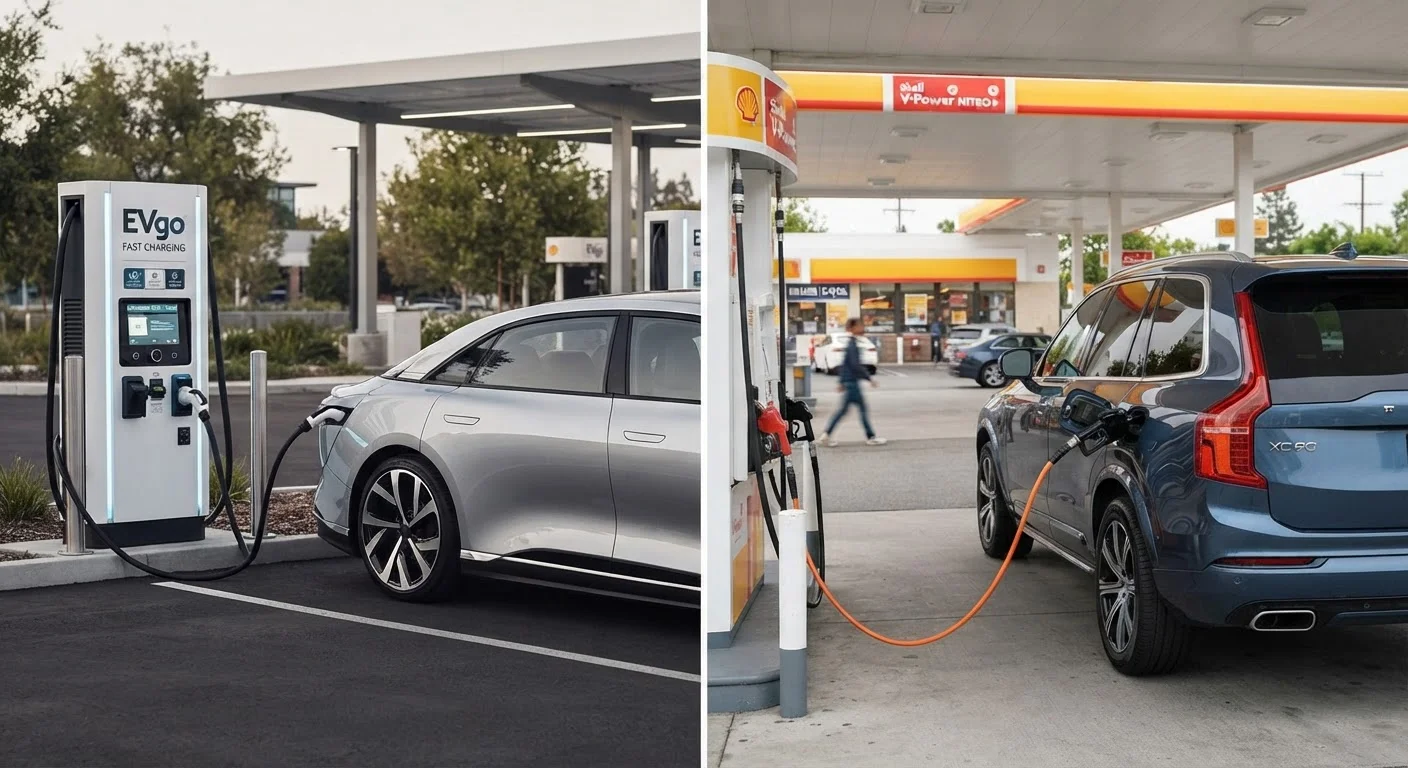
Key Takeaways
- BEVs run entirely on electricity; PHEVs combine a battery with a gasoline engine for extended total range.
- Most PHEVs offer 20-50 miles of electric-only range before switching to gas, while BEVs typically offer 200-350+ miles.
- Home charging access is critical for both, but BEV owners depend on it more heavily for their total driving needs.
- PHEVs generally cost less upfront than comparable BEVs, though both may qualify for federal tax incentives subject to eligibility rules.
- BEV maintenance needs are typically lower since there are no oil changes and fewer mechanical components to service.
- Rural drivers or frequent long-distance travelers often find PHEVs a lower-stress transition to electrified driving.
Option A
Battery Electric Vehicle (BEV)
The fully committed, zero-tailpipe-emission choice.
Best for: Drivers with predictable daily routes, reliable home charging access, and confidence in the public charging network along their regular corridors.
Option B
Plug-In Hybrid Electric Vehicle (PHEV)
The flexible bridge between electric and gasoline power.
Best for: Drivers who want meaningful electric-only driving for daily errands while retaining a gasoline engine as a backup for longer or unpredictable trips.
If you have home charging and a predictable daily commute under 200 miles
Battery Electric Vehicle (BEV)
A BEV covers most American daily driving needs on a single overnight charge and eliminates gas costs and oil changes entirely.
If you live in a rural area or regularly drive long distances without reliable charging infrastructure
Plug-In Hybrid Electric Vehicle (PHEV)
The gasoline engine removes range anxiety on extended trips, making a PHEV a practical stepping stone toward electrified driving.
If you primarily want to reduce fuel costs and emissions on short daily trips but aren't ready to give up gas backup
Plug-In Hybrid Electric Vehicle (PHEV)
Drivers who charge regularly can complete most daily errands on electricity alone while keeping the gas tank as insurance.
If minimizing long-term maintenance costs is a top priority
Battery Electric Vehicle (BEV)
BEVs have fewer moving parts - no combustion engine, no exhaust system, no transmission - which generally translates to lower scheduled maintenance costs over time.
How Each Powertrain Actually Works
A Battery Electric Vehicle (BEV) is powered exclusively by one or more electric motors drawing energy from a large onboard battery pack. There is no combustion engine, no fuel tank, and no exhaust pipe. Everything the vehicle needs to move comes from electricity stored in the battery, recharged through a plug. For a deeper look at the mechanics, see how electric cars actually work.
A Plug-In Hybrid Electric Vehicle (PHEV) pairs a smaller battery and electric motor with a conventional gasoline engine. In most PHEVs, the car operates in electric-only mode until the battery depletes, then the combustion engine takes over - or the two work together depending on the vehicle's design. Importantly, the battery is recharged both by plugging in and through regenerative braking, not just by running the engine. Understanding the two range figures on a PHEV window sticker matters here: electric range vs. total range on a plug-in hybrid explains what each number means in practice.
| Criterion | BEV | PHEV |
|---|---|---|
| Power source | Electric only | Electric + gasoline |
| Typical electric range | 200-350+ miles | 20-50 miles |
| Total range | Electric only (charge needed) | 400-500+ miles (gas included) |
| Charging requirement | Essential for all driving | Helpful but not mandatory |
| Tailpipe emissions | None | None in EV mode; present on gas |
| Scheduled maintenance | Lower (no engine service) | Higher (engine upkeep required) |
| Purchase price (general) | Typically higher | Typically lower |
| Range anxiety risk | Higher without charging plan | Lower due to gas fallback |
Range, Charging, and Real-World Driving
Range is where the two powertrains diverge most sharply. Most current BEVs offer an EPA-estimated 200-350+ miles on a full charge, though real-world range varies with temperature, speed, and climate system use. PHEVs typically deliver 20-50 miles of electric-only range before switching to gasoline, with total range (electric plus gas) often exceeding 400-500 miles.
~90%
US daily trips under 30 miles
According to US Department of Transportation data, the vast majority of American daily trips fall well within most PHEVs' electric-only range.
20-50 mi
Typical PHEV electric-only range
EPA-rated electric-only ranges for current US-market PHEVs vary widely by model and battery size.
~60,000
Public EV charging ports in the US
The US Department of Energy tracks the national charging station count, which has grown substantially but remains uneven geographically.
For drivers whose daily trips fall comfortably within a PHEV's electric range and who charge overnight, a PHEV can function like an electric car most of the time - with gas as a safety net. BEV owners, by contrast, need to plan charging more deliberately, especially on road trips. The day-to-day differences of EV ownership are worth understanding before committing. Drivers in areas with sparse charging infrastructure should also read going electric in a rural area for an honest assessment of the challenges.
Cost, Maintenance, and Incentives
BEVs generally carry a higher purchase price than comparable PHEVs, though the gap has narrowed. Both vehicle types may qualify for federal tax incentives under current US law, but eligibility depends on vehicle price, buyer income, and where the vehicle's battery components are sourced - rules that have evolved and may continue to change. Consult a tax professional or the IRS's official guidance for your specific situation.
Federal Tax Incentive Eligibility Varies
The federal clean vehicle tax credit available in the US applies to both BEVs and PHEVs under certain conditions, but income caps, vehicle price limits, and battery sourcing requirements all affect whether a specific buyer and vehicle combination qualifies. These rules have changed over time. Always verify current eligibility through IRS.gov or a qualified tax adviser before factoring a credit into your purchase decision.
On the maintenance side, BEVs hold a structural advantage: no oil changes, no spark plugs, no exhaust system, and no transmission fluid. PHEVs still require routine gasoline-engine servicing. Over a typical ownership period, BEV maintenance costs tend to be lower, though battery replacement - if ever needed outside warranty - represents a significant potential expense for both vehicle types. If you're considering a used electrified vehicle, the pros and cons of buying a used electric vehicle outlines what to scrutinize around battery health and warranty coverage.
First-time EV buyers of either type will benefit from the practical groundwork covered in EV ownership from day one, including what charging equipment to plan for at home.