

Key Takeaways
- EV range can drop 40-60% when towing, far more than most drivers expect.
- Aerodynamic drag from a trailer is the single largest contributor to energy loss.
- EPA range ratings do not account for towing - they reflect unloaded highway and city cycles.
- Charging stops will be more frequent and may take longer on towing trips.
- Planning routes around DC fast chargers is essential for long towing journeys.
- Plug-in hybrids offer a practical middle ground for drivers who tow regularly.
EV Towing Range Penalty
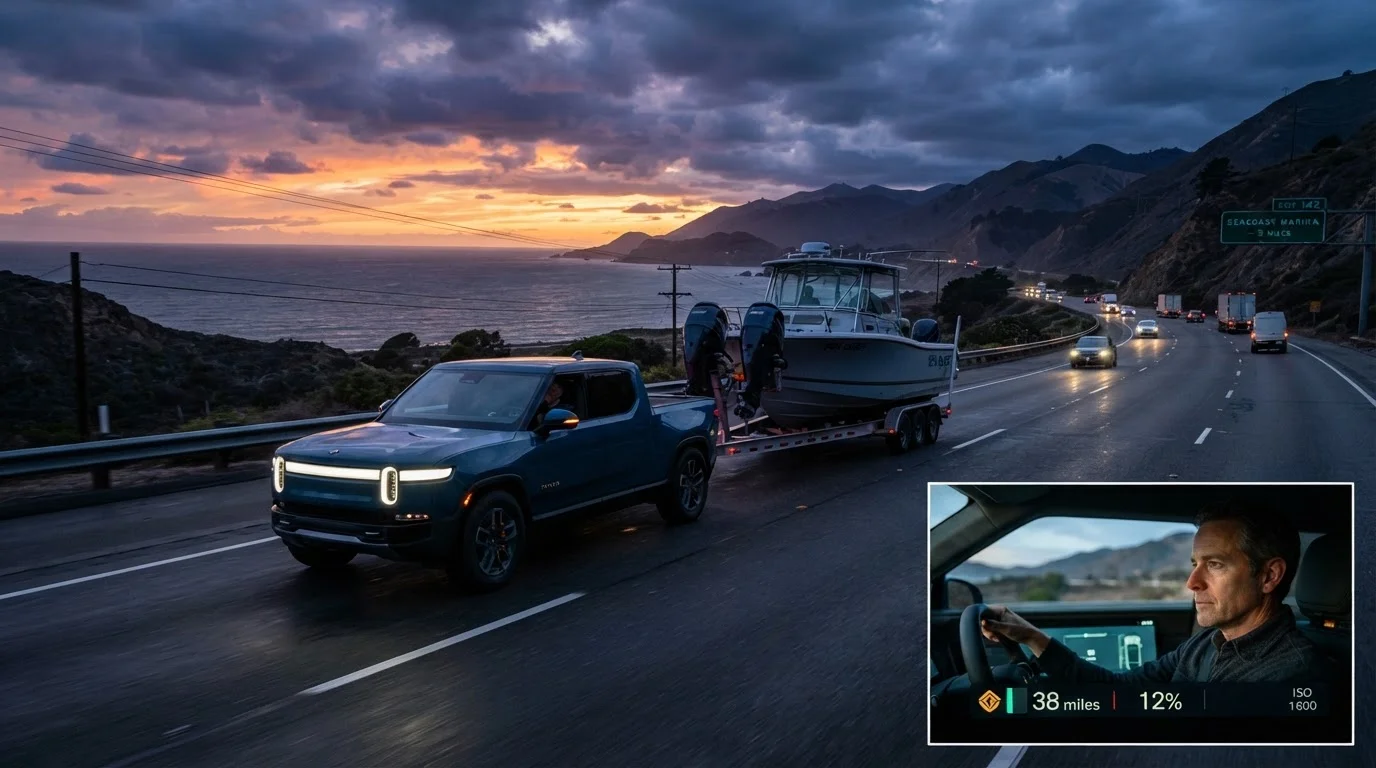
When a battery-electric truck or SUV pulls a trailer, its driving range drops significantly - often by 40% to 60% compared to its rated figure. This happens because towing multiplies the aerodynamic drag and weight the motor must overcome, which drains the battery far faster than normal highway driving. The result is a real-world range that can be dramatically lower than what the EPA label suggests.
Unlike combustion engines, which can simply inject more fuel, electric motors draw directly from a fixed energy store. Every additional kilowatt-hour spent fighting drag or lifting load is a kilowatt-hour unavailable for forward motion, making the energy penalty more immediately visible.
Why the Physics Work Against EV Towing
Towing has always been hard on vehicles, but battery-electric trucks and SUVs face a uniquely punishing challenge. To understand why, consider what towing actually demands of a drivetrain.
When you hitch a trailer, two forces increase simultaneously: aerodynamic drag and total vehicle mass. Drag grows with the square of speed - double your speed and drag quadruples. A boxy trailer dramatically increases the frontal area the vehicle must push through air, multiplying drag well beyond the tow vehicle's own profile. Weight adds rolling resistance and makes every uphill grade more costly.
In a gas or diesel truck, the engine compensates by burning more fuel. The tank doesn't shrink - you just stop to refuel more often. In an EV, the energy store is fixed. Every additional kilowatt-hour (kWh) spent fighting drag and mass is subtracted directly and immediately from the battery, reducing the miles remaining on the screen in real time. There's no equivalent of adding more fuel mid-trip.
40-60%
Typical EV range reduction while towing
Multiple independent real-world towing tests have consistently documented this range of energy penalty when towing near maximum rated capacity.
4×
Drag increase when vehicle speed doubles
Aerodynamic drag scales with the square of velocity, meaning highway speed choices have an outsized effect on towing range.
0 miles
Additional range EPA tow tests account for
The EPA's standard range test cycles do not include towing scenarios, making window-sticker figures unreliable for towing range planning.
This is why the EPA range figure on an electric truck's window sticker tells you almost nothing about towing range. EPA test cycles simulate typical unloaded driving - they do not include trailer loads.
How Much Range Actually Disappears
Independent tests and owner reports consistently show that towing at or near maximum rated capacity reduces EV range by 40% to 60%. A truck advertised at 300 miles of range may return 130 to 180 miles with a heavy trailer - sometimes less in hot or cold conditions.
Several variables shape the exact penalty:
- Trailer frontal area and shape: A tall, flat-fronted camper creates far more drag than a low, aerodynamic boat trailer of similar weight.
- Speed: Drag increases exponentially with speed. Towing at 70 mph costs substantially more energy per mile than 60 mph.
- Terrain: Sustained grades drain the battery quickly and may not be fully offset by regenerative braking on descents.
- Temperature: Cold weather compounds the problem, as lithium-ion batteries lose efficiency in freezing temperatures independently of the towing load.
Slow Down to Stretch Towing Range
Reducing cruising speed from 70 mph to 60 mph when towing can meaningfully improve energy efficiency, because aerodynamic drag grows exponentially with speed. On a long towing trip, accepting a slightly longer drive time is often the most practical way to reach the next charger without anxiety. Factor speed into your route plan alongside charger locations.
It's also worth reviewing towing capacity limits before hitching anything - exceeding rated capacity stresses brakes, suspension, and structural components regardless of powertrain type.
Practical Planning for EV Towing Trips
The range penalty is real, but it doesn't make EV towing impossible - it makes planning mandatory. Drivers accustomed to stopping for gas every 300-400 miles need to recalibrate expectations and route strategies.
Key adjustments for towing with an electric truck or SUV:
- Map DC fast chargers in advance. Unlike gas stations, fast chargers are not uniformly distributed. Rural and remote routes may have significant gaps. Use route-planning tools that factor in towing range, not rated range.
- Reduce cruising speed. Dropping from 70 mph to 60 mph can recover 15-20% of range in some conditions. On long pulls, this trade-off in time can be worthwhile.
- Pre-condition the battery. Departing with a fully charged, thermally managed battery gives the best starting position.
- Charge more conservatively. Charging to 80% at stops is faster than topping to 100%, and it's easier on the battery. With a reduced tow range, plan shorter legs between stops.
For drivers who tow regularly and over long distances, a plug-in hybrid powertrain may better match current infrastructure realities. A PHEV still sees efficiency losses while towing, but the combustion backup eliminates the risk of running out of charge before the next station.
“The honest answer is that towing stress-tests every assumption EV buyers bring from their experience with gasoline trucks. The fundamentals of physics don't change - they just become more immediately visible on a battery charge display.”
— Automotive Engineering Analyst, EV powertrain researcher, published in automotive engineering journals