

Key Takeaways
- Lithium-ion cells perform best within a narrow temperature window of roughly 59°F-95°F.
- Excess heat is the primary driver of long-term battery capacity loss.
- Liquid cooling systems are far more effective than air-cooled alternatives at managing pack temperature.
- Cold batteries charge more slowly and deliver less range - active heating addresses both problems.
- Preconditioning (warming or cooling the pack before charging) is one of the most effective driver-controlled TMS features.
- A well-designed TMS is one of the strongest predictors of long-term battery health.
EV Thermal Management System
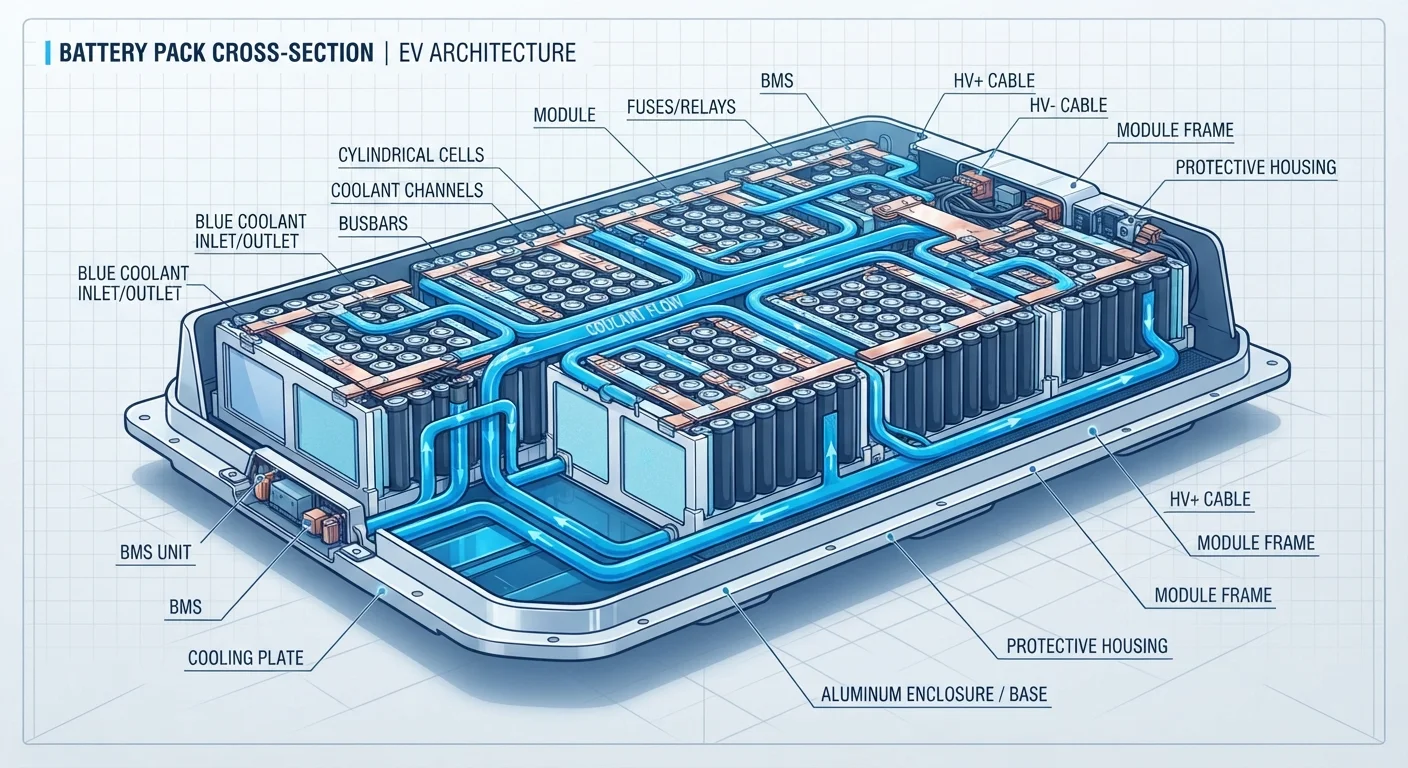
An EV thermal management system (TMS) is the collection of hardware and software that regulates the temperature of a battery pack. It keeps cells within the narrow temperature band - roughly 59°F to 95°F (15°C to 35°C) - where they charge efficiently, deliver full power, and age slowly. The system both cools the pack during fast charging and hot weather and warms it in cold conditions.
Most modern systems use a glycol-water coolant loop that circulates through a series of flat plates or channels pressed against the battery modules, with a chiller or heat pump exchanging energy with the cabin HVAC circuit.
Why Temperature Is Everything for Lithium-Ion Cells
Lithium-ion batteries are electrochemical devices with a strong preference for moderate conditions. Too cold, and the chemical reactions that move lithium ions between electrodes slow dramatically - reducing both the power the pack can deliver and the speed at which it can safely accept a charge. Too hot, and those same reactions accelerate in destructive ways: electrolyte breaks down, electrode materials degrade, and in extreme cases, a condition called thermal runaway can become a safety concern.
The practical consequence for everyday drivers is straightforward: a battery pack that spends most of its life outside its preferred temperature window will lose usable capacity faster than one that stays within range. Long-term battery degradation studies consistently point to heat as one of the strongest predictors of capacity loss. Managing temperature isn't a luxury feature - it's fundamental to the value proposition of owning an EV.
59°F-95°F
Optimal lithium-ion operating temperature range
Battery engineers broadly cite this range as the zone where lithium-ion cells balance performance, charging efficiency, and long-term health.
~20%
Typical winter range reduction in cold EVs
The U.S. Department of Energy has noted EV range can drop significantly in freezing temperatures due to cold battery chemistry and cabin heating demands.
5-10x
Heat transfer advantage of liquid vs. air cooling
Thermal engineering references indicate liquid coolants have heat transfer coefficients many times higher than forced-air systems, enabling tighter temperature control.
How Liquid Cooling Systems Work
The dominant thermal management approach in current EVs is active liquid cooling. A glycol-water coolant solution circulates through a network of channels or flat plates - often called a cold plate - that sit in direct contact with the battery modules. Heat generated by the cells transfers into the coolant, which carries it to a radiator or a refrigerant-based chiller that dumps the energy outside the pack.
The same loop can run in reverse for heating. When ambient temperatures are low, a resistive heater or, increasingly, a heat pump warms the coolant before it circulates through the pack. Heat pumps are considerably more efficient than straight resistive heating because they move existing thermal energy rather than generating it from scratch - an important advantage when every kilowatt-hour of battery capacity counts.
Air-cooled battery designs exist but are generally considered less capable of handling the heat loads generated by modern DC fast charging. Liquid systems can respond faster, maintain tighter temperature uniformity across all cells in a pack, and scale better as pack sizes grow.
Use Preconditioning Before Fast Charging
If your EV supports navigation-triggered preconditioning, enter the charging station as a destination rather than driving there without a set route. This gives the TMS time to bring the pack to optimal temperature before you arrive, potentially unlocking faster charge speeds and reducing time spent at the charger.
Preconditioning: The Driver-Accessible TMS Feature
Most current EVs allow - and some automatically trigger - a process called preconditioning. Before a DC fast-charging session, the vehicle's software brings the battery pack to an optimal temperature using power from the grid (if plugged in) or from the pack itself. Arriving at a fast charger with a thermally ready battery can meaningfully shorten charge time and reduce the risk that the charger throttles back its output to protect cold or hot cells.
Preconditioning also applies to cold-morning departures. Warming the pack before driving means the vehicle can draw full power from the start rather than operating in a reduced-performance mode until cells reach temperature. Winter range loss stems from both the energy cost of heating the cabin and the inherent slowdown of cold chemistry - preconditioning addresses the second factor directly.
Drivers can reinforce TMS effectiveness through charging habits as well. Certain charging patterns - such as routinely topping to 100% or frequent DC fast charging without need - generate additional heat stress the TMS must counteract.
TMS Capability Varies by Vehicle
Not all EVs have equally sophisticated thermal management. Some older or lower-cost designs rely on air cooling or simpler liquid systems with less precise temperature control. When evaluating an EV, understanding whether it uses active liquid cooling for the battery pack - and whether it supports preconditioning - is a practical consideration for long-term ownership.
The Link Between TMS Design and Battery Longevity
Automakers design thermal management systems with long-term cell health as a primary objective, alongside performance and safety. The architecture choices they make - coolant chemistry, plate geometry, sensor density, software control algorithms - collectively determine how tightly the pack temperature is managed across a wide range of real-world conditions.
A finer-grained TMS can detect temperature variation between individual cell groups (called modules) and adjust coolant flow to equalize them. Cell-level temperature uniformity matters because a pack is effectively limited by its hottest or coldest cells; uneven temperatures accelerate differential aging within the pack. As battery chemistry continues to evolve - solid-state designs, for instance, may have different thermal characteristics - TMS engineering will adapt alongside them.
For consumers, the takeaway is that TMS quality is a meaningful but often invisible factor in the total cost of EV ownership. A pack that ages slowly because its thermal environment was consistently well-managed retains more usable range and resale value over time. What happens to batteries at end of life is increasingly shaped by how well they were managed during their working years.