

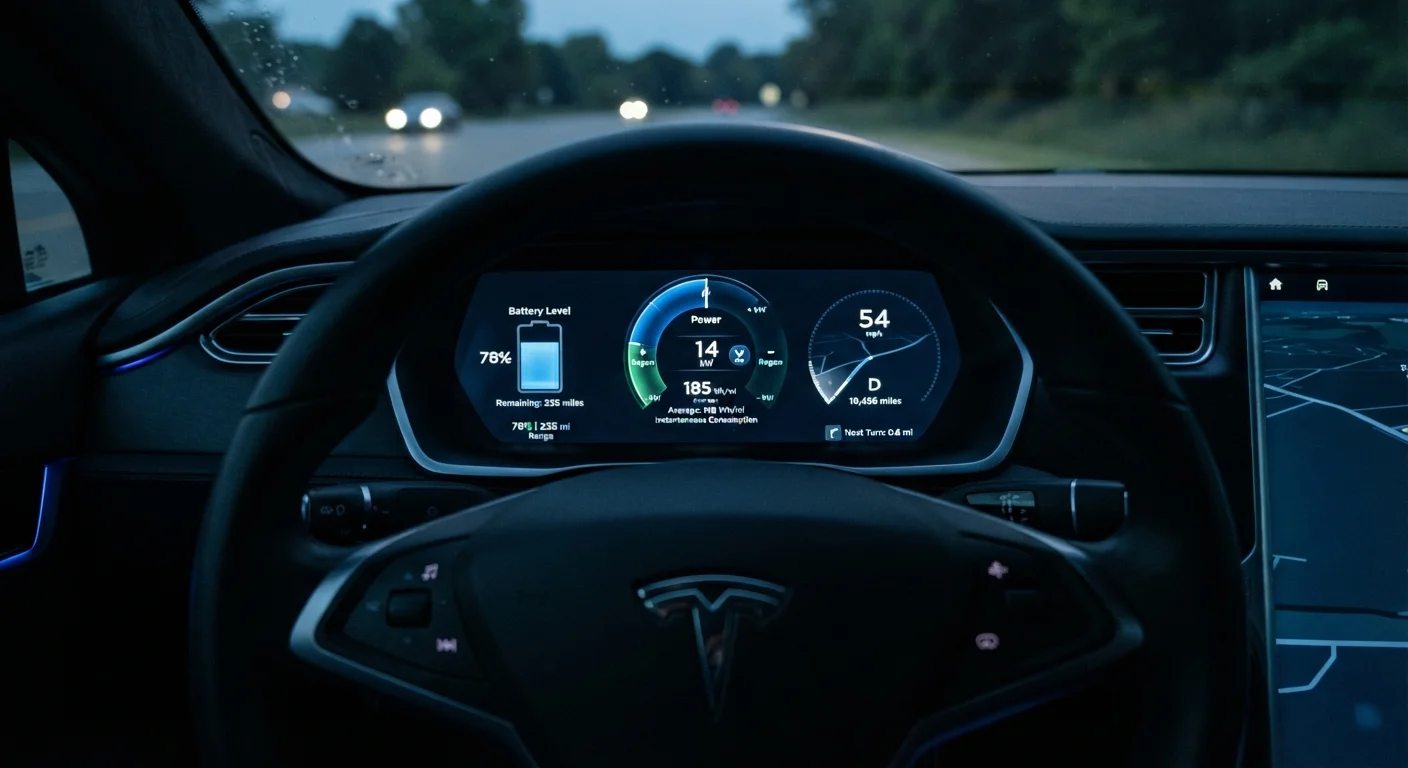
What a Kilowatt-Hour Actually Measures
A kilowatt-hour (kWh) is a unit of energy - specifically, the amount of energy consumed when one kilowatt of power runs for one hour. If a device draws 1,000 watts and you run it for 60 minutes, it has used 1 kWh. Your home electricity bill is already denominated in kWh; an EV battery is simply a much larger version of the same concept.
On a spec sheet, the battery's total capacity is listed in kWh. A 75 kWh pack holds roughly 75 kWh of usable energy - though manufacturers typically reserve a buffer at both ends of the charge range to protect long-term cell health. The figure you can actually draw on is called usable capacity and is often a few kWh lower than the headline number.
Understanding this distinction matters when comparing vehicles. Two EVs with nominally similar range estimates may have different usable capacities, different drivetrain efficiencies, or both.
kW vs. kWh: Power vs. Energy
Confusing kilowatts (kW) with kilowatt-hours (kWh) is one of the most common stumbling blocks for new EV shoppers. The difference is straightforward:
- kW (kilowatts) measures rate - how fast energy is flowing at a given moment. A charger rated at 11 kW delivers energy at that rate continuously while connected.
- kWh (kilowatt-hours) measures quantity - the total energy stored or consumed over time.
Think of it like water: kW is the flow rate from a faucet, and kWh is how many gallons end up in the tank. A fast-charger rated at 150 kW can theoretically replenish a 75 kWh battery in about 30 minutes under ideal conditions - though real-world charging curves slow down as the battery approaches full.
Kilowatt-hour (kWh)
A unit of energy equal to one kilowatt of power sustained for one hour. Used to measure EV battery capacity and total energy consumed during charging.
Kilowatt (kW)
A unit of power measuring the rate of energy transfer. Used to describe charger output speed - higher kW means faster charging.
Usable capacity
The portion of an EV battery's total kWh that the driver can actually access. Manufacturers reserve a buffer at both the top and bottom to protect battery longevity.
Miles per kWh (mi/kWh)
An EV efficiency metric indicating how far the vehicle travels per kilowatt-hour of energy consumed. Higher numbers indicate greater efficiency.
DC fast charging
A high-power charging method (typically 50-350 kW) that delivers direct current to the battery, enabling rapid replenishment at public charging stations.
State of Charge (SoC)
The current charge level of an EV battery expressed as a percentage of usable capacity, similar to a fuel gauge reading.
Charging speed specifications, whether on a home charger or a public DC fast charger, are always expressed in kW. For a deeper look at how charging rates translate into real costs, see how home and public charging costs compare.
Miles Per kWh: The EV Equivalent of MPG
Miles per kWh (mi/kWh) is the primary efficiency metric for electric vehicles - the direct counterpart to miles per gallon in a gas-powered car. A vehicle achieving 4 mi/kWh will travel roughly 300 miles on a 75 kWh pack (before accounting for the reserved buffer). One achieving 3 mi/kWh on the same pack covers only about 225 miles.
3-4 mi/kWh
Typical real-world EV efficiency range
Most mainstream EVs sold in the US fall within this band under moderate driving conditions, per EPA test data.
~20-40%
Range reduction in extreme cold
Cold weather can reduce EV range significantly; the AAA has documented reductions in this range during below-freezing temperatures.
10-15 kWh/100 mi
Alternate efficiency expression used by EPA
The EPA also expresses EV efficiency as energy consumed per 100 miles, mirroring the liters-per-100-km convention used internationally.
Efficiency varies with speed, temperature, use of climate control, terrain, and load. Highway driving at high speeds typically reduces mi/kWh compared to city driving - the opposite of what most drivers expect from decades of gasoline experience. Cold weather can meaningfully reduce both range and charging speed.
The EPA publishes standardized range and efficiency ratings for EVs sold in the United States, giving consumers a consistent basis for comparison. These ratings are useful benchmarks, but individual results depend heavily on real-world driving conditions. For practical context on how efficiency plays out day-to-day, see what daily EV ownership actually looks like.
For a full rundown of additional EV-specific terminology - from SoC to regenerative braking - the EV driver's glossary covers 40 terms you'll encounter across spec sheets, charging apps, and owner forums.
This article is for general informational purposes only. Specifications, EPA ratings, and charging capabilities vary by vehicle and real-world conditions; consult manufacturer documentation for vehicle-specific details.