

Key Takeaways
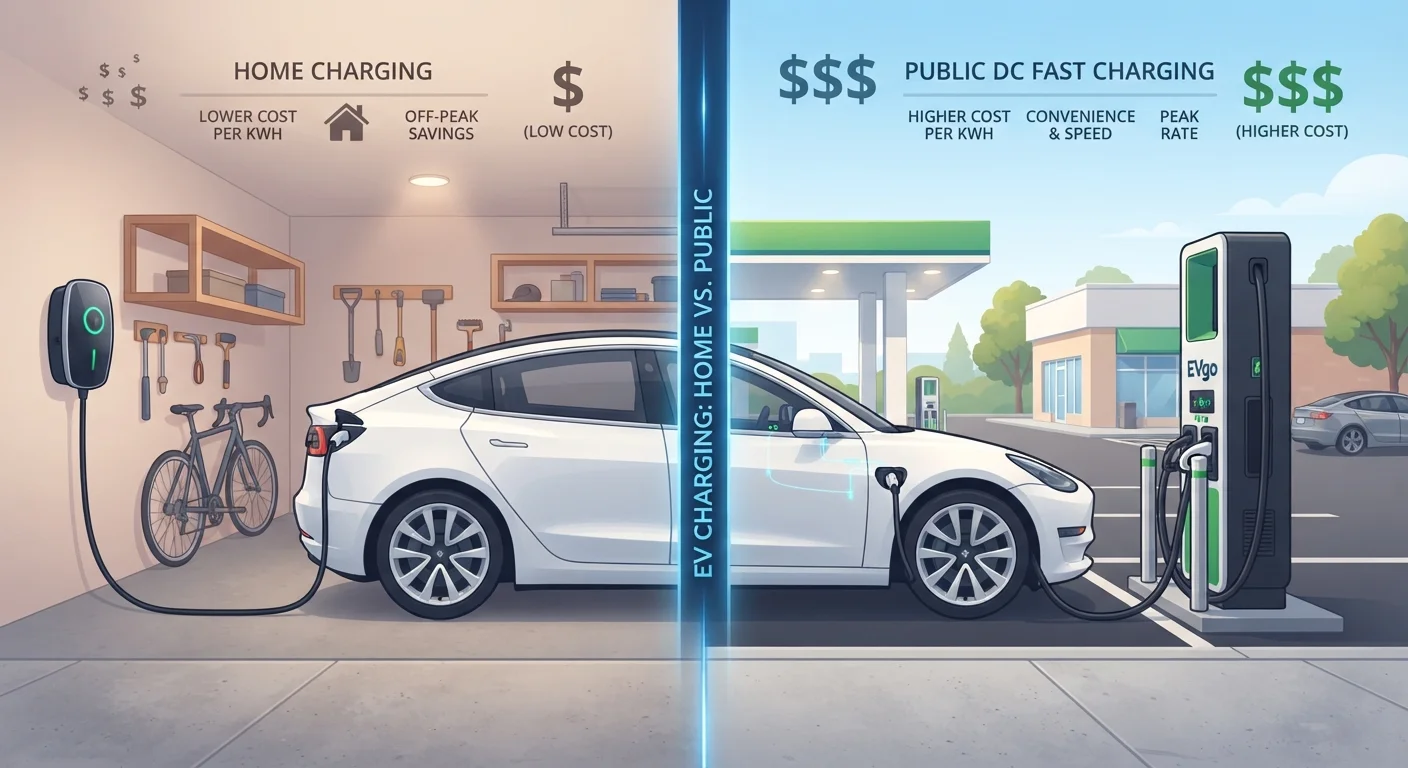
- Home charging is almost always cheaper per kWh than public fast charging.
- Time-of-use electricity rates can significantly lower overnight home charging costs.
- Public DC fast charging is convenient but typically costs 2-4 times more per kWh than home rates.
- Per-minute pricing at some public stations can penalize slower-charging vehicles.
- Most EV owners do the majority of their charging at home, keeping average costs low.
EV Charging Cost
The cost to charge an electric vehicle depends on where you plug in and how electricity is priced at that location. At home, you pay your utility's rate per kilowatt-hour (kWh). At public stations, pricing varies by network and can be structured as a flat per-kWh rate, a per-minute rate, or a session fee. Understanding both helps drivers estimate their true fueling costs.
A kilowatt-hour (kWh) is the standard unit for measuring electrical energy consumed. Charging cost = battery capacity (kWh) × price per kWh. Efficiency losses during charging mean you typically pay for slightly more energy than the battery stores.
Home Charging: The Baseline for EV Cost Comparisons
For most EV owners, home charging sets the cost baseline. You're drawing electricity from your utility at whatever rate applies to your account - typically expressed in cents per kilowatt-hour (kWh). The US Energy Information Administration tracks average residential electricity prices, which nationally have hovered in the range of $0.12-$0.17 per kWh in recent years, though state-level averages vary widely. Hawaii and California sit at the high end; states like Louisiana and Idaho are among the lowest.
To estimate a full charge, multiply your EV's usable battery capacity by your electricity rate. A vehicle with a 65 kWh battery charged at $0.15/kWh costs about $9.75 for a full charge - enough for roughly 200-250 miles of range for many models. That's a meaningful contrast to gasoline costs over the same distance.
Use Off-Peak Charging to Lower Your Bill
Many utilities offer time-of-use (TOU) plans with significantly lower rates during overnight hours. Setting your EV to begin charging after 10 or 11 PM - using your vehicle's built-in scheduling or a smart charger - can reduce your home charging cost by a third or more. Contact your utility to ask about available TOU rate plans designed for EV owners.
One important variable is time-of-use (TOU) pricing. Many utilities offer rate plans where electricity costs less during off-peak hours - often late night and early morning. Drivers who schedule their charging overnight through their vehicle's app or home charger timer can reduce their per-kWh cost by 30-50% compared to peak-hour rates. Check with your utility to see what TOU plans are available.
For a deeper look at the practical setup involved, see our guide to home EV charging setup. Renters and condo residents face additional considerations covered in our piece on apartment and condo EV charging.
Public Charging: Convenience Comes at a Price
Public charging stations fall into two broad categories by speed: Level 2 AC chargers (found in parking lots, workplaces, and some retail locations) and DC fast chargers (often called DCFC or, in some network branding, "fast" or "rapid" chargers). The cost structures differ accordingly.
Level 2 public chargers often carry rates closer to home electricity prices - sometimes $0.20-$0.30 per kWh - though session fees and parking costs can add up. DC fast chargers, which can add significant range in 20-45 minutes, typically carry a premium: $0.30-$0.50 per kWh is common, and some networks price higher for their highest-speed hardware.
~$0.16
Average US residential electricity rate per kWh
Based on US Energy Information Administration residential electricity price data; varies significantly by state.
2-4×
Higher cost at DC fast chargers vs. home rates
Public DC fast charging typically runs $0.30-$0.50+ per kWh, compared to average home rates in the $0.12-$0.17 range.
~80%
Share of EV charging done at home
Industry surveys consistently find that most EV drivers perform the large majority of their charging at home or at work.
Pricing models also differ by network and by state law. Some networks bill per kWh; others bill per minute of charging time. Per-minute pricing introduces unpredictability - a vehicle with a larger battery or one that's nearly full charges more slowly, meaning you pay more per unit of energy added. Understanding which model applies before you plug in helps avoid surprises.
For a full overview of how US public charging networks are structured, see our guide to navigating public charging networks.
Doing the Math: What Drivers Actually Pay
Comparing home and public charging costs on a per-mile basis is the most useful frame. If your EV averages 3.5 miles per kWh and you charge at home for $0.13/kWh, your fuel cost is roughly $0.037 per mile. At a public fast charger running $0.42/kWh, that same efficiency works out to about $0.12 per mile - more than three times higher.
That gap matters most for drivers who rely heavily on public charging because they lack home charging access. For the majority of EV owners who charge overnight at home and use public stations only for road trips or occasional top-offs, the blended average cost remains favorable compared to gasoline. Everyday EV ownership involves building habits around this cost structure.
A few additional cost factors to keep in mind:
- Network membership fees: Some public networks offer lower per-kWh rates to subscribers, which can pay off for frequent users.
- Idle fees: Many stations charge by the minute after your session ends if you leave the vehicle connected. Moving promptly avoids these fees - a norm also covered in our public charging etiquette guide.
- Charging efficiency losses: Not all energy from the grid ends up in the battery. Onboard chargers typically operate at 85-95% efficiency, meaning actual cost per stored kWh is slightly higher than the listed rate.