

Key Takeaways
- Festival culture emphasizes communal discovery and multi-day immersion across many genres and artists.
- Club culture offers closer artist proximity, lower costs per show, and a more devoted, genre-specific crowd.
- Neither format is objectively superior - each shapes the fan-artist relationship in distinct ways.
- Emerging artists often build careers through clubs before graduating to festival stages.
- Logistics, budget, and musical preferences all influence which format suits a given listener.
Our Verdict
Festival culture and club culture are two sides of the same live-music coin. Festivals deliver scale, spectacle, and the joy of unexpected discovery across a long weekend. Clubs deliver intimacy, authenticity, and the electric charge of seeing tomorrow's headliners up close tonight. Most devoted music fans find a natural home in both, depending on the season and the artist.
| Best for | Recommended |
|---|---|
| Fans who want variety and a social, event-style experience | Festival Culture |
| Those seeking deep connection with a specific artist or scene | Club Culture |
| First-time live-music goers on a modest budget | Club Culture |
| Listeners who treat live music as an annual bucket-list adventure | Festival Culture |
The Big Picture: What Each Format Actually Is
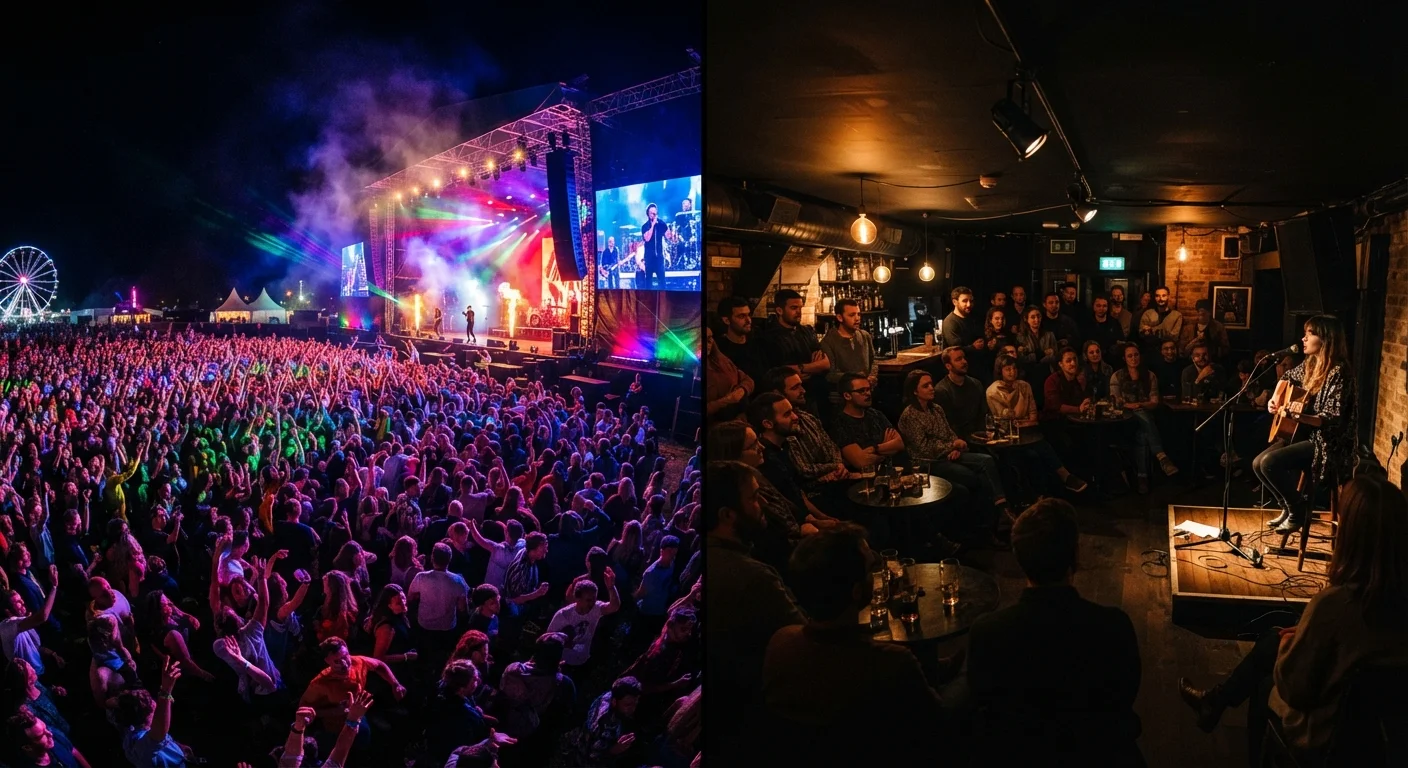
When Americans talk about experiencing live music, they're usually imagining one of two very different scenes. The first is a sprawling outdoor festival - think acres of stages, food vendors, camping tents, and headliners performing to tens of thousands. The second is a packed club - maybe 150 to 500 people crammed into a room where the performer is close enough that you can see them sweat.
Both formats have deep roots in American music history. Clubs gave rise to jazz in New Orleans, punk in New York, and grunge in Seattle - scenes that defined entire generations. Many of today's mainstream sounds began in exactly those kinds of small rooms. Festivals, meanwhile, trace their cultural peak to events like Woodstock and have evolved into sprawling branded experiences that now function as their own tourism industry. For a deeper dive into how they operate, this guide to American music festivals covers the full picture.
Side by Side: Festival vs. Club
These two formats differ across almost every practical and emotional dimension. Here's how they stack up.
| Festival Culture | Club Culture | |
|---|---|---|
| Typical capacity | 10,000-100,000+ | 100-1,500 |
| Ticket cost | $150-$500+ for multi-day passes | $15-$50 per show |
| Artist proximity | Often distant, large stage | Close, sometimes arm's length |
| Genre variety | Broad - multiple genres per event | Narrow - one scene or style |
| Discovery potential | Very high - many unplanned acts | Low - crowd knows who they came for |
| Community atmosphere | Mass communal, temporary city vibe | Tight-knit, scene-specific crowd |
| Logistical complexity | High - travel, camping, planning | Low - show up, enjoy, leave |
| Artist career stage | Established to superstar acts | Emerging to mid-level artists |
The numbers tell part of the story, but the atmosphere gap may matter even more. At a festival, you might catch three artists you love and stumble onto five you'd never heard of - that serendipity is a core part of the appeal. At a club, the audience largely showed up for one act, which creates a shared intensity that's hard to replicate on a sprawling festival lawn.
The Club Experience: Intimacy as a Feature
Club culture rewards patience and curiosity. Tickets are generally cheaper, shows are shorter logistically, and the physical closeness to performers creates a feedback loop that changes how music sounds and feels. Artists often take more risks in small rooms - longer improvised sections, between-song storytelling, experimental set lists.
Some of the most storied rooms in American music - CBGB in New York, the Fillmore in San Francisco, the Troubadour in Los Angeles - became cultural landmarks precisely because of what they let artists do. Certain venues did more than host shows - they defined movements.
Catch Artists Early in Clubs
If an artist is currently playing 300- to 500-capacity clubs, that window is often brief. Tickets are cheaper, the setlist is often more adventurous, and the memory tends to be more vivid than catching the same artist years later on a festival main stage. Following local venue calendars is one of the most reliable ways to spot those moments before they pass.
Club culture also serves as a proving ground. Nearly every major festival headliner spent years grinding through 300-capacity rooms before landing a festival slot. Catching an artist at that stage of their career often produces memories that outlast anything witnessed on a main stage.
The Festival Experience: Scale as a Feature
Festivals operate on an entirely different emotional register. The scale itself becomes part of the experience - singing alongside thousands of strangers, watching production design that simply can't fit in a club, and building a temporary community over 48 or 72 hours. That communal dimension is something clubs structurally can't replicate.
Discovery is another festival superpower. With five or six stages running simultaneously, attendees routinely wander into sets they hadn't planned to see and leave as converted fans. That accidental exposure is one of the ways festivals have historically shaped taste at a cultural level. Of course, the experience comes with real trade-offs around cost, logistics, and comfort - an honest breakdown of what festivals actually involve is worth reading before committing to one.
35M+
Americans attending music festivals annually
Industry research has estimated that tens of millions of Americans attend at least one music festival each year, reflecting the format's mainstream integration.
~$1.8B
US live music club venue annual revenue
The National Independent Venue Association and industry analysts have documented the significant economic footprint of small and mid-sized clubs across the country.
Merchandise also plays a differently weighted role at festivals, where branded goods become mementos of the larger event rather than just artist fandom - a dynamic worth understanding on its own terms. The cultural economics of merch reflect how deeply both formats have commercialized fan identity.
Which Format Fits Your Music Life?
There's no universal right answer here, and most enthusiastic live-music fans don't choose just one lane. The practical question is which format fits a particular moment, budget, and musical appetite. If you're new to live music entirely, a practical orientation to concert-going can help you walk into either setting with confidence.
Geography matters too. Thriving club scenes exist well beyond the obvious coastal hubs - cities whose sounds have shaped genres without the spotlight often support remarkably active live-music ecosystems. And for listeners who want to understand how the energy of a live show translates to recorded form, what live versus studio albums reveal about an artist offers a complementary angle.
Ultimately, festival culture and club culture aren't competing philosophies - they're complementary ones, each illuminating a different truth about what live music does for people.