

Key Takeaways
- A music era is a recognizable creative phase defined by shifts in sound, visuals, and artistic identity.
- Artists use eras intentionally to reinvent themselves and maintain long-term audience engagement.
- Fan communities actively participate in defining, naming, and celebrating each era.
- The concept of eras predates Taylor Swift, appearing throughout pop music history.
- Streaming culture has made eras shorter and more frequent for many artists.
Music Era
A music era is a distinct creative phase in an artist's career - or in the broader music landscape - defined by a recognizable shift in sound, visual identity, themes, and overall aesthetic. Think of it as a chapter in an artist's story, complete with its own mood, color palette, and message. Eras often align with album cycles but can also be marked by major life events, cultural shifts, or even a single transformative song.
In musicology and cultural studies, these phases are sometimes called 'stylistic periods' - analogous to the way art historians divide painters' work into distinct creative periods.
Where the Idea of a 'Music Era' Comes From
Long before Taylor Swift announced her Eras Tour, music critics and fans were already talking about artists in terms of distinct phases. David Bowie cycled through Ziggy Stardust, the Thin White Duke, and a dozen identities in between. Madonna reinvented herself so consistently that reinvention became her brand. Prince pivoted from funk to pop to spirituality with barely a pause between chapters.
What these artists understood intuitively - and what fans have always responded to - is that a great music career isn't a flat line. It's a series of chapters. Each one has its own emotional temperature, visual world, and creative obsession. That's the essence of a music era: a coherent phase where everything from the bassline to the album art feels like it belongs to the same moment in an artist's evolution.
The album era gave structure to these phases, with LPs acting as containers for a complete artistic vision. Even as streaming reshapes how music is released, the era concept has proven remarkably durable.
What Actually Defines an Era
Sound is the starting point, but a music era is really a total package. When an artist enters a new era, the shift is typically visible before it's audible. A new hair color, a cryptic Instagram post, an aesthetic pivot in promotional photos - fans are trained to read these signals like cultural semaphore.
3.4x
More streams for catalog albums during anniversary tours
Industry analysts have noted significant catalog streaming spikes when artists perform older era-specific albums on tour, reflecting deep fan investment in distinct creative periods.
72%
Of fans identify with one specific artist era
A 2023 survey by music audience research firm MRC Data found the majority of dedicated fans associate most strongly with a single creative phase of their favorite artist's career.
18 months
Average length of a modern album-era cycle
Music industry analysts estimate the typical promotional era tied to a major album release spans roughly 12-18 months, though streaming has shortened this window for many artists.
The full anatomy of an era usually includes:
- A sonic identity - distinct production choices, instruments, or vocal approaches
- A visual language - color palettes, fashion, album artwork, and music video aesthetics
- A thematic core - recurring emotional or narrative subjects throughout the body of work
- A cultural moment - the broader context of what was happening in the world or in the artist's personal life
These elements reinforce each other. When they cohere, the era feels unified and memorable. When they don't, fans and critics tend to describe the project as scattered or transitional.
“When an artist changes their sound, look, and subject matter all at once, they're essentially inviting fans into a new room of the house. The best eras make you feel like you've been given a key.”
— Carl Wilson, Music critic and author of 'Let's Talk About Love: A Journey to the End of Taste'
Why Fans Become So Devoted to Specific Eras
Here's the thing about music eras: fans don't just observe them. They live inside them. A specific era often becomes the soundtrack to a defining personal moment - a summer, a heartbreak, a coming-of-age year. That emotional imprint is powerful and lasting.
Modern fan communities take era devotion to another level entirely. They organize online discussions, create detailed aesthetic guides, and debate which era represents an artist's creative peak with the intensity of literary scholars. Naming eras - even ones the artist never officially labeled - is a collaborative fan act that builds community identity.
There's also a nostalgia dimension at play. Fans who discovered an artist during a particular era often feel a protective affection for that creative period, even as the artist moves on. This explains why reunion tours focused on specific albums generate enormous excitement - they're essentially invitations to re-enter a beloved era together.
Viral moments often signal the start of a new era, collapsing what used to take months of marketing rollout into a single explosive online event.
Eras as a Lens on Music History
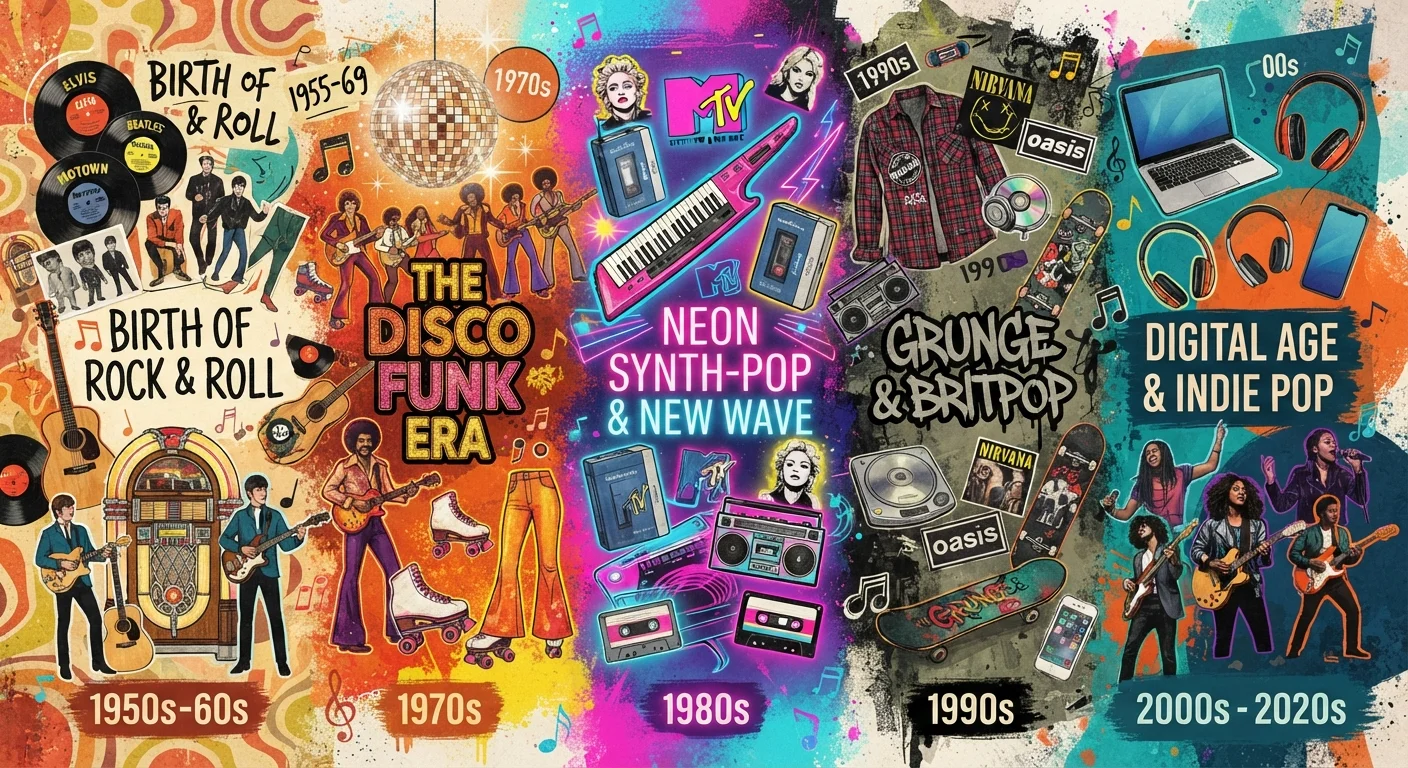
The era framework isn't just useful for individual artists - it's one of the most intuitive ways to understand the sweep of American music history. Broad cultural eras like the Motown sound of the 1960s, the arena rock peak of the late 1970s, or the grunge wave of the early 1990s each reflect something true about the social and economic climate that produced them.
Music has always responded to major moments in American history, and those responses tend to cluster into recognizable phases. Protest folk emerged during the civil rights movement. Hip-hop arose from specific urban conditions in the 1970s and 1980s. Each represents a macro-era with its own internal logic and emotional vocabulary.
How to Explore an Artist's Eras
Start by listening to an artist's discography in release order rather than by algorithm or playlist. Notice how the sound, lyrics, and production shift between projects. Reading interviews from each album cycle can reveal what was driving those creative changes - and make each era feel like a conversation across time.
Understanding eras - whether of a single artist or an entire genre - gives listeners a richer way to engage with music. It transforms passive consumption into active cultural participation. And if fan devotion to specific eras tells us anything, it's that people don't just want great songs. They want a world to belong to, even temporarily.