

Key Takeaways
- Behavioral research suggests people tend to spend more freely when paying with cards than with cash.
- The physical act of handing over cash creates a psychological 'pain of paying' that can curb impulse purchases.
- Cards offer fraud protection, rewards, and transaction records that cash cannot provide.
- A hybrid approach - cash for discretionary spending, cards for fixed bills - works well for many budgeters.
- Neither method guarantees better financial outcomes; your habits and awareness matter most.
Our Verdict
Cash creates natural friction that can slow impulsive spending, while cards offer convenience, trackability, and security benefits. Neither is universally superior - the best choice depends on your spending triggers, budgeting style, and financial goals. Most people benefit from a deliberate combination of both.
| Best for | Recommended |
|---|---|
| Those prone to overspending on discretionary categories like dining or entertainment | Cash |
| People who rely on automated tracking and need detailed spending records | Card |
| Budgeters who want to leverage both accountability and convenience | Hybrid (Cash + Card) |
The Psychology Behind How You Pay
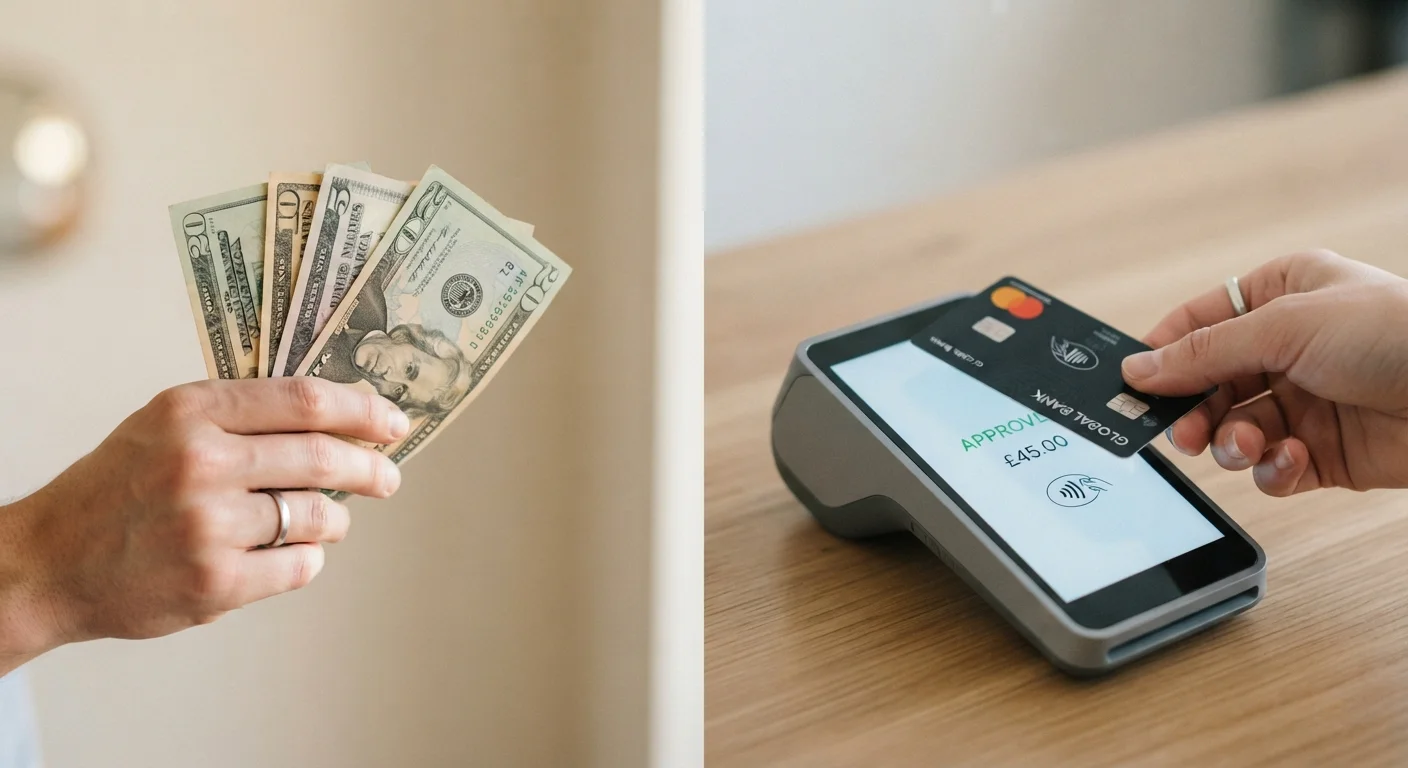
When you hand over a $20 bill, you feel it leave your hand. When you tap a card, nothing tangible disappears. This seemingly small difference has a measurable effect on spending behavior, a concept behavioral economists call the "pain of paying." The theory holds that physical money feels more real, making the cost of a purchase more emotionally salient - and therefore more likely to trigger restraint.
Research from MIT and Carnegie Mellon University has explored how card payments can deactivate the psychological discomfort associated with spending. When that friction is removed, people tend to authorize purchases more readily, often spending more than they originally intended. This isn't a personal failing - it's a documented response to how payment systems are designed.
Understanding this dynamic is the first step toward using it to your advantage. See our guide to emotional spending triggers for a deeper look at the psychology behind unplanned purchases.
Cash vs. Card: A Side-by-Side Comparison
Both payment methods carry real trade-offs. The table below breaks down how each performs across criteria that matter most for budget-conscious consumers.
| Cash | Debit Card | Credit Card | |
|---|---|---|---|
| Spending friction | High - physical loss is felt | Moderate - funds limited to balance | Low - easy to exceed budget |
| Fraud protection | None - lost cash is unrecoverable | Limited federal protections apply | Strong - disputes generally reversible |
| Spending records | Manual tracking required | Automatic via bank statement | Automatic via card statement |
| Impulse control support | Strong - hard spending ceiling | Moderate - balance acts as limit | Weak without disciplined tracking |
| Online / recurring payments | Not accepted | Widely accepted | Universally accepted |
| Rewards potential | None | Rare, typically minimal | Can be significant if used carefully |
One nuance worth noting: cards aren't a monolith. Debit cards draw from your existing funds, which adds some natural limit, while credit cards introduce the possibility of spending money you don't yet have - a factor that can amplify overspending if balances aren't paid monthly.
When Cash Has a Budgeting Edge
For discretionary spending categories - restaurants, entertainment, personal shopping - cash imposes a hard ceiling that no budget spreadsheet can replicate. When the physical bills in your wallet are gone, spending stops. There's no app needed and no willpower test at checkout.
This is the core principle behind the envelope budgeting method, where you allocate a fixed amount of cash to each spending category at the start of the month. Once an envelope is empty, that category is done until the next cycle. Explore how it works in practice with our overview of the envelope system.
Try a One-Week Cash-Only Experiment
If you suspect card spending is quietly inflating your budget, consider using only cash for discretionary categories for one week. Withdraw what your budget allows at the start of the week and observe how your purchase decisions shift. Many people find this exercise illuminating even if they don't continue it long-term. It builds awareness of spending patterns that card statements alone rarely reveal.
Cash also tends to reduce the likelihood of "phantom" small purchases - the $4 coffee or $12 impulse download that registers as negligible on a card statement but accumulates significantly over weeks.
Where Cards Offer Real Advantages
Cards aren't simply a spending trap - they carry genuine practical benefits that cash cannot match. Key advantages include:
- Fraud protection: Lost cash is gone permanently; disputed card charges can often be reversed under federal consumer protection rules.
- Automatic records: Card statements provide a complete spending history that simplifies budgeting reviews and tax preparation.
- Rewards programs: Some cards return a percentage of spending in cash back or points - provided the balance is paid in full each month to avoid interest charges that would eliminate any benefit.
- Online and recurring payments: Subscriptions, utility autopay, and online purchases typically require card or digital payment.
The key is pairing card use with deliberate tracking. If you spend by card without reviewing statements regularly, the convenience can quietly enable drift. Building consistent review habits is what separates effective card users from those who consistently overspend.
83%
US adults who use non-cash payments regularly
According to the Federal Reserve's Diary of Consumer Payment Choice, the vast majority of Americans now rely primarily on cards or digital payments for everyday transactions.
~12-18%
Typical overspend premium with cards vs. cash
Multiple behavioral economics studies, including work by Drazen Prelec and Duncan Simester, found that card users were willing to pay meaningfully more for the same item compared to cash payers.
Building a Hybrid Approach That Works
For most consumers, the most practical strategy isn't choosing one method exclusively - it's assigning each method to the type of spending it handles best. A straightforward framework:
- Fixed expenses (rent, utilities, subscriptions): Pay by card or autopay for the record-keeping and fraud protection benefits.
- Discretionary variable spending (groceries, dining, entertainment): Use cash or a separate debit card with a preset weekly limit to maintain friction and awareness.
- Large planned purchases: Card can be appropriate here, particularly if you pay the balance immediately and want purchase protection.
This kind of structured thinking fits within several popular budgeting frameworks. See how it maps to other approaches in our comparison of budgeting methods, or explore the pay-yourself-first philosophy as a complementary strategy.
This article is for general informational and educational purposes only and does not constitute personalized financial advice. Consult a qualified financial professional for guidance specific to your situation.