

Key Takeaways
- DTI compares your monthly debt obligations to your gross monthly income as a percentage.
- Most conventional mortgage lenders prefer a back-end DTI at or below 43%.
- A strong credit score cannot fully compensate for a high DTI in a lender's eyes.
- Reducing debt balances or increasing income are the two primary ways to lower your DTI.
- DTI does not appear on your credit report but is calculated directly from the information you provide on loan applications.
Debt-to-Income Ratio (DTI)
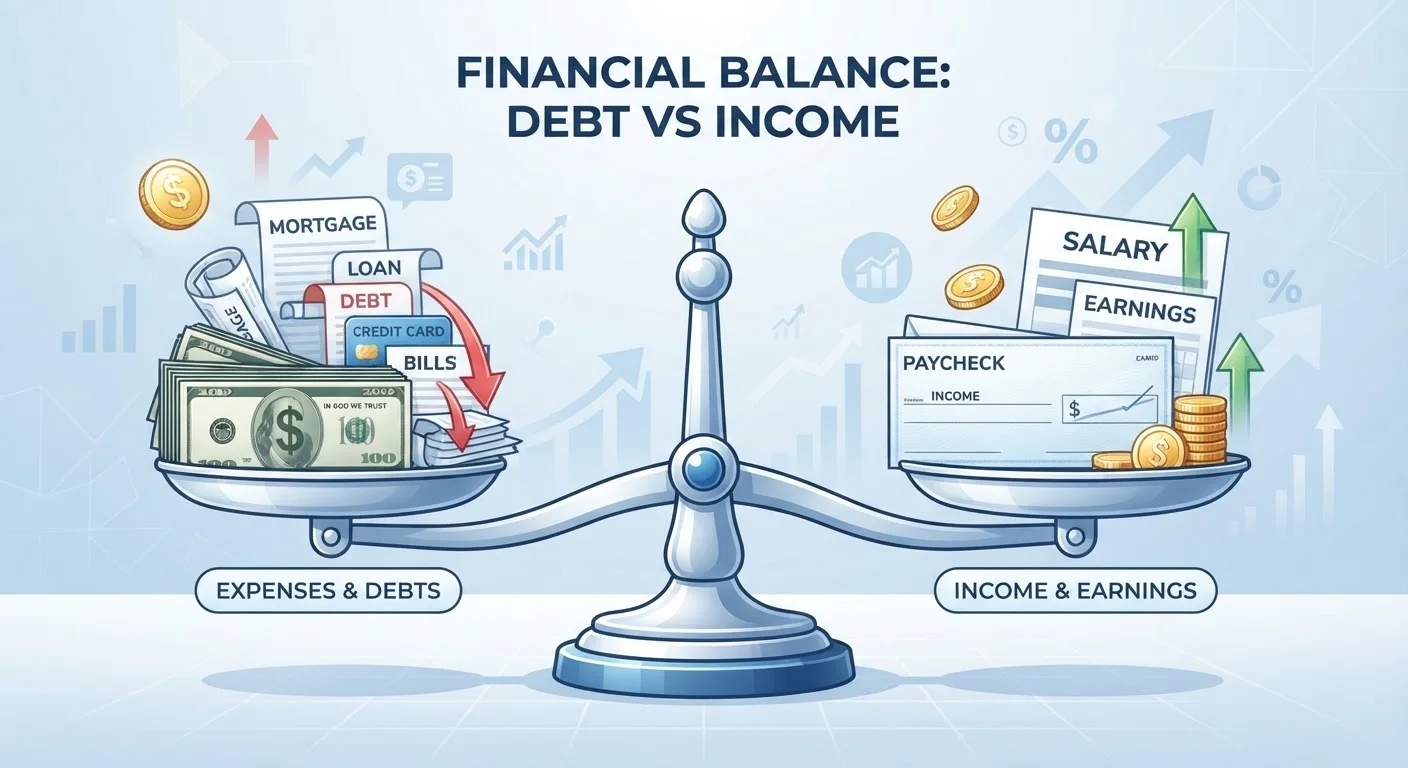
Your debt-to-income ratio (DTI) is a simple percentage that compares how much you owe each month to how much you earn each month. Lenders use it to gauge whether you can realistically take on new debt without becoming financially overextended. A lower DTI signals that you have a healthy balance between what you earn and what you owe.
DTI is calculated by dividing your total monthly debt payments by your gross monthly income (before taxes). Most lenders evaluate both a "front-end" DTI (housing costs only) and a "back-end" DTI (all recurring debts).
How DTI Is Calculated - and Why It Matters
When you apply for a mortgage, auto loan, or personal loan, lenders look beyond your credit score. One of the first numbers they run is your debt-to-income ratio. The math is straightforward: add up every required monthly debt payment, divide by your gross monthly income, and express the result as a percentage.
For example, if your monthly obligations include a $1,200 rent payment, a $350 car loan, $150 in student loan payments, and $100 in minimum credit card payments, your total monthly debt is $1,800. If your gross monthly income is $5,000, your DTI is 36% ($1,800 ÷ $5,000 × 100).
Lenders often distinguish between two types of DTI. The front-end DTI covers housing costs only - your mortgage principal, interest, taxes, and insurance. The back-end DTI captures all recurring debt obligations. Most lenders focus heavily on back-end DTI when making credit decisions.
43%
Common maximum DTI for conventional mortgages
The Consumer Financial Protection Bureau has identified 43% back-end DTI as a widely referenced threshold for conventional qualified mortgage standards.
36%
DTI many lenders consider a healthy target
Many financial guidance sources, including government-backed consumer education programs, cite 36% as a general benchmark for a manageable debt load relative to income.
2 levers
Ways to reduce your DTI
Reducing monthly debt payments and increasing gross monthly income are the only two variables in the DTI equation that borrowers can directly control.
To understand how DTI fits alongside credit scores, see what your credit score actually measures - the two metrics tell lenders different things about your financial health.
Why Lenders Care About DTI Independently of Your Credit Score
A high credit score tells a lender you've managed past debts responsibly. But it doesn't tell them whether you can comfortably afford another payment right now. That's where DTI comes in.
Consider two borrowers, each with a 740 credit score. One earns $8,000 per month and carries $1,600 in monthly debt obligations - a 20% DTI. The other earns $4,500 per month with $2,000 in obligations - a 44% DTI. The first borrower has substantial room to absorb a new payment. The second is already allocating nearly half of their pre-tax income to debt service, leaving less cushion for emergencies or unexpected expenses.
Lenders use DTI as a measure of capacity, not just creditworthiness. Even a pristine payment history can't change the reality that a borrower with little remaining income may struggle to keep up with an additional obligation. This is why building a strong credit profile involves managing both score factors and your overall debt load.
“Lenders are not just asking whether you've paid your bills on time - they're asking whether you can realistically afford one more bill. Debt-to-income ratio is how they answer that second question.”
— Consumer Financial Protection Bureau, U.S. federal agency overseeing consumer financial products and education
Common DTI Thresholds Across Loan Types
Different loan types carry different DTI benchmarks. While individual lenders set their own standards, these general thresholds are widely referenced in the industry:
- Below 36%: Generally considered a healthy DTI; most lenders view this range favorably.
- 36%-43%: Typically still acceptable for conventional loans, though some lenders may scrutinize the application more closely.
- 44%-50%: Higher risk territory; approval may depend on compensating factors like a large down payment or significant cash reserves.
- Above 50%: Most conventional lenders will decline; some government-backed programs allow exceptions under specific conditions.
For conventional mortgages, a back-end DTI at or below 43% is a common cutoff - though many lenders prefer to see it at 36% or lower. FHA loans have historically allowed DTIs up to 50% for borrowers who meet other criteria, though approval is never guaranteed.
It's also worth noting how student loan debt factors into this calculation. Monthly student loan payments are included in back-end DTI, which is why understanding how student loans interact with your credit profile matters when planning major borrowing.
Time Your Application Strategically
If you're planning a major loan application, consider paying down high-payment debts several months in advance rather than the week before you apply. Lenders typically verify your current monthly obligations at the time of application, so eliminating a debt payment beforehand directly improves your calculated DTI. Even paying off one smaller loan can move you into a more favorable threshold range.
How to Lower Your DTI
There are only two levers available to reduce your DTI: lower your monthly debt payments, or increase your gross monthly income. In practice, both take time - but both are achievable with a deliberate approach.
Reduce Monthly Debt Obligations
Focus extra payments on debt with the highest monthly payment relative to its balance. Paying off a car loan or personal loan eliminates that payment entirely, producing an immediate DTI improvement. Avoid taking on new debt while working toward a major loan application.
Be aware that your credit utilization ratio and your DTI are related but separate: paying down revolving credit card balances can improve both simultaneously.
Increase Gross Monthly Income
Additional income from a second job, freelance work, or a raise factors directly into your DTI denominator. Even a modest income increase can meaningfully shift the ratio. Note that lenders typically want income sources to be documented and consistent - one-time windfalls may not be counted.
Keep in mind that this article provides general financial education and is not personalized advice. Consult a licensed financial professional to evaluate your specific situation before making significant borrowing decisions.
This article is for informational purposes only and does not constitute personalized financial, lending, or investment advice. Consult a qualified financial professional before making decisions specific to your circumstances.