

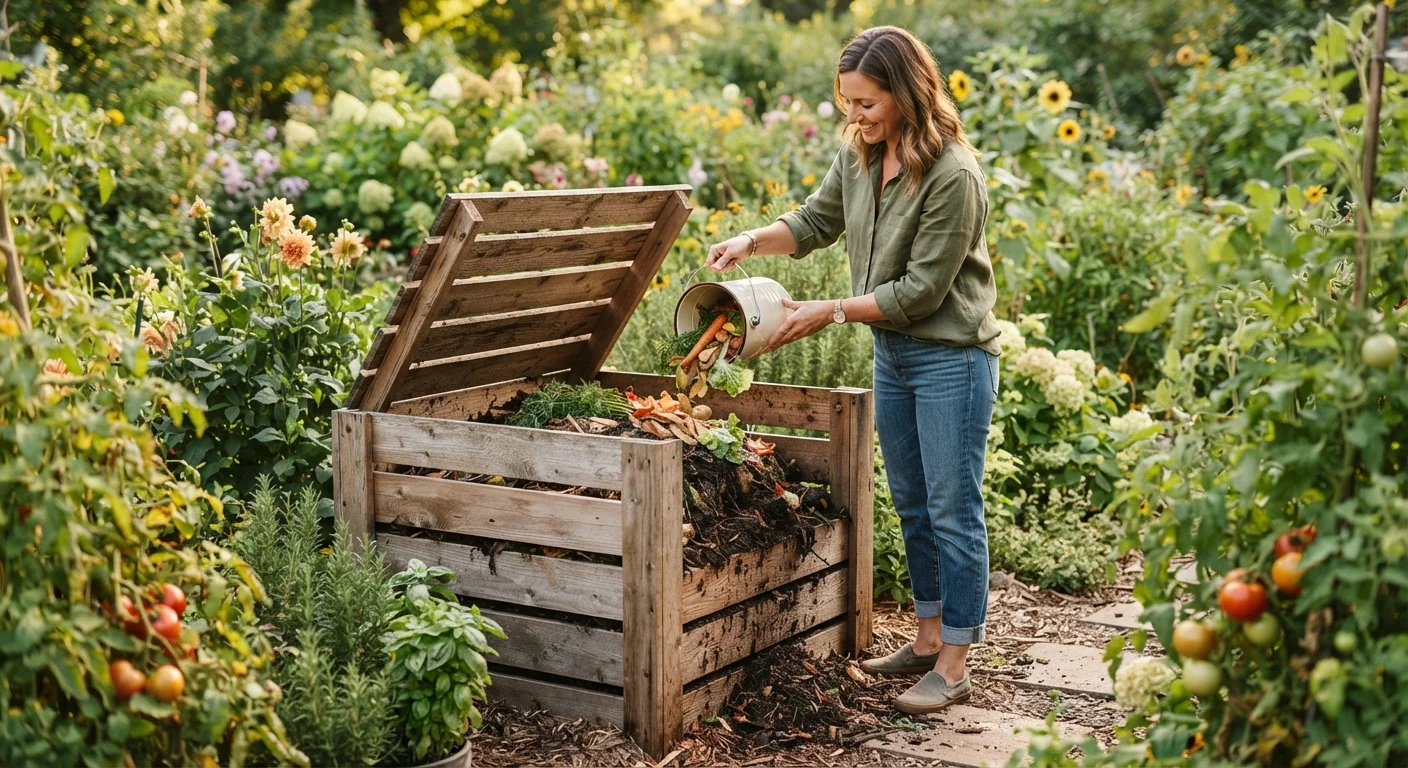
Key Takeaways
- Compost turns kitchen scraps and yard waste into a free, nutrient-rich soil amendment.
- Balancing carbon-rich 'browns' with nitrogen-rich 'greens' is the single most important skill.
- Meat, dairy, and diseased plants should never go into a backyard compost pile.
- Moisture, aeration, and particle size all affect how quickly a pile breaks down.
- Finished compost dramatically improves soil structure in garden beds and lawn areas.
Start here
Why Composting Belongs in Your Backyard Plan
Next
Choosing the Right Bin for Your Space
Core concept
The Carbon-to-Nitrogen Ratio Explained
Practical step
What to Add - and What to Keep Out
Level up
Managing Your Pile for Faster Results
Why Composting Belongs in Your Backyard Plan
Composting is one of the most practical things a homeowner can do with outdoor space. Rather than bagging kitchen scraps and yard clippings for the landfill, you redirect that organic matter into a slow-working process that ends with something genuinely useful: a dark, crumbly material called finished compost that improves nearly any soil it touches.
Gardens fed with compost tend to hold moisture better, drain more effectively, and support a richer population of soil organisms. If you're building out raised garden beds, homemade compost becomes a natural and cost-effective component of your fill mix. It also pairs well with mulching practices, since both approaches target the same goal: healthier, more productive soil. Think of composting not as a chore but as a low-effort system that runs quietly in the background of your broader year-round outdoor maintenance plan.
Choosing the Right Bin for Your Space
You don't need a purpose-built bin to compost - a simple freestanding pile works - but a bin keeps things tidy, retains heat, and deters casual wildlife. Three common formats suit most backyards:
- Open bin or wire cage: Inexpensive and easy to build from hardware cloth or wood pallets. Good for larger yards with plenty of yard waste. Requires manual turning.
- Enclosed plastic bin: A lidded, vented container that sits directly on soil. Neater looking and better at retaining moisture. Slower than an actively turned pile but nearly hands-off.
- Tumbler: A drum mounted on a frame that rotates to mix the pile without digging. Ideal for smaller yards or homeowners who prefer minimal contact. Tumblers can produce compost faster than static bins, though they hold a fixed volume.
Regardless of which format you choose, site the bin in partial shade to prevent the pile from drying out too quickly, and place it on bare soil rather than concrete so beneficial organisms can migrate in from the ground.
Start Small and Scale Up
If you're new to composting, begin with a single enclosed bin or a small wire cage rather than building an elaborate three-bin system right away. Get comfortable with the basics - what to add, how often to turn - before expanding. Most homeowners find they want more capacity once they see results, and it's easy to add a second bin later.
The Carbon-to-Nitrogen Ratio Explained
Every composting guide eventually mentions the carbon-to-nitrogen ratio, often written as C:N. This is the core chemistry behind decomposition. Microbes that break down organic matter need both carbon for energy and nitrogen to build proteins. The ideal ratio for fast decomposition is roughly 25-30 parts carbon to 1 part nitrogen by weight.
Carbon-to-nitrogen ratio (C:N)
The proportion of carbon-rich materials to nitrogen-rich materials in a compost pile. Getting this balance roughly right keeps decomposition active and odor-free.
Browns
Carbon-rich compostable materials such as dry leaves, cardboard, and straw. They provide energy for microbes and help aerate the pile.
Greens
Nitrogen-rich compostable materials such as vegetable scraps and grass clippings. They supply the protein microbes need to reproduce and break down organic matter.
Aerobic decomposition
Decomposition that occurs in the presence of oxygen. It is faster, produces less odor, and generates heat - the most desirable type for backyard composting.
Finished compost
Fully decomposed organic material that looks dark and crumbly, smells earthy, and is ready to be mixed into garden soil or applied as a top dressing.
Hot composting
An actively managed approach where the pile heats up to 130-160°F internally, killing weed seeds and pathogens while speeding decomposition significantly.
In practice, you don't need to measure anything. You just need to know which materials are carbon-heavy (browns) and which are nitrogen-heavy (greens):
- Browns (carbon-rich): Dry leaves, cardboard, straw, paper bags, wood chips, sawdust from untreated wood
- Greens (nitrogen-rich): Vegetable and fruit scraps, grass clippings, coffee grounds, fresh plant trimmings
A rough rule of thumb is to aim for a 2:1 or 3:1 volume ratio of browns to greens. A pile that smells like ammonia has too many greens; a pile that isn't heating up or breaking down probably has too many browns.
What to Add - and What to Keep Out
One of the fastest ways to undermine a backyard compost pile - and frustrate your neighbors - is adding the wrong materials. Here's a clear breakdown:
Safe to add
- Fruit and vegetable scraps
- Eggshells
- Coffee grounds and paper filters
- Dry leaves and grass clippings
- Shredded newspaper or cardboard (no glossy coatings)
- Spent garden plants (disease-free)
- Hair and nail clippings
Keep these out
- Meat, fish, and bones - attract pests and create strong odors
- Dairy products and fats - same issue as meat
- Diseased plants - pathogens may survive and spread when compost is applied
- Pet waste - can contain harmful pathogens
- Treated wood products - may introduce chemical residues
- Glossy or coated paper - breaks down poorly
Never Compost These Materials
Meat, dairy, pet waste, and diseased plant matter can introduce harmful pathogens or attract wildlife like rats and raccoons into your yard. Even small amounts of the wrong input can create persistent odor problems and undermine the pile's health. When in doubt, leave it out and check with your local waste management service for disposal guidance.
Citrus peels and onions are safe in moderate amounts, despite persistent myths to the contrary. Worms may avoid them in vermicomposting (worm bin) setups, but they decompose fine in outdoor piles.
Managing Your Pile for Faster Results
Once your pile is established, three factors determine how quickly it works: moisture, aeration, and particle size.
Moisture: The pile should feel about as damp as a wrung-out sponge. Too dry, and microbial activity slows dramatically. Too wet, and the pile becomes anaerobic (oxygen-deprived) and starts to smell. In dry climates or summer heat, water the pile occasionally. In rainy regions, consider a loose cover.
Aeration: Turning the pile introduces oxygen, which fuels the aerobic microbes responsible for fast decomposition. Turning once a week speeds things up; once a month produces results on a slower timeline. A garden fork works fine for most backyard bins.
Particle size: Smaller pieces decompose faster. Shredding leaves before adding them, chopping up large vegetable scraps, and tearing cardboard into strips all accelerate the process.
When your compost is dark, earthy-smelling, and crumbly throughout, it's ready to use. Work it into planting beds, top-dress your lawn, or blend it into container soil. If you're designing a full outdoor living area, including a compost station in your planning - much like balancing hardscape and softscape - pays dividends in long-term yard health.