

Key Takeaways
- Concrete slabs typically cost less upfront but can be harder and more expensive to repair once cracked.
- Paver patios allow individual unit replacement, making targeted repairs straightforward.
- Both surfaces require proper base preparation to prevent settling and drainage problems.
- Climate plays a major role - freeze-thaw cycles stress poured concrete more than interlocking pavers.
- Permits and inspections may be required for either surface depending on your local building codes.
Our Verdict
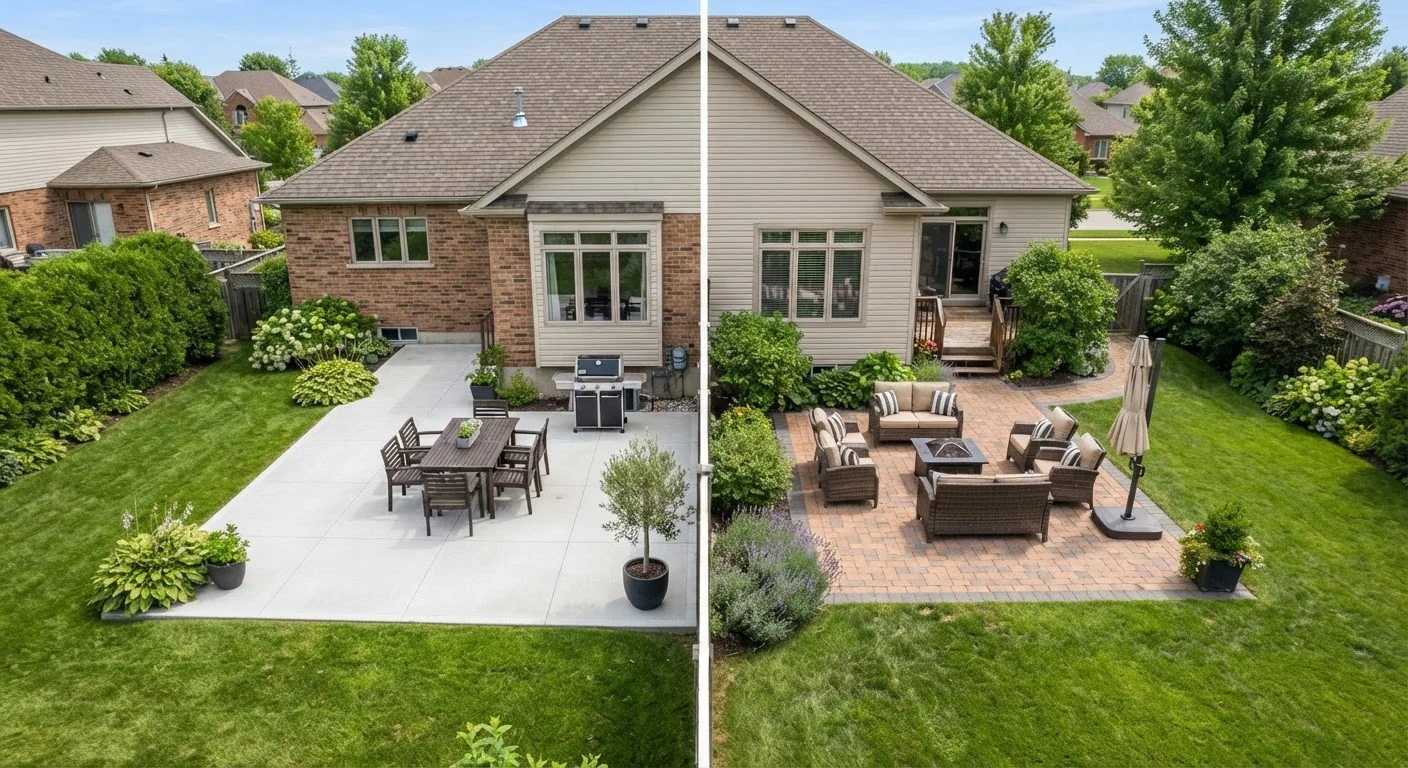
Neither concrete nor pavers is universally better - the right choice depends on your budget, climate, aesthetic goals, and long-term maintenance tolerance. Concrete wins on initial simplicity and cost for large flat areas, while pavers offer greater design flexibility and easier spot repairs over time.
| Best for | Recommended |
|---|---|
| Homeowners prioritizing lower upfront installation cost | Poured Concrete |
| Those wanting easy DIY-friendly repairs and design flexibility | Paver Patio |
| Yards in cold climates with significant freeze-thaw cycles | Paver Patio |
| Large, simple rectangular patio areas with a tight timeline | Poured Concrete |
How Each Surface Is Installed
Both patio surfaces begin the same way: excavating several inches of soil and compacting a gravel base to manage drainage and prevent settling. From there, the processes diverge significantly.
Poured concrete involves setting forms, laying reinforcing steel (rebar or wire mesh), then pouring and finishing a continuous slab - typically 4 inches thick for residential patios. Once poured, it must cure for several days before any load is placed on it. The process is fast once begun, but it requires professional equipment and significant labor coordination.
Paver patios use a compacted sand or gravel bed over which individual units - brick, concrete paver, or natural stone - are laid by hand in a chosen pattern. Because no mortar is typically required between units, the system is flexible and somewhat more forgiving during installation. However, precision matters: uneven sand beds lead to rocking or sinking pavers down the line.
Either way, proper subgrade preparation is the foundation of longevity. Cutting corners on the base will show up as cracks or heaving within a few years regardless of which surface you choose. For a broader look at how patios fit into overall yard planning, see how hardscape and softscape work together.
Durability, Cracking, and Climate Sensitivity
Concrete is strong under compression but brittle under tension - meaning it can crack when the ground beneath it shifts. Expansion joints built into the slab help manage this, but cracking remains one of the most common complaints about poured concrete patios, especially in regions with cold winters.
Freeze-thaw cycles are particularly hard on concrete: water seeps into micro-pores, expands when frozen, and gradually degrades the surface. Sealing the slab every few years helps, but is an ongoing maintenance commitment.
Pavers handle freeze-thaw conditions more gracefully because the joints between units allow slight movement without structural failure. If frost heaving pushes a paver up, it can be reset - a repair that takes minutes rather than a concrete patch that takes days and rarely looks seamless.
| Poured Concrete | Paver Patio | |
|---|---|---|
| Typical upfront cost | Generally lower per sq ft | Generally higher per sq ft |
| Installation time | Fast pour; several days curing | Slower hand-laying; usable sooner |
| Freeze-thaw performance | Prone to cracking over time | Handles movement better |
| Ease of repair | Difficult; patches are visible | Easy; replace individual units |
| Design flexibility | Limited once poured | Wide range of patterns and colors |
| Ongoing maintenance | Sealing every few years | Re-sanding joints; occasional resetting |
| Lifespan (with care) | 25-50 years | 30-50+ years |
In consistently warm, dry climates, both surfaces perform reliably over decades with routine care. In the upper Midwest, Northeast, or high-altitude regions, pavers generally hold their appearance longer without professional intervention.
Repair Realities and Long-Term Maintenance
Repairing a cracked concrete slab is genuinely difficult. Surface patches are visible and rarely bond well over time. Full slab replacement - breaking out the old concrete, disposing of the rubble, and pouring fresh - is disruptive and costly. Grinding or resurfacing can extend life but adds expense.
Pavers offer a practical advantage here: a single damaged or stained unit can be lifted and replaced without touching the surrounding surface. Keeping a small cache of matching pavers from the original installation is a smart habit, as color matching becomes harder over years as pavers weather.
Save Spare Pavers After Installation
When your paver patio is installed, ask your contractor to set aside 5-10% of the units for future repairs. Pavers from the same production batch weather consistently, and matching color from a different run years later can be surprisingly difficult. Store them flat in a dry location away from direct freeze-thaw exposure.
Both surfaces benefit from periodic cleaning - pressure washing removes biological growth and staining. Concrete may also require resealing to protect against moisture intrusion and surface spalling (flaking). Pavers need occasional re-sanding of joints to prevent weed growth and ant colonization in the gaps.
For comparison, if you're weighing other outdoor surface materials for covered areas, outdoor flooring options for patios and covered porches covers tile, stone, and composite alternatives side by side.
Cost, Aesthetics, and Design Flexibility
On a cost-per-square-foot basis, poured concrete is generally less expensive to install than a paver patio when comparing standard finishes. However, decorative concrete - stamped, stained, or exposed aggregate - can approach or exceed basic paver costs depending on the complexity of the design.
Pavers come in a wide range of shapes, colors, and laying patterns (running bond, herringbone, basket weave), giving homeowners considerably more design control. Natural stone pavers - bluestone, travertine, flagstone - expand the aesthetic range further, though they raise the price considerably.
4-6"
Recommended concrete slab depth for residential patios
The Portland Cement Association recommends a minimum 4-inch thickness, with heavier-use areas calling for up to 6 inches.
25-30%
Cost premium pavers typically carry over basic concrete
Industry estimating guides generally place standard paver installation 25-30% above comparable plain concrete, though decorative concrete can close the gap.
Concrete's aesthetic can be limiting once poured: color choices are locked in, and any surface treatment must be reapplied as it wears. Stamped concrete mimics the look of pavers or stone at lower cost, but the pattern is purely cosmetic - it doesn't provide the structural flexibility of true interlocking units.
Homeowners considering decking as an alternative outdoor surface can explore the trade-offs in pressure-treated lumber vs. composite decking for a parallel material comparison.